Why Onboarding Pass Rates Fail to Measure Verification Accuracy
Author: admin | 30 Jun 2026In This Post
Onboarding pass rate is often treated as the main sign of verification success. If more users pass, the journey looks smooth. If fewer users pass, teams assume the process is too strict or slow.
But the pass rate alone does not prove that verification is working.
Today, that gap matters because identity fraud is not a rare edge case in onboarding. It is one of the main risks that digital businesses need to detect before granting access. Cifas Fraudscape 2026 reported a record 444,993 fraud risk cases filed to the UK National Fraud Database in 2025, including 242,003 identity fraud cases. Identity fraud accounted for 54% of all filings, showing why businesses cannot measure onboarding only by completion.
A high pass rate only shows that users moved through the process. It does not show whether they were genuine, risky, or likely to create fraud exposure later.
That is why businesses need onboarding pass rate verification accuracy: a way to understand whether the right users were approved, risky users were rejected, and every verification decision was made with confidence.
Industry Challenges: Why Identity Verification Accuracy Is Harder in 2025 and 2026
The threat of fraud is made more credible, automated, and scalable, making digital onboarding verification even more challenging. In today’s world, businesses are encountering new kinds of documents created by AI, deepfakes, synthetic identities, and document injection attacks designed to evade authentication.
The modern onboarding journey now sits at the center of multiple fraud vectors, each capable of weakening verification accuracy if pass rate is the only success metric.
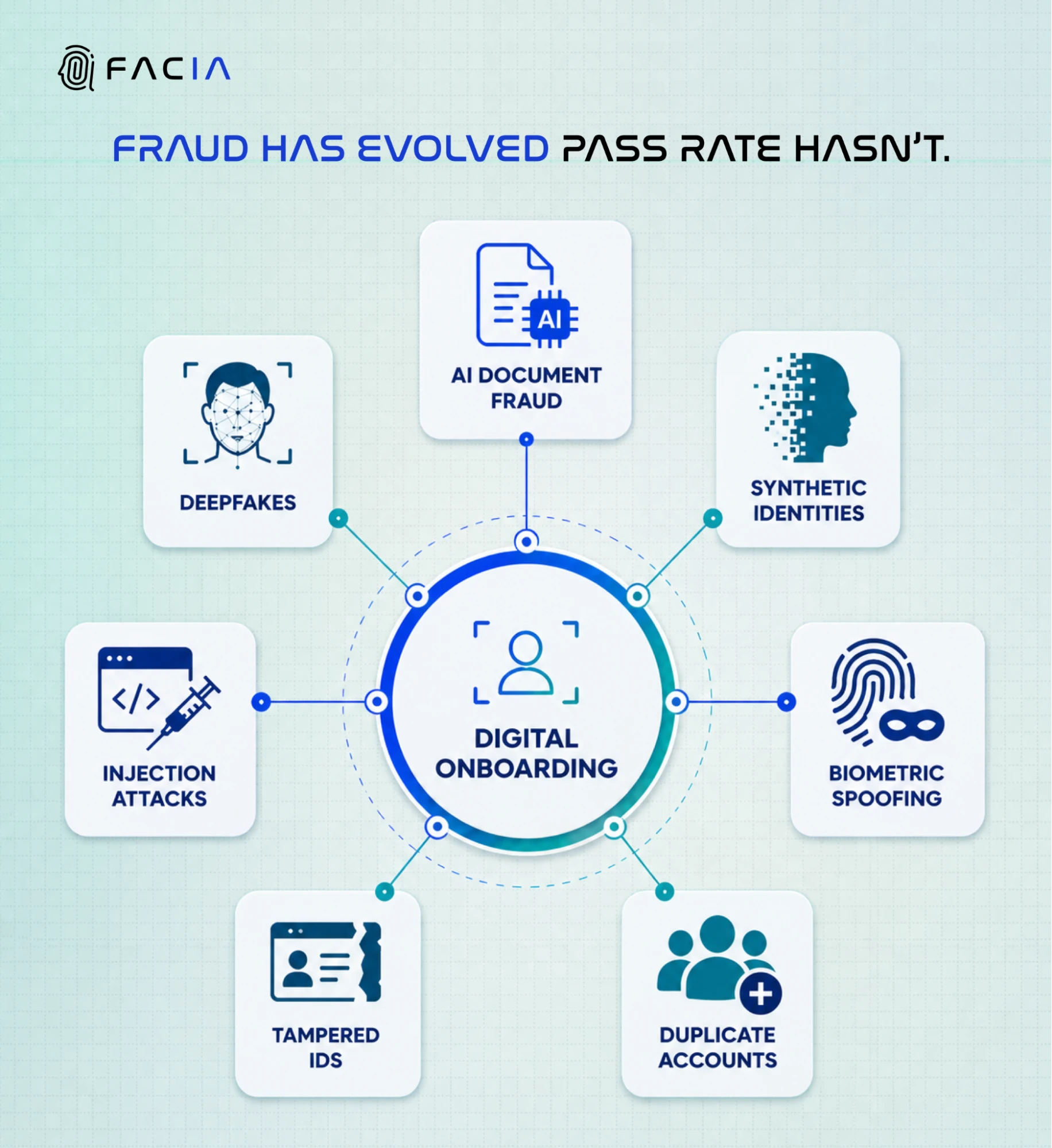
A recent report from ACFE found that 77% of anti-fraud pros reported an uptick in deepfake social engineering over the past two years, 75% reported an increase in generative AI document fraud/forgery, and 72% reported an increase in deepfake digital injection attacks in 2026.
These threats directly affect the validity of the verification. Document checks will be contaminated by a forged document. Biometric verification can be compromised by deepfakes. An injection attack (in contrast to weak camera-based flow) can be used to bypass a weak camera. An artificial identity can look real enough in order to pass the simplest verification, but it isn’t.
That’s why it’s important for companies to adopt a more nuanced approach than just pass/fail. They need to recognize the identities they are accepting, who they are rejecting, and the potentially dangerous factors they are missing.
The Onboarding Fraud Risk Hidden Behind High Pass Rates
There is a possibility of concealing the onboarding fraud risk within a high pass rate. Completing at the cost of quality can result in a low threshold or fewer cases for review, or too much business can be directed towards completing the review. This is what can make onboarding look good and let bad guys in.
A false approval is when an unauthorized or unqualified person approves the verification. This is one of the biggest challenges encountered in any KYC verification system, as the account appears to be trusted on the platform.
The potential for approving false accounts, chargebacks, bonus abuse, money mule activity, policy problems, regulatory liability, and damage to reputation are risks associated with false approvals. The risk is likely to manifest later, when the approved account is used for transactions, receiving and withdrawing funds, applying for a service, or engaging in interaction with other users.
The follow-up post onboarding behavior is key in this. Any verification rules triggered by users passing verification after the fact could be used to provide duplicate account signals, fraud reporting, compliance alerts, and other feedback on suspicious transactions. A pass rate indicates how many people took the test. As a result, we can predict post-onboarding behavior, which indicates if they should enter or not.
Why KYC Onboarding Success Rate Should Measure More Than Approvals
A successful KYC onboarding rate shouldn’t just be an increase in users that get approved. It should mean approval of legitimate users in a timely fashion, accurate rejection of risky users, and escalation of uncertain cases with sufficient context to inform the decision appropriately.
A more successful KYC onboarding rate should feature:
- Smooth flowing for real users
- Correctly rejecting high-risk users.
- Identify escalation for ambiguous situations
- The feedback on the outcomes of post-approval frauds.
KYC should be easy and convenient for legitimate users. RISKY users should consider it a pretty good control point. It has to be able to detect any tampering with documents, any spoofing attempts, any duplicate identities, and any unusual patterns, and deny access if it is.
Actually, KYC success goes beyond only converting. It’s all about conversion and control.
Measuring Identity Verification Accuracy: Risk Metrics That Matter
To properly measure verification, businesses need metrics that distinguish completion from correctness.
The four core accuracy outcomes are:
- True pass: a legitimate user is correctly approved
- False pass: a fraudulent or ineligible identity is incorrectly approved
- True fail: a bad actor is correctly rejected
- False fail: a legitimate user is wrongly rejected
These outcomes create the foundation of identity verification accuracy. Businesses should also track manual review accuracy, appeal overturn rate, post approval fraud rate, and time to an accurate decision.
Manual review accuracy shows whether reviewers are consistent. The appeal overturn rate shows whether users were wrongly blocked. Post approval fraud rate connects onboarding decisions to real outcomes. Time to accurate decision shows whether teams are balancing speed with correctness.
Together, these metrics give teams a clearer view of verification performance than pass rate alone.
Digital Onboarding Verification Needs Continuous Risk Measurement
The onboarding verification process shouldn’t end at identity verification. Frauds evolve, users evolve, and risk signals evolve.
In 2025, NIST published SP 800-63 Rev. 4, which revises the NIST Digital Identity guidance for identity proofing, authentication, fraud demand, continual evaluation metrics, and protections against injection attacks and forged media.
This is part of a broader movement in identity verification: from a one-time level of confidence to continuous risk measurement.
Onboarding data needs to be linked to fraud monitoring, transaction activity patterns, duplicate account detection, account recovery alerts, device patterns, and compliance alerts. The more feedback a business receives, the more flexibility it can add to verification thresholds and minimize false approval and false rejection.
How Businesses Should Evaluate Identity Verification Vendors on Accuracy
When evaluating identity verification vendors, businesses should look beyond headline pass rate claims. A high pass rate may sound attractive, but it does not explain how the number is calculated, how fraud is detected, or how accuracy is measured.
Businesses should ask:
- Are abandoned users, retries, manual reviews, and failed attempts included?
- How are false approvals, false rejections, appeals, and post approval fraud measured?
- Can the system detect document tampering, biometric spoofing, injection attacks, deepfakes, duplicate accounts, and synthetic identity patterns?
- Does the vendor provide audit trails, review workflows, and visibility across user segments?
Accuracy should be measurable, not just promised.
Building a KYC Verification System That Balances Conversion and Accuracy
The KYC verification process should provide an excellent user experience while simultaneously preventing fraud. The aim is not to block more users. The objective is to make better risk-based decisions.
Document Verification: This is to verify if an ID is valid and untampered. Biometric verification verifies that the individual presenting the document matches the identity claimed. Liveness detection is used to ensure that a real person is recorded. Deepfake defense is used for the protection against synthetic media, spoofing, and injection attacks.
In today’s world, there is an opportunity to learn from fraud experiences downstream of a modern KYC system. According to the Federal Reserve Bank of Boston, in 2025 there were more than $35 billion in losses from synthetic identity fraud, underscoring the need for KYC systems to use signals beyond identity matching.
The best KYC verification solutions are those that provide ongoing risk feedback alongside onboarding verification. This results in a verification cycle that improves future decisions with each fraud signal.
Solution Framework: From Pass Rate Reporting to Accuracy-Driven Verification
By using a straightforward framework, businesses can achieve a transition from pass rate reporting to accuracy-driven verification:
- Clearly outline each outcome: pass, fail, retry, abandon, manual review, false approval, false rejection, appeal, and post approval fraud.
- Distinguish between conversion and accuracy measures; do not mix them up.
- Log false approvals and false rejections as they both represent business risk.
- Map onboarding data to the post approval fraud signals and adjust thresholds based on fraud pattern, user segment, document type, and risk appetite.
This can help businesses maintain conversion while not compromising fraud control measures.
How Facia Helps Businesses Move Beyond Pass Rates
Onboarding pass rate still matters, but it cannot prove whether a verification decision was correct. When businesses rely solely on pass rates, they risk approving fraudulent users, rejecting genuine customers, and missing post-onboarding signals that reveal weak identity checks.
Facia helps address this gap by strengthening the most risk-sensitive parts of digital onboarding. Its liveness detection helps confirm that a real person is present during verification, reducing spoofing, replay, and AI-generated face risks.
Its deepfake detection supports stronger defense against manipulated media, synthetic selfies, and face swaps across the KYC journey. By adding these checks to identity verification workflows, Facia helps businesses move from simple pass/fail reporting to more accurate, fraud-aware onboarding decisions.
Ready to measure verification by accuracy, not just pass rates? Explore Facia and build a safer onboarding flow today.