
10 Best Identity Verification Platforms for Fintech in 2026
Author: Carter H | 23 Jul 2026In This Post
Identity verification in fintech now involves more than checking whether a document appears genuine. Financial platforms must also determine whether an applicant matches the identity presented, whether a real person is physically present, and whether facial media has been replayed, manipulated, generated, or digitally injected.
The risk continues after onboarding. The FBI’s 2025 Internet Crime Report recorded 31,675 identity-theft complaints and approximately $185.8 million in reported losses. Account takeover accounted for around 4,700 complaints and $359.7 million in losses.
The NIST Digital Identity Guidelines also address injection attacks and forged media, including deepfakes. The guidance notes that biometric comparison alone cannot prevent these threats.
This guide compares ten identity verification platforms based on biometric security, KYC capabilities, geographic reach, integrations, and suitability for fintech use cases.
How the Best Fintech Identity Verification Platforms Were Evaluated
The following criteria were used to assess the platforms:
- Facial recognition and liveness detection.
- Deepfake and presentation attack defense
- Document verification
- The capabilities of KYC and KYB.
- Geographic coverage
- Integrating and deployment options.
- This authentication must be repeated during onboarding.
- Analyze the suitability of applications for fintech purposes.
The “best for” categories are based on the provider’s main positioning and publicly available information about their product. Not an independent test of accuracy or performance.
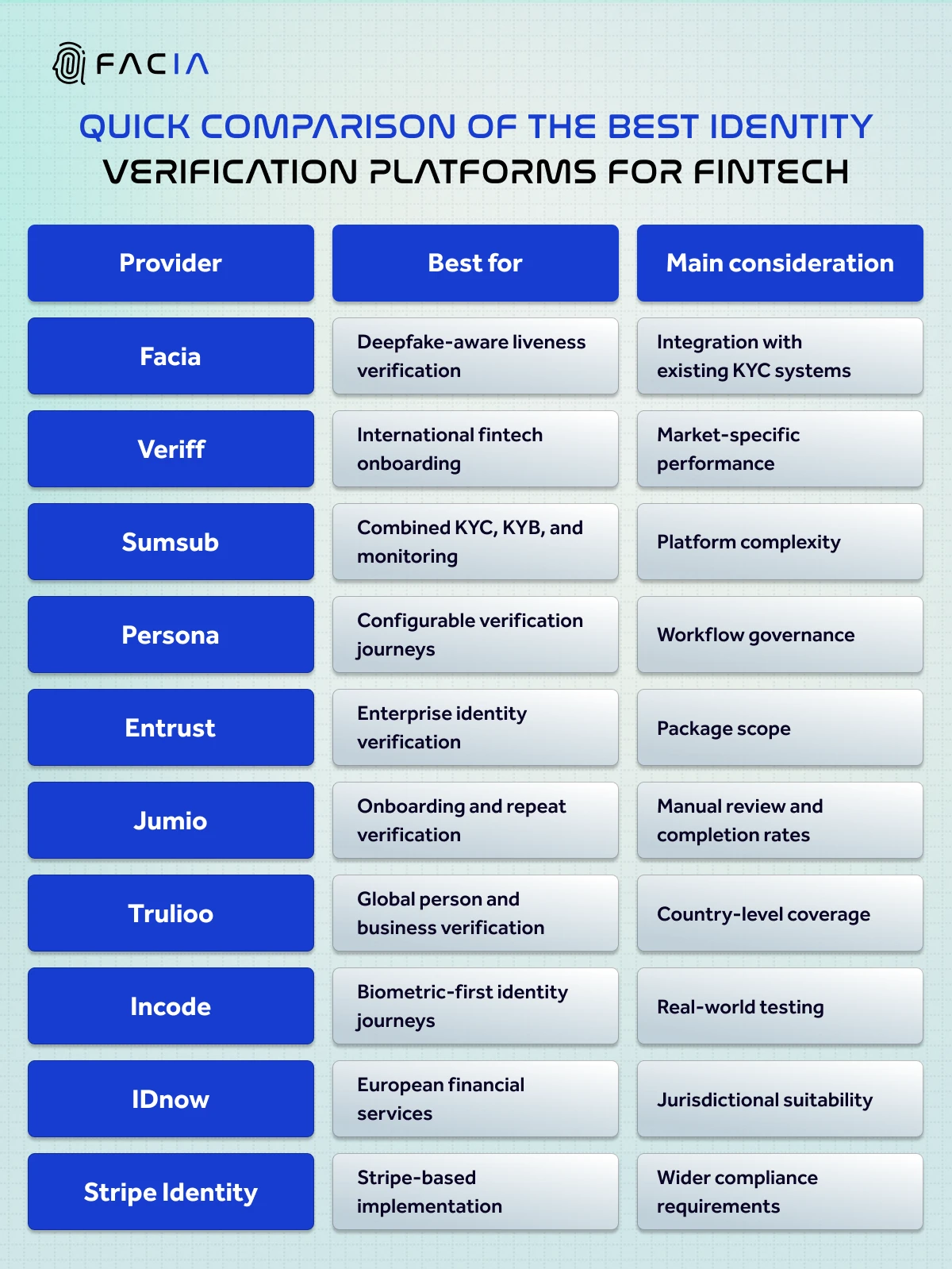
Quick Comparison of the Best Identity Verification Platforms for Fintech
Best Identity Verification Software for Fintech in 2026
1. Facia: Best for Deepfake-Aware Liveness Verification
Facia specializes in facial recognition, liveness detection, and deepfake-aware identity verification. Its technology helps fintech companies determine whether a genuine person is present and whether facial input shows signs of manipulation, replay, synthetic generation, or digital injection.
Facia’s DeepLiveness technology combines liveness analysis and deepfake detection into a single biometric verification layer. It can support customer onboarding, account recovery, returning-user authentication, high-risk withdrawals, payment authorization, and step-up verification.
Facia is particularly suitable for fintech companies that already use document verification, KYC, or AML tools but require a specialist biometric security layer.
What to check: Confirm how Facia’s APIs, SDKs, cloud deployment, or on-premise options connect with the existing identity and compliance stack.
2. Veriff: Best for International Fintech Onboarding
Veriff offers document verification, identity verification, biometric authentication, and fraud prevention features. It can be applicable for neobanks, payment services, investment platforms, and fintech businesses in multiple markets.
Items to review: See supported documents, fallbacks, and verification performance on an individual-priority-country basis.
3. Sumsub: Best for KYC, KYB and Ongoing Monitoring
Sumsumb integrates user verification, business verification, AML screening and fraud controls, transaction monitoring, and case management.
It might be right for organizations that want to combine multiple compliance functions into a single solution rather than linking to multiple providers.
Things to look out for: Identify the required modules and whether they will make the platform easier to operate or introduce unnecessary complexity.
4. Persona: Best for Configurable Identity Verification Workflows
Persona allows fintech teams to set up KYC/KYB processes based on customer type, geographic area, product, and risk level.
This could be useful for embedded finance, marketplaces, and other platforms with different verification needs, as well as banking and payments.
Items to check: Identify who is responsible for workflow changes, and define how new rules will be tested before release.
5. Entrust Identity Verification: Best for Enterprise Fintech Identity Verification
Through its portfolio, Entrust Identity Verification offers document and biometric verification technology, including technology previously developed by Onfido.
It is better suited for enterprise banks, lenders, payment service providers, and fintech firms that handle verification across a variety of their products.
Items to verify: Ensure the available verification tools, orchestration options, review services, and support are verified.
6. Jumio: Best for Customer Onboarding and Repeat Verification
Jumio offers document verification, biometric verification, Know Your Customer (KYC), Anti-Money Laundering (AML), and identity-verification workflows for the financial sector.
It can be used for onboarding, account recovery, lending applications, and high-risk transactions.
What to look for: Completion percentage, manual review time, retries, and fallback journeys with the devices and documents most frequently used by customers.
7. Trulioo: Best for Global Person and Business Verification
Trulioo offers document checking, identity data, and business information to verify individuals and businesses.
As payment providers, remittance services, marketplaces, and fintech expand to other jurisdictions, its modular platform could prove useful.
What to look for: Availability at the country, document, and data-source levels, not just at the global coverage level.
8. Incode: Best for Biometric-First Identity Verification
The Incode combines document verification, facial biometrics, liveness, and identity orchestration.
It could be beneficial for digital banks and payment service providers who wish to integrate biometric identity into onboarding and user re-authentication.
What to look for: Conduct a controlled pilot with typical users, devices, documents, and fraud situations.
9. IDnow: Best for European Financial Services
IDnow offers all of the above and more: Document verification, biometric verification, electronic identity, and compliance-based onboarding.
Its European positioning might be appropriate for banking, lending, BNPL, and business-verification applications across Europe.
What to look for: Ensure the chosen verification process meets the criteria for each financial product and jurisdiction.
10. Stripe Identity: Best for Stripe-Based Identity Verification
Stripe Identity enables identity data checks, such as government ID verification, selfie matching, and other identity checks.
It may offer an easy starting point for those already leveraging Stripe’s payments and developer platform.
Checkpoints: Identify the need for separate providers for KYB, AML screening, advanced liveness, transaction monitoring, or case management.
How to Choose Identity Verification Software for Fintech
The optimal platform will depend on the types of identity risks introduced into the customer journey and the existing capabilities in the fintech stack.
Companies that prefer to streamline KYC and KYB processes may find a provider with expansive KYC and KYB coverage beneficial.
For companies with multiple products and/or customer types, a configurable orchestration platform might be a better fit. When the focus is on deepfakes, spoofing, account takeover, or injection attacks, a specialist biometric platform like Facia could be a more appropriate choice.
Before selecting a provider, identify:
- Which checks are required during onboarding
- When customers may need to verify again
- Which fraud scenarios are most relevant
- Whether a cloud or on-premise deployment is required
- How failed checks will be reviewed
- Which systems already handle KYC, AML, or document verification
What Fintech Teams Should Test Before Choosing an Identity Verification Provider
A controlled pilot should measure:
- Completion and abandonment rates
- Verification speed
- Retries and false rejections
- Manual-review volume
- Fraud-detection performance
- Accessibility and fallback options
Older devices, weak internet, poor lighting, low-resolution cameras, and priority-market documents should be tested. Printed photos, screen replays, masks, virtual cameras, deepfakes, face swaps, and injected media are all fraud scenarios that should be addressed.
Another important factor to consider is the complexity of biometric consent that can be built into the system, the time limits for data storage, hosting, encryption, audit trails, SDK support, escalation options, and overall cost.
Adding in retries, manual reviews, more modules and implementation work can make the smallest quote an unexpectedly big personality.
Why Facia Is a Leading Identity Verification Platform for Fintech
Identity verification providers solve different parts of the digital trust problem. Some offer broad KYC, KYB, and monitoring capabilities. Facia focuses on one of the most security-sensitive points: confirming that the person behind the camera is real and that the facial input can be trusted.
This specialist approach makes Facia relevant for fintech companies facing deepfakes, replay attacks, facial manipulation, account takeover, and injection-based fraud.
Facia can complement existing KYC and AML solutions without requiring a fintech company to replace its entire identity stack. DeepLiveness can be applied during onboarding, account recovery, returning-user authentication, and high-risk financial activity.
A document can look genuine, and a face can match its photograph. Neither result is sufficient when the facial input may be generated, manipulated, replayed, or injected.
Explore Facia’s DeepLiveness technology or book a demo to strengthen biometric verification across the fintech customer journey.