

How Social Media Platforms Can Comply with EU AI Act Article 50
Author: Carter H | 30 Jul 2026In This Post
Can your platform tell what is real and what is AI-generated?
Deepfakes, synthetic identities, and AI-generated content are becoming harder to spot. Social media platforms must protect users and clearly show when AI has shaped what they see, hear, or read.
AI now powers customer support, content moderation, recommendations, advertising, and identity verification. However, without clear disclosures and reliable detection systems, users may unknowingly interact with bots, view manipulated media, or trust content presented as authentic.
According to Eurostat, 32.7% of people aged 16 to 74 in the EU used generative AI tools in 2025. Article 50 of the EU AI Act introduces transparency requirements for AI interactions, deepfakes, machine-readable content marking, and certain biometric technologies. The main obligations apply from 2 August 2026.
This guide explains how Article 50 affects social media platforms and how deepfake detection, identity verification, and transparent processes can support compliance while protecting user trust.
What Is EU AI Act and Who Does It Apply To?
The EU AI Act governs the deployment, sale, and business applications of AI in the EU. It comes into force on the 1st of August 2024 and will be implemented gradually.
Social media companies might add chatbots, recommendation features, moderation systems, advertising technology, facial recognition, account verification, and deepfake identification and detection.
Partly, responsibilities depend on whether a company is a provider or a deployer. A provider creates or provides an AI system with its own identity. An AI system is part of a deployer’s business. A platform may act as both.
These roles determine which transparency and compliance obligations apply to each AI system. For social media platforms, the risks are particularly significant because AI-generated and manipulated content can be distributed to large audiences within minutes. This makes Article 50 especially relevant to the way platforms identify, label, and manage AI-driven interactions and content.
Why Article 50 Matters for Social Media Platforms
Social media allows for content to be disseminated rapidly, and once posted, manipulated media is hard to control.
Before a moderation team can investigate, a fake video, a cloned voice, or a false profile can reach thousands of users. This material can be used for various purposes, including fraud, impersonation, political manipulation, or reputational damage.
In a 2025 Eurobarometer survey, 66 percent of respondents said they had encountered disinformation or fake news at least once in the last seven days.
Article 50 Rules for AI Chatbots and Assistants
The user must be aware that the person with whom they are communicating is a human, and the other is an AI system.
Social media sites could leverage this to power chatbots, messages, virtual assistants, digital avatars, and virtual influencers.
The disclosure should be triggered at the start of the interaction. It should be clear to the user whether they are in conversation with a person or a machine, without having to read all the terms and conditions.
Machine-Readable Marking for AI-Generated Content
Providers of systems that generate or alter text, images, audio, or video must make the output identifiable in a machine-readable format.
This can be done through metadata, digital watermarks, content credentials, or similar technical methods. The approach should be reliable and suitable for the content being produced.
Machine-readable marking does not mean every post needs a large visible label. Its purpose is to make the content’s origin technically detectable. A platform publishing the material may still have a separate duty to tell users that it was generated or manipulated.
EU AI Act Deepfake Disclosure Requirements
Deepfakes are also covered in Article 50. A deepfake is an image, recording, or video that appears to be a real person, object, place, organization, or event, produced or manipulated with AI to appear real.
Someone who produces or shares a deepfake image should label it as created or altered by artificial means.
Not all AI-generated images are “deepfakes.” A fictional illustration is not a realistic video of a public person saying something that they never said.
Disclosure of AI-Generated Public Interest Content
Article 50 may also apply to AI-generated or manipulated text published to inform the public about matters of public interest, including elections, health, finance, government policy, public safety, or breaking news.
An exception might apply in cases where content has been reviewed by a person, is under editorial control, and is published under the responsibility of a person or organization.
Article 50 Rules for Biometric and Emotion Recognition
Platforms involving emotion recognition or biometric categorization systems must communicate to people the impact of those systems.
This can involve analyzing facial expressions, predicting emotional reactions, or user identification based on biometric traits. Other privacy laws may apply, such as GDPR.
The platform should capture the reasons for the technology’s use, the type of data involved, and the impact of the results on decision-making. Users should also be able to challenge decisions affecting their accounts.
How Social Media Platforms Can Prepare for Article 50
Before making changes, teams should check whether existing policies, contracts, and user notices align with how each system is actually used. This helps avoid gaps between legal wording and day-to-day platform operations, particularly where several departments share responsibility for the same AI tool.
Platforms should review chatbots, content generation, moderation, advertising, facial recognition, account recovery, profile verification, and synthetic media detection.
For each system, the company should decide whether it is acting as a provider, deployer, or both. It should then assess whether the system interacts with users, creates or modifies content, processes biometric data, or produces public-interest material.
A workable process should combine technical marking, visible disclosures, human review, and clear records. Moderation teams should be able to explain why content was labeled, removed, restricted, or approved. Users should also have a reasonable way to challenge incorrect decisions.
Why Watermarks Are Not Enough to Detect Deepfakes
Watermarks and metadata are useful, but they are not always preserved. Images may be cropped, videos compressed, and screenshots shared without the original technical information. Content may also pass through several editing tools before reaching a platform.
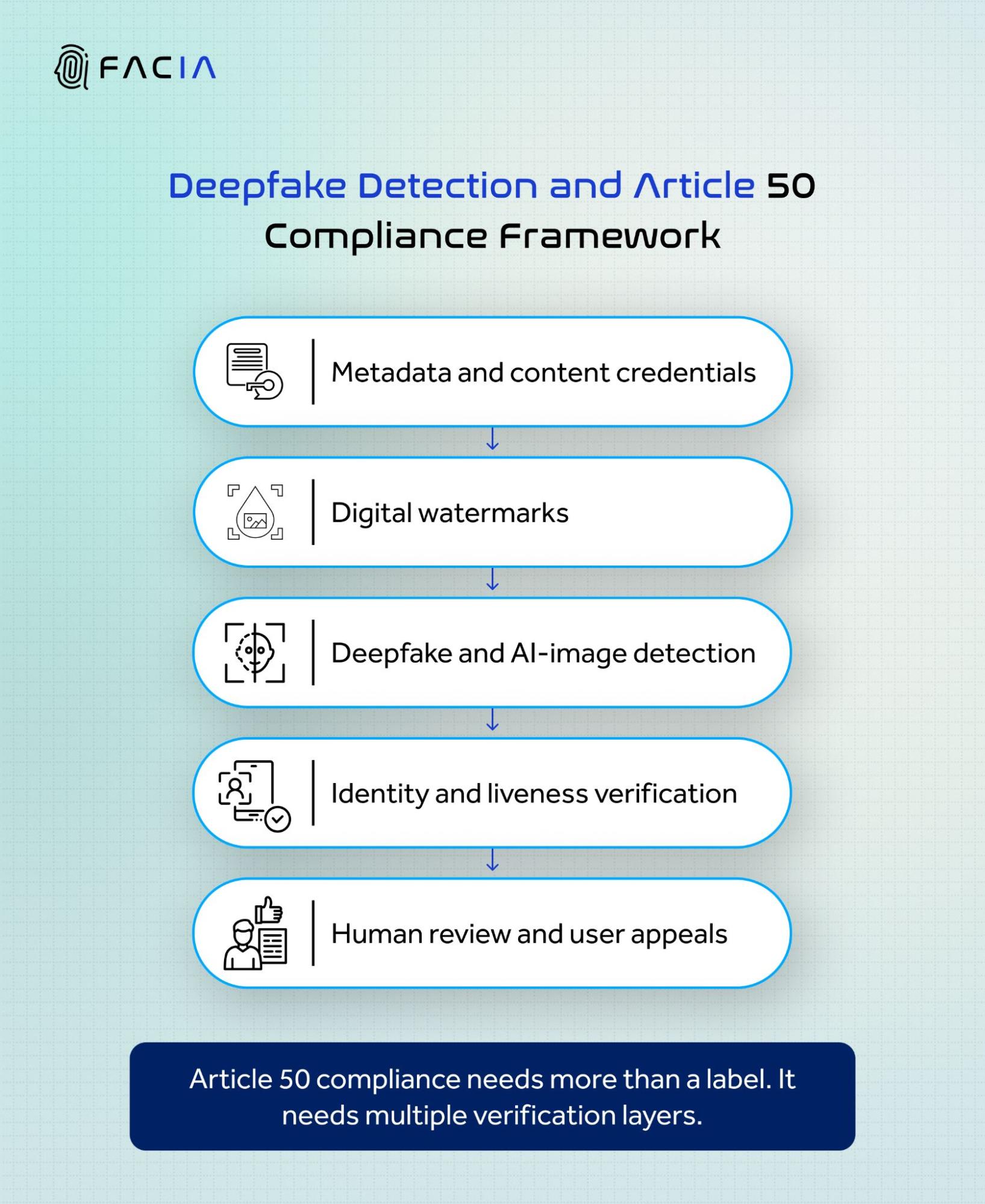
Platforms should not rely on a single method. A more reliable approach combines provenance signals with media analysis, account history, visible disclosures, and human review.
Deepfake detection can help when metadata or content credentials are missing, but it does not replace Article 50 duties.
EU AI Act Article 50 Penalties for Non-Compliance
The penalty framework is set out in Article 99 of the EU AI Act.
Failing to meet relevant provider or deployer obligations, including Article 50 requirements, may result in fines of up to €15 million or 3% of the provider’s or deployer’s total worldwide annual turnover for the previous financial year.
Poor handling of deepfakes, impersonation, or misleading content can also erode user confidence and the platform’s reputation. The full framework is available in the official EU AI Act text.
How Facia Helps Social Media Platforms Meet Article 50 Requirements
Article 50 is about more than just labeling AI-generated content. Social media platforms need clear processes for handling synthetic media, verifying identities, and explaining when AI is being used. They must also reduce the risk of impersonation, fraud, and the spread of manipulated content to users.
Facia supports these efforts through facial recognition, liveness detection, deepfake detection, and AI image detection. These tools can help platforms verify users, identify presentation attacks, and review suspicious images or videos when metadata and digital watermarks are missing.
It alone cannot guarantee compliance with Article 50. It works best alongside clear disclosures, human review, machine-readable marking, and documented moderation policies.
Preparing early gives platforms more time to improve systems, train teams, and build transparency into existing workflows. It can also help them respond more consistently when suspicious content or identity fraud is detected.
Learn how Facia’s deepfake detection and biometric verification solutions can help your platform prepare for EU AI Act Article 50 compliance.