
Your Verification Flow Is
Losing You Customers
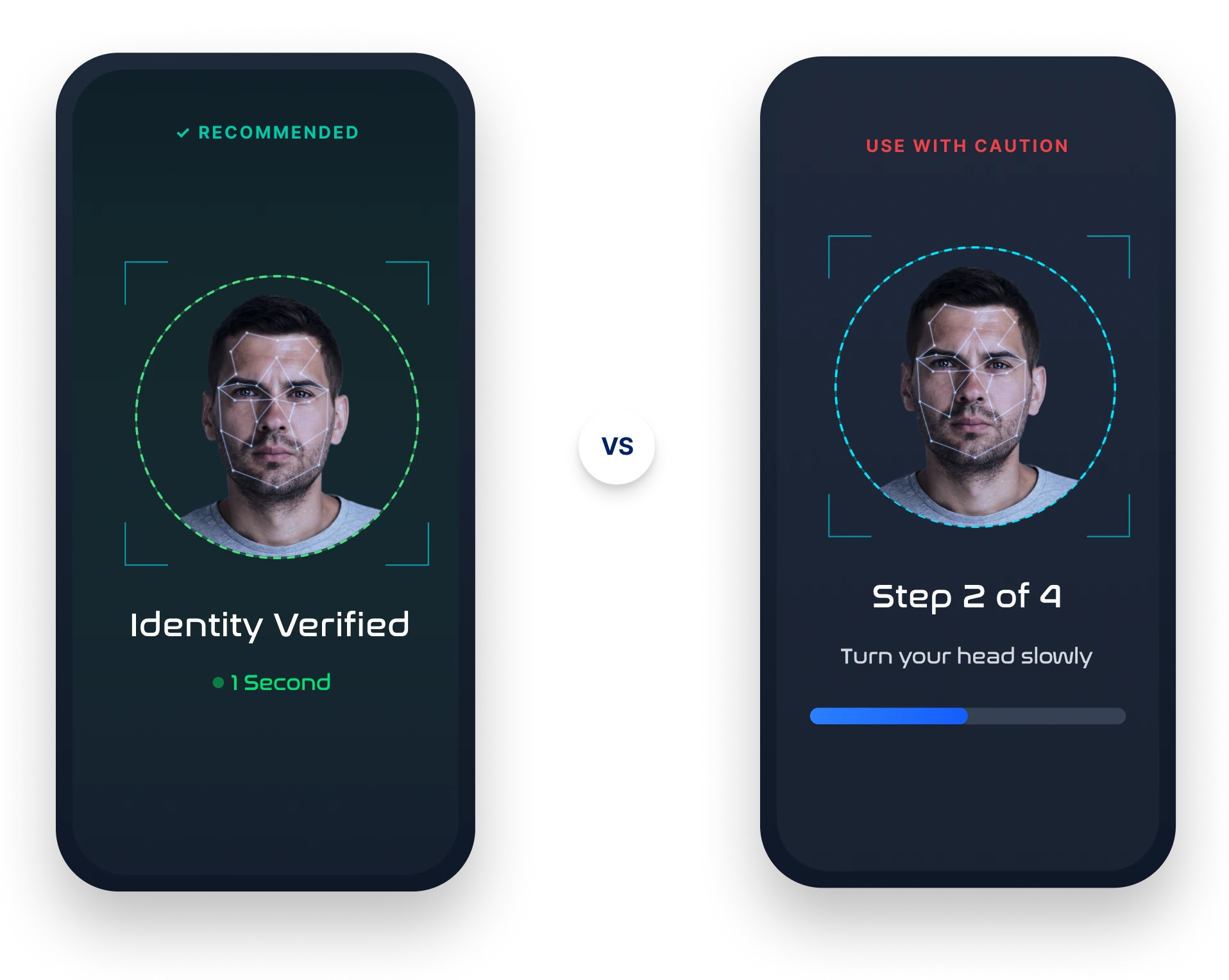
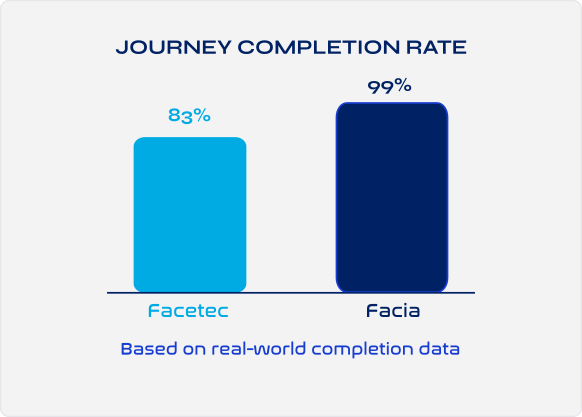
FaceTec puts users through 100 frames, forced movements, and a 10-second wait. Facia reads one selfie and gets out of the way. Same security. Far fewer drop offs.
FaceTec checks at enrollment The fraud happens during the call
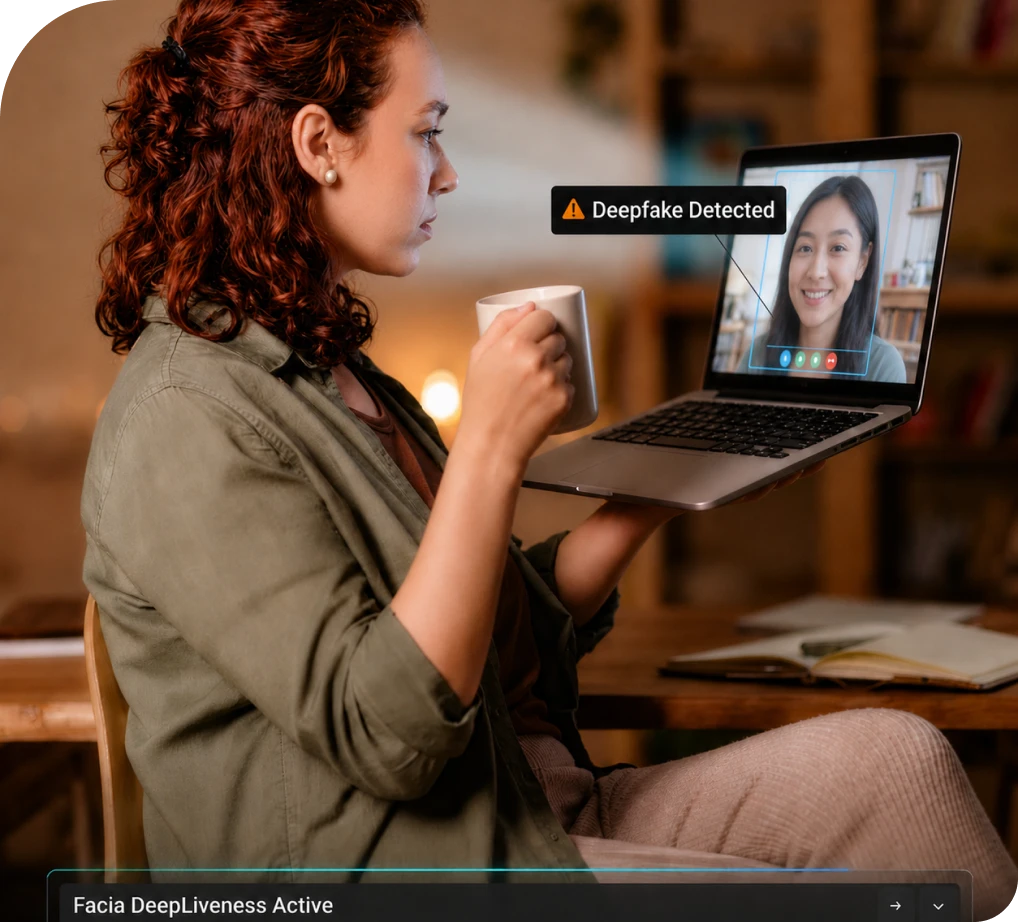
FaceTec verifies once and stops there. Facia detects deepfakes in real time, flagging face swaps and synthetic faces the moment they appear.
Every false rejection
is a customer you paid to lose
A user who fails verification does not complain. They leave and take their revenue with them. Facia's 0% FAR means genuine users always get through.
Global accuracy gap
Your users in emerging markets deserve the same accuracy
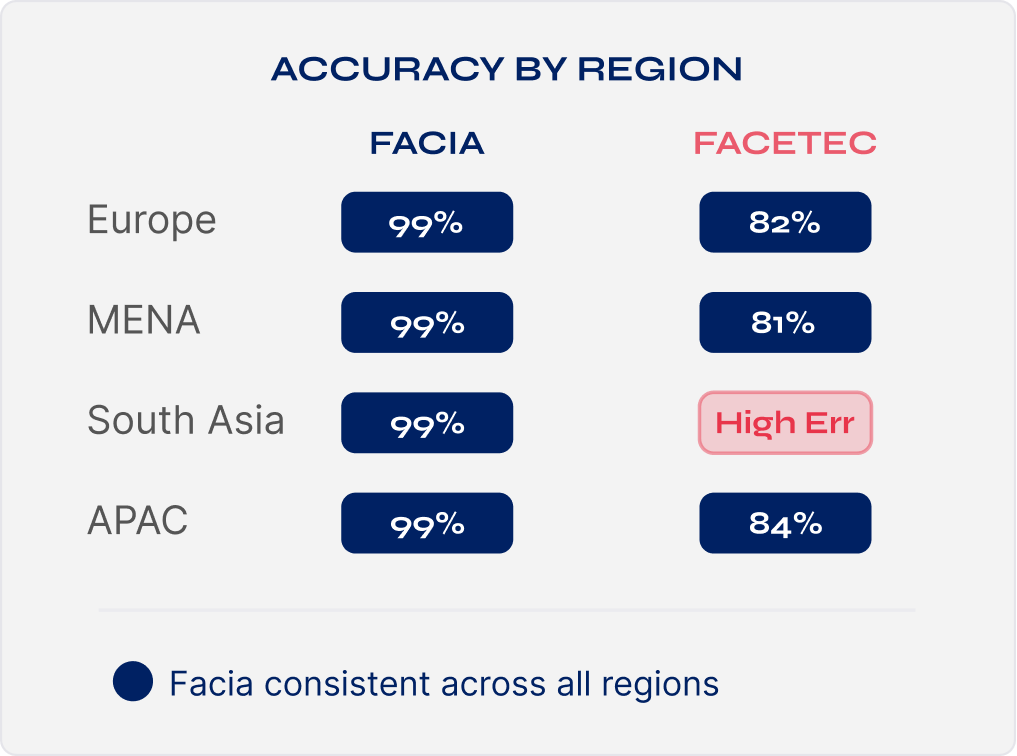
FaceTec has higher error rates on South Asian faces.
Facia delivers consistent accuracy regardless of ethnicity, skin tone, or region.
Three capabilities FaceTec cannot match
Publicly certified. Not just claimed
- Facia is NIST ranked and iBeta Level 2 certified.
- FaceTec has no public benchmark to verify.
Works where your users actually are
- Facia works in low light, with glasses or beards, on budget phones.
- FaceTec needs controlled conditions to operate.
FaceTec captures. Facia integrates
- Facia uses pre-captured images with lightweight APIs and 5MB SDKs.
- FaceTec is capture only, no image upload, closed SDK.
Everything side by side.
Nothing hidden.
A complete look at where each platform stands across every capability that matters.
| Capability | Facia | FaceTec |
|---|---|---|
| Liveness method | Single-frame passive Zero user instruction | Multi-frame guided, 100 plus frames Movement required |
| Verification speed | 1 to 3 seconds Industry leading | 10 plus seconds High abandonment risk |
| Deepfake detection | Images, video and live calls at 95% accuracy Real-time coverage | Static images only No live video detection |
| Live video fraud | Active detection during calls Unique capability | Not available Critical blindspot |
| NIST ranking | NIST FRTE ranked, publicly verifiable Trusted Benchmark | No public NIST ranking Unverified claims |
| Spoof certification | iBeta Level 2, 53 plus attack types, 0% FAR Independently certified | iBeta certified, limited published scope Limited transparency |
| Passive liveness | Single frame, no user action required Highest completion rate | 100 plus frames required High friction on weak networks |
| Real-world conditions | Low light, accessories, glare, legacy devices Battle-tested | Requires controlled conditions Struggles in the field |
| Demographic accuracy | APAC, MENA, South Asia optimised Consistent globally | Higher error rates on South Asian faces Emerging market risk |
| Deployment model | Cloud, on-premise, hybrid, open APIs Full flexibility | Closed SDK only No deployment flexibility |
| Device support | Any device, low bandwidth supported Universal access | Requires stronger devices and network Not built for all users |
| Age verification | 16 plus, 18 plus, 21 plus thresholds built in Regulatory ready | Basic estimation only, no compliance thresholds Compliance gap |
| KYC coverage | Identity plus fraud detection, one vendor Complete stack | Face biometrics only Needs additional vendors |
Trusted and Certified for Compliance
Fastest Liveness Detection Technology






Frequently Asked Questions
Photo ID matching verifies identity by comparing a user's selfie with their official ID photo. To make sure both photos are of the same person, it makes use of facial recognition technology.
While face ID matching compares a live face to a stored biometric template, photo ID matching checks a face against an image from an ID document. While the latter verifies users directly, the former verifies identity documents.
Yes, online onboarding frequently uses photo ID matching to remotely verify users. It assists companies in preventing identity fraud and adhering to KYC.
Generally, national ID cards, driver's licenses, and passports are accepted forms of identification. Valid credentials and a clear photo are required for these documents.
Indeed, Facia combines photo ID matching with sophisticated liveness detection. It guarantees that the user is not using spoof or fake images and is physically present.
In order to confirm an individual's identity and stop identity theft, photo ID matching is essential. It guarantees safe service access, particularly in regulated or high-risk settings.


