What Is Proof of Life Verification for Pensions? A Practical Guide
Author: Carter H | 14 Jul 2026In This Post
A pension should stop when life does, but outdated records do not always get the memo.
Pension programs depend on accurate data. When records are not updated in a timely manner, payments may continue after a beneficiary has passed away. That can lead to loss, audit problems, and pension fraud. In fiscal year 2025, U.S. federal agencies reported about $186 billion in estimated improper payments across 64 programs, with overpayments making up most of that amount.
Proof of life verification helps administrators confirm a beneficiary is alive and eligible to receive payments. It helps reduce fraud, improve payment accuracy, and keep cleaner records.
Still, the process has to be fair. Many pensioners are elderly, disabled, overseas, or lack reliable digital access. Verification should protect funds without requiring genuine beneficiaries to constantly prove they exist.
What Is Proof of Life Verification?
Proof of life verification allows checking whether the pensioner or benefits recipient is alive before payments are made.
A pensioner can provide proof of life, attend an appointment, take part in a video call, present a document via a portal, or provide biometric authentication.
Proof of Life vs. Identity Verification
Identification is the process of establishing someone’s identity. Proof of life verification is a process that confirms a person’s continued existence and ability to receive pension payments.
An ID card, a passport, or a logon could provide proof of identity, but not current life status. A proof of life check can fill that void by verifying at the time of verification that the beneficiary is in attendance.
Why Proof of Life Verification Matters for Pension Programs
Its primary object was to stop payments after the death of the person. It also helps ensure compliance, reduce errors, make audits easier, and promote trust.
The issue is real. The U.S. Treasury’s January 2025 report on the five-month pilot of using the Social Security Administration’s Full Death Master File (FDMF) to prevent and recoup over $31 million in fraud and improper payments.
If pension and payment records are not linked, funds may continue to flow even after a person is no longer eligible for pension payments.
How Pension Fraud Can Happen Without Proper Verification
The most common fault line in pension schemes is the fact that they cannot determine if the person who is supposed to be receiving the pension is deceased.
Typical risks consist of payments after death, withdrawals by family or caregivers, delayed reporting of deaths, duplicate records, forged proof of life documents, poor death registry matching, and overseas beneficiaries who are difficult to reach.
The issue can also be slow reporting or disjointed databases. However, the pension program is out of control, with no clear criteria for who gets the money.
What Is a Proof of Life Check?
A proof-of-life check is a procedure that establishes that a beneficiary still exists. This can be done through an office visit, a signed certificate, a video call, a digital ID process, or biometric authentication.
Some administrators make it a point to check every year. Others ask only if it seems unusual, such as whether it’s returned mail, whether the account hasn’t been used, whether there was no contact, whether there is a discrepancy in the records, or whether the person lives overseas.
Routine vs. Risk-Based Proof of Life Checks
Regular inspections are carried out at regular intervals. They are easy to do, but may irritate pensioners if they have to do them too often.
Risk-based checks target beneficiaries with warning signs, rather than requiring checks on everyone. This allows administrators to limit fraud while not forcing low-risk pensioners to pay more.
What Is a Proof of Life Document?
Proof of life document: A certificate or declaration that a beneficiary is living. May also be known as a life certificate, certificate of existence, pension life certificate, or beneficiary status certificate.
These include documents signed and witnessed, local authority certificates, bank confirmations, embassy attestations, or signed notarial declarations. For instance, the Department for Work and Pensions uses a Life Certificate to determine whether a person living abroad can claim a UK State Pension.
For overseas pensioners, those without internet access, and others who can’t do online checks, proof of life documents remain relevant. Paper verification has its drawbacks, however. The process of forming the form can be delayed, it can be lost, it can be forged, and it can be difficult to witness.
Digital Proof of Life Verification and Biometric Authentication
The digital proof-of-life verification can save paper, branch visits, and processing time. It can be through an app, portal, video call, one-time password, digital ID match, or death record screening.
The Digital Life Certificate in India is a prime example of a large-scale digital verification system. Its campaign generated a total of 1.91 crore Digital Life Certificates in November 2025, equivalent to 19.1 million certificates.
Where Biometric Authentication Adds Security
Biometric authentication verifies that the person completing the verification matches the enrolled pension beneficiary. It can use fingerprint, voice, iris, or facial biometrics.
For pension programs, facial biometrics can be useful because many beneficiaries can complete the check through a phone camera. That reduces office visits and helps pensioners who live far from service centers.
Why Liveness Detection Matters
Facial biometrics are stronger when paired with liveness detection. This helps confirm that a real person is present, rather than a printed photo, replayed video, mask, or deepfake.
NIST’s digital identity guidance notes that biometric characteristics are not secrets, since facial images, fingerprints, and iris patterns can sometimes be captured without consent. That is why biometric systems need spoof detection, encryption, consent, and careful data handling.
The Role of Facial Biometrics in Proof of Life Checks
Facial biometrics can make proof-of-life checks faster and easier to complete remotely. A pensioner can capture a live selfie or short video, which is matched against an enrolled image or trusted identity record.
This can help overseas pensioners, rural beneficiaries, and older users who may struggle to travel. It can also reduce pressure on branch staff and manual review teams.
But facial biometrics should be used carefully. Poor lighting, low-quality cameras, health conditions, aging, disability, or confusing instructions can affect the result. A pensioner should not lose income because one scan failed on a bad internet day.
Why Human Review Is Still Needed
A failed facial biometric check should not automatically stop a pension payment. It should trigger manual review, assisted verification, or another proof-of-life option. Strong verification should stop fraud, not punish genuine beneficiaries for technical issues.
Best Practices for Secure and Inclusive Verification
Use a risk-based model. Low-risk beneficiaries can often be checked through trusted records, while higher-risk cases may need active verification.
Offer multiple channels, including digital tools, biometric authentication, in-person visits, call centers, assisted service points, and proof of life documents. One channel will never work for everyone.
Protect personal and biometric data with encryption, consent controls, access limits, data minimization, retention rules, and audit logs. Missed notices, failed scans, or incomplete documents should trigger reminders and a review before suspension.
A Practical Proof of Life Verification Workflow
A reliable workflow starts with updated beneficiary records, death and civil database checks, risk grouping, and a proof-of-life check only when needed.
Here is what a practical proof-of-life verification process can look like, from record update to final payment decision.
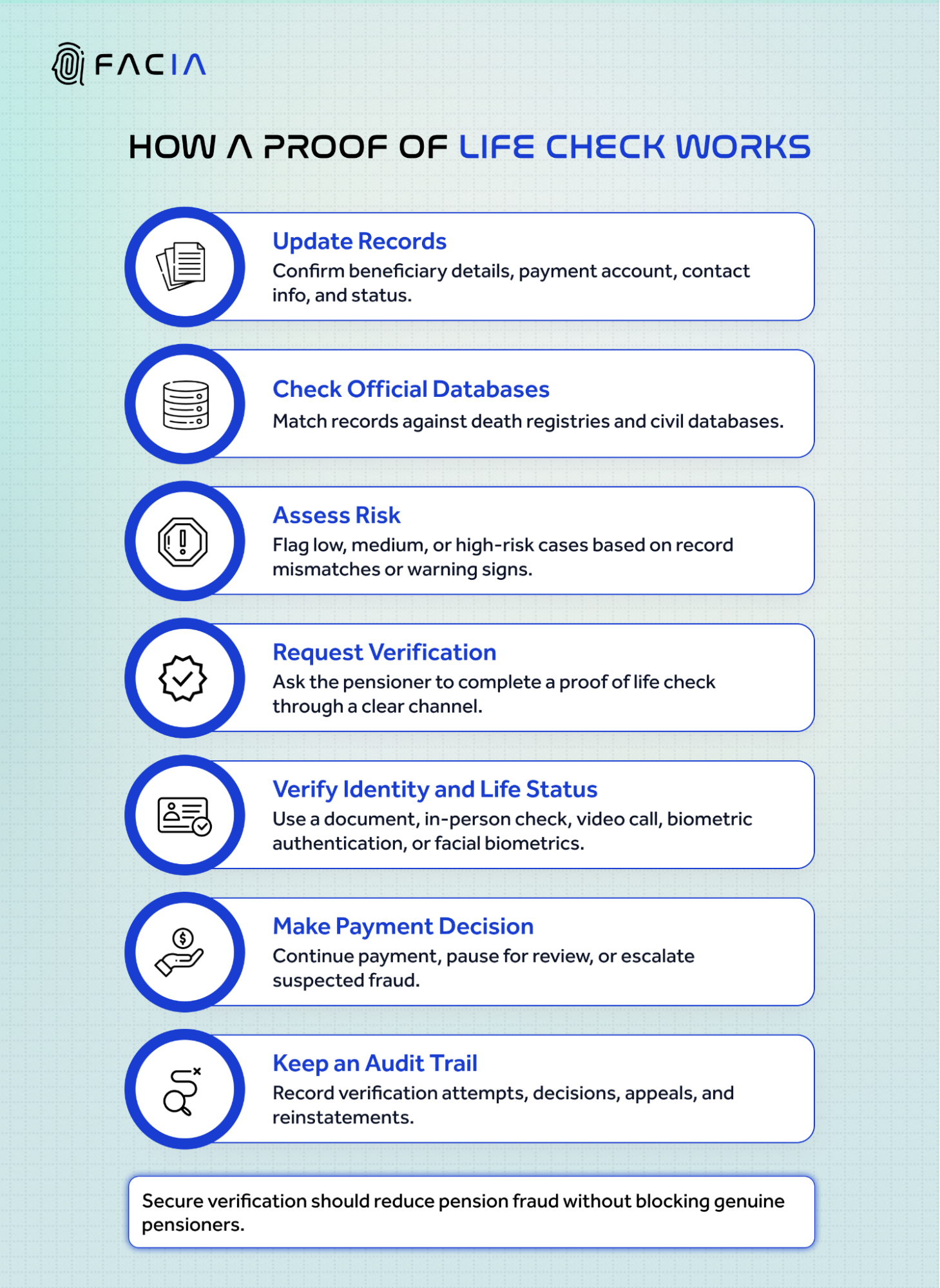
The pensioner should be offered suitable verification options, such as digital, biometric, in-person, assisted, or document-based methods. Unclear cases should go to manual review before any payment decision is made. The program should also keep a clear record of attempts, decisions, appeals, and reinstatements.
How Facia Supports Secure Proof of Life Verification for Pensions
Proof-of-life verification is not just a fraud-prevention measure. It is a critical safeguard that helps pension programs protect funds, maintain accurate beneficiary records, and ensure payments are made only to eligible recipients. For administrators, the challenge is to strengthen verification without creating unnecessary barriers for genuine pensioners.
Facia supports this balance by enabling remote proof-of-life verification via facial recognition, real-time liveness detection, biometric enrollment, and re-verification. This allows pensioners to complete checks securely from anywhere, while helping administrators detect impersonation attempts, reduce manual workload, and improve audit readiness.
By combining biometric authentication with liveness detection and a user-friendly verification flow, Facia helps pension programs move from outdated, paper-heavy processes to faster and more secure digital checks. The result is a verification system that protects pension funds without making life harder for the people who depend on them.
Learn how Facia’s proof of life verification for pensions helps prevent pension fraud, reduce improper payments, and protect genuine beneficiaries. Book a demo today.