Best Age Verification Software: 12 Providers Compared 2026
Author: Carter H | 16 Jul 2026In This Post
Age verification has moved well beyond a date-of-birth field and a hopeful click on “I am over 18.” In 2026, businesses need to confirm whether users meet an age threshold without turning every sign-up, checkout, or content gate into an identity-document marathon. The best age verification software balances confidence, privacy, fraud resistance, and a journey people will actually complete.
The shift is already visible. According to Ofcom’s May 2026 research, 51% of UK children aged 8 to 17 with social media profiles recalled being asked to prove their age by January 2026.
The market now spans facial age estimation, ID checks, reusable digital identities, database matching, and layered age assurance.
This guide compares 12 leading age verification providers by their methods, fraud controls, fallback options, and integration flexibility. Facia is our best overall pick for businesses seeking document-free facial age estimation with liveness, deepfake detection, and flexible deployment in one biometric stack.
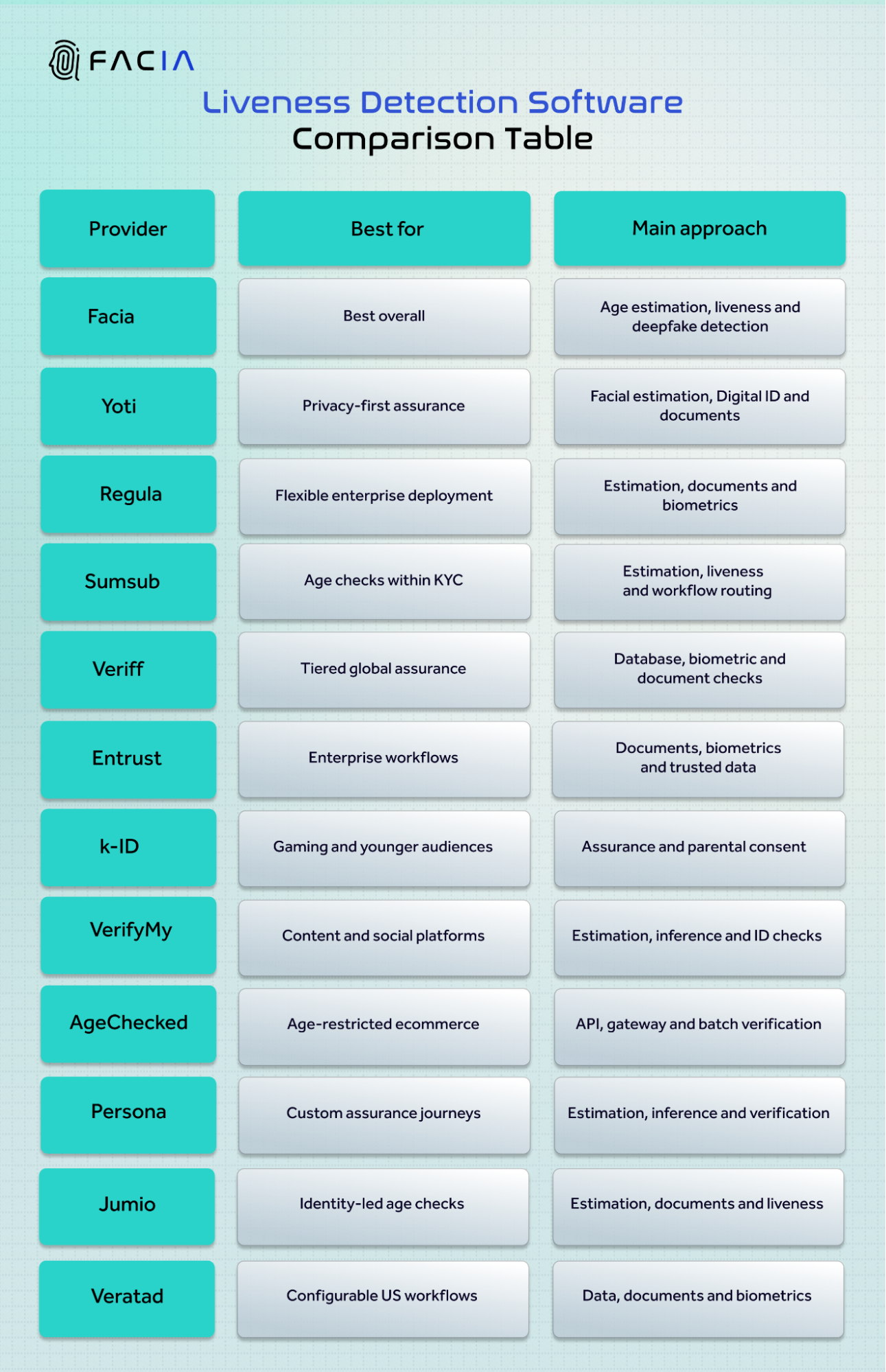
Best Age Verification Software in 2026: 12 Providers at a Glance
For this comparison, we reviewed official provider documentation and assessed verification methods, privacy, fraud controls, fallback options, integration flexibility, and suitability for different customer journeys.
A Closer Look at the Leading Age Verification Providers
1. Facia
Best for: Document-free age estimation with biometric fraud protection.
Why consider it: Facia combines facial age estimation, active/passive liveness, and deepfake detection to help determine whether the face is real and present. Mobile SDKs, REST APIs, and cloud or on-premises solutions are our top overall options for a flexible, easy-to-implement solution.
2. Yoti
Best suited to: Privacy-focused guarantees and verifiable age evidence.
Why think of it: Yoti provides facial age estimation, Digital ID, mobile-number verification, and document validation. A business may not be given an entire identity profile; instead, age or threshold. It’s a reusable Digital ID that’s useful for repeat age checks.
3. Regula
Ideal for: Businesses that require document expertise and deployment flexibility.
Why to consider it: Regula is a bundle of facial estimation, document authentication, face matching, and liveness. It can start with a selfie and ask for an ID at the threshold or as risk increases. The deployment options are API, SDK, cloud, hybrid, and on-premises.
4. Sumsub
Best for: Regulated businesses implementing age checks for KYC.
Why consider it: Sumsub uses liveness-based age estimation and can detect attacks involving video, masks, and deepfakes. It features a workflow builder that routes users based on estimated age and confidence level, making it suitable for a variety of regulated services, such as fintech and gambling.
5. Veriff
Ideal for: International sites with age restriction levels.
Why consider it: Veriff begins by checking databases, then implements an approach that estimates biometrics without documents, and uses government IDs only when the information is less clear or a higher risk. This layered journey provides different assurance levels to international platforms, without treating all adults the same.
6. Entrust Identity Verification
Best suited for: Enterprises with extensive identity needs.
For what it’s worth, entrusted integrates document checks, facial biometrics, trusted data, and even custom no-code workflows. Routes are flexible enough to evolve alongside the market in response to changing requirements, especially when age checks are part of a broader identity program.
7. k-ID
Most suitable for: Mixed-age groups in games and services.
Why it’s good to think about: age assurance is part and parcel of age-appropriate. It can identify checks based on jurisdiction and access, and accommodate parent consent requirements. This is a more useful outcome than an adult-or-minor outcome for services for young people.
8. VerifyMy
Ideal for: Content, social, and user-generated content platforms.
Why consider it: VerificationMy enables facial estimation, government ID checks, inference via email, mobile, and payment signals. Platforms may provide background evidence, then present a visible age gate only when additional evidence is needed.
9. AgeChecked
Best for: Ecommerce & online services that require age restriction.
Why it’s worth considering: AgeChecked provides a Client API, Consumer Gateway, and batch verification. Checks are either performed during registration or checkout; if the first route is unavailable to confirm eligibility, the alternate route is used. It is appropriate for stores looking for multiple implementation options.
10. Persona
Ideal for: age assurance journeys with a high degree of configuration.
It has been thought about because why not? Selfie estimation, email based inference, and government ID verification all use Persona. First, businesses can rely on existing signals, then resort to a selfie, and escalate to an identity document in case of ambiguity. It’s flexible, but rules are necessary to be careful with it.
11. Jumio
Ideal for: Cases where identity is the basis for verification, and additional proof is needed.
Why to consider: Jumio can start with facial age estimation and request more in-depth checks. With ID flow, it pulls a date of birth, links the document to a selfie, and performs regulated onboarding and purchases with liveness detection.
12. Veratad
Ideal for: Companies in the USA creating checks with various options.
Why it matters: Veratad’s all-in-one API and no-code interface enable a single solution for identity data, documents, biometrics, and reusable credentials. Methods and certainty thresholds can be set for transactions or for business risks. International buyers to verify regional coverage.
Before You Compare Age Verification Solutions, Know the Difference
Age verification establishes an exact age or a minimum age with authoritative evidence, such as a government ID or a trusted record. Age estimation answers the question of whether a person is likely to be above or below a threshold, often by examining facial characteristics. Age inference is based on context, behavior or transaction.
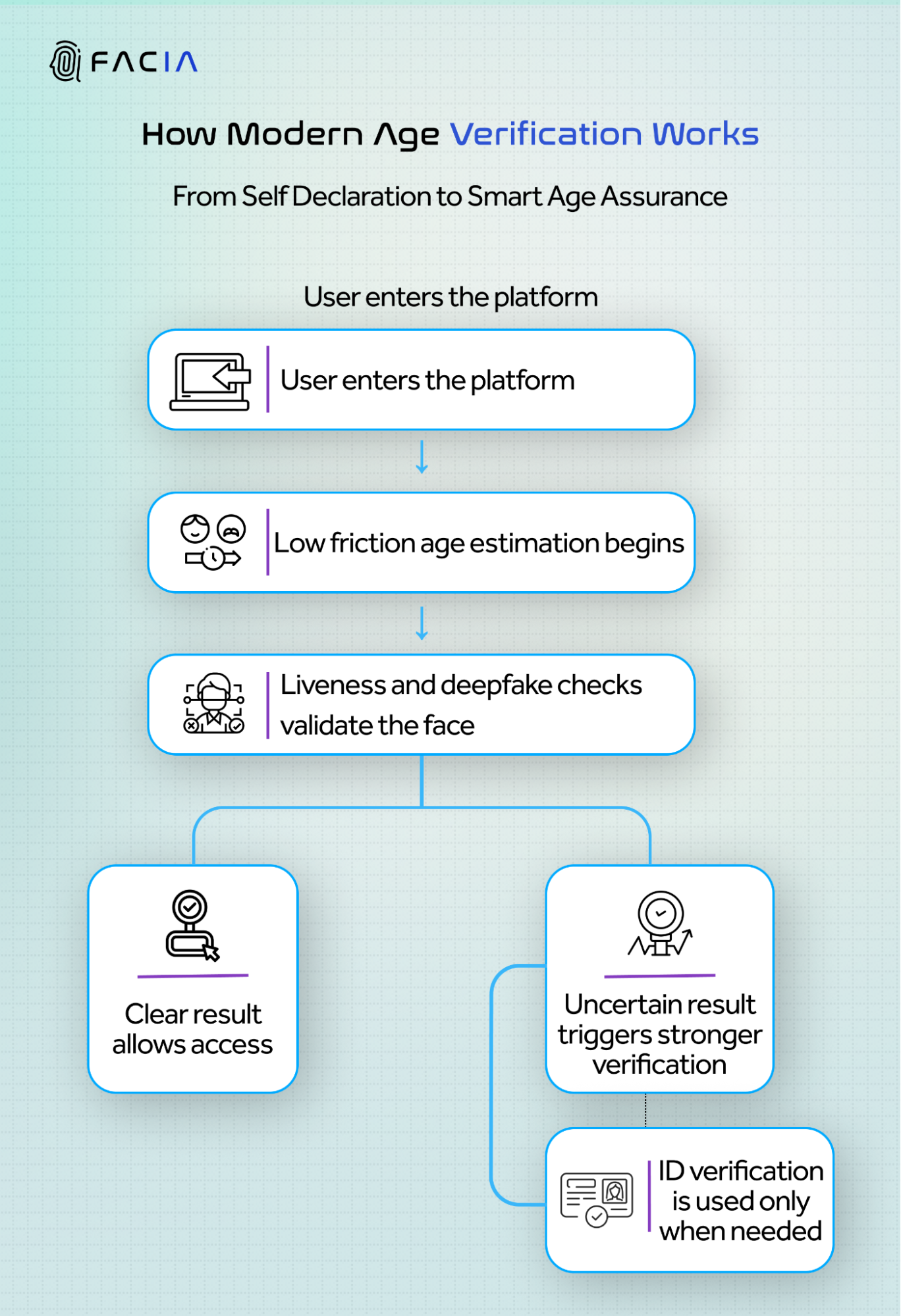
The three are all covered by age assurance. A layered workflow could allow an obvious adult to bypass facial estimation and challenge an individual at the threshold, with document verification reserved for more risky activities. A robust age verification software solution is the least intrusive, capable of delivering sufficient confidence, and will ramp up if necessary.
The infographic below shows how a modern age assurance journey begins with a low-friction check and branches into stronger verification only when greater confidence is required.
How to Choose Without Turning It Into a Six-Month Project
Begin with the problem that the software should solve, and then consider the following 6 factors:
- Coverage: Efforts are made to maintain coverage requirements and markets.
- Method mix: A documentless trail for users who have unambiguous tasks to complete.
- Fraud controls Include Liveness, replay, and deepfake checks.
- Fallbacks: A set path when there are uncertain outcomes.
- Privacy: Clear policies around collection, retention, and sharing.
- Integration: API, SDKs, and deployment that fit.
Don’t use a single “accuracy percentage” to rely upon. Inquire about the system’s behavior near the threshold, where errors are at a maximum. Ask for independent testing, breakdowns, and retries or appeals. The right provider should help to translate policy into proportionate assurance, and not create a digital obstacle course.
Why Facia Is Our Best Overall Age Verification Software Pick
Several providers excel in specialized areas. Yoti offers reusable proof of age. Sumsub connects checks with broader KYC. k-ID supports youth-focused experiences, while Persona provides extensive workflow control.
Facia is the best overall pick because it combines document-free facial age estimation with biometric fraud protection in a single, broader stack. Active and passive liveness, plus deepfake detection, help determine whether a facial sample can be trusted before it informs an age decision. That matters as photographs, replays, and AI-generated faces weaken selfie-only checks.
Facia also supports mobile SDKs, REST APIs, cross-platform implementation, and cloud or on-premises deployment. Teams can use a low-friction first-line check for clear-cut cases, then escalate uncertain results in line with their policies and risk appetite.
For businesses prioritizing age estimation, fraud resistance, and deployment flexibility, Facia offers the strongest overall fit in this comparison.
Ready to replace blunt age gates with a faster, deepfake-aware journey? Explore Facia’s age verification technology and book a demo today.