Best Liveness Detection Software in 2026: 10 Vendors Compared
Author: Carter H | 14 Jul 2026In This Post
To make the right decision about the best liveness detection software in 2026, you cannot simply look at face-matching accuracy. Deepfakes, virtual cameras, replay attacks, and injected video can all mimic real users and fool remote verification systems.
The risk is evident in a South China Morning Post report citing Hong Kong Police statements. The police said that eight suspects used at least 21 lost identity cards and AI-generated facial images to submit 44 applications to open bank accounts in April 2025. It is claimed that 30 passed online checks. The vendors weren’t identified, but the case demonstrates why people can’t just selfie and be matched to an ID photo anymore.
Liveness detection software verifies that the camera is capturing a live person and that the camera’s capture channel is reliable. This guide compares 10 vendors on liveness, public PAD evidence, deployment flexibility, and best fit.
Key Highlights
- This guide compares Facia, iProov, FaceTec, Incode, Jumio, Entrust, IDnow, Sumsub, Regula, and Yoti.
- Deepfake resistance claims should be supported by independent PAD evidence that matches the current SDK, device, and production configuration.
- There are threats of presentation attacks and injection attacks. Buyers have to verify that the product is print-proof, mask-proof, screen replay-proof, deep fake-proof, virtual camera-proof, and manipulated media stream-proof.
Why Liveness Detection Software Matters in 2026
According to the World Economic Forum’s Global Cybersecurity Outlook 2026, 77% of respondents reported an increase in cyber-enabled fraud and phishing. The report also lists identity theft as a common attack type.
There are two types of presentation and injection attacks: they target different aspects of the verification process. A printed photo, a screen replay, or a mask displayed before a camera attacks the capture scene. The virtual camera or virtual media pipeline can bypass the physical camera altogether, allowing for synthetic video to be inserted.
NIST SP 800-63B provides guidance on addressing biometric presentation attacks, and NIST SP 800-63A addresses the requirements for remote identity proofing when injection, forged media, and genuine sensor capture are relevant.
How We Evaluated the Vendors
This comparison focuses on the liveness methods, injection defense, deployment options, developer tools, pricing transparency, and testing evidence from July 2026 that is public. The vendors are not ranked numerically. Facia is listed first as this article is published by Facia.
Independent PAD evidence refers to the software version tested, the backend, the device configuration, and the attack instruments. Do not expect it to be a guarantee that every deployment or “next release” will execute in the same manner.
Liveness Detection Software Comparison Table
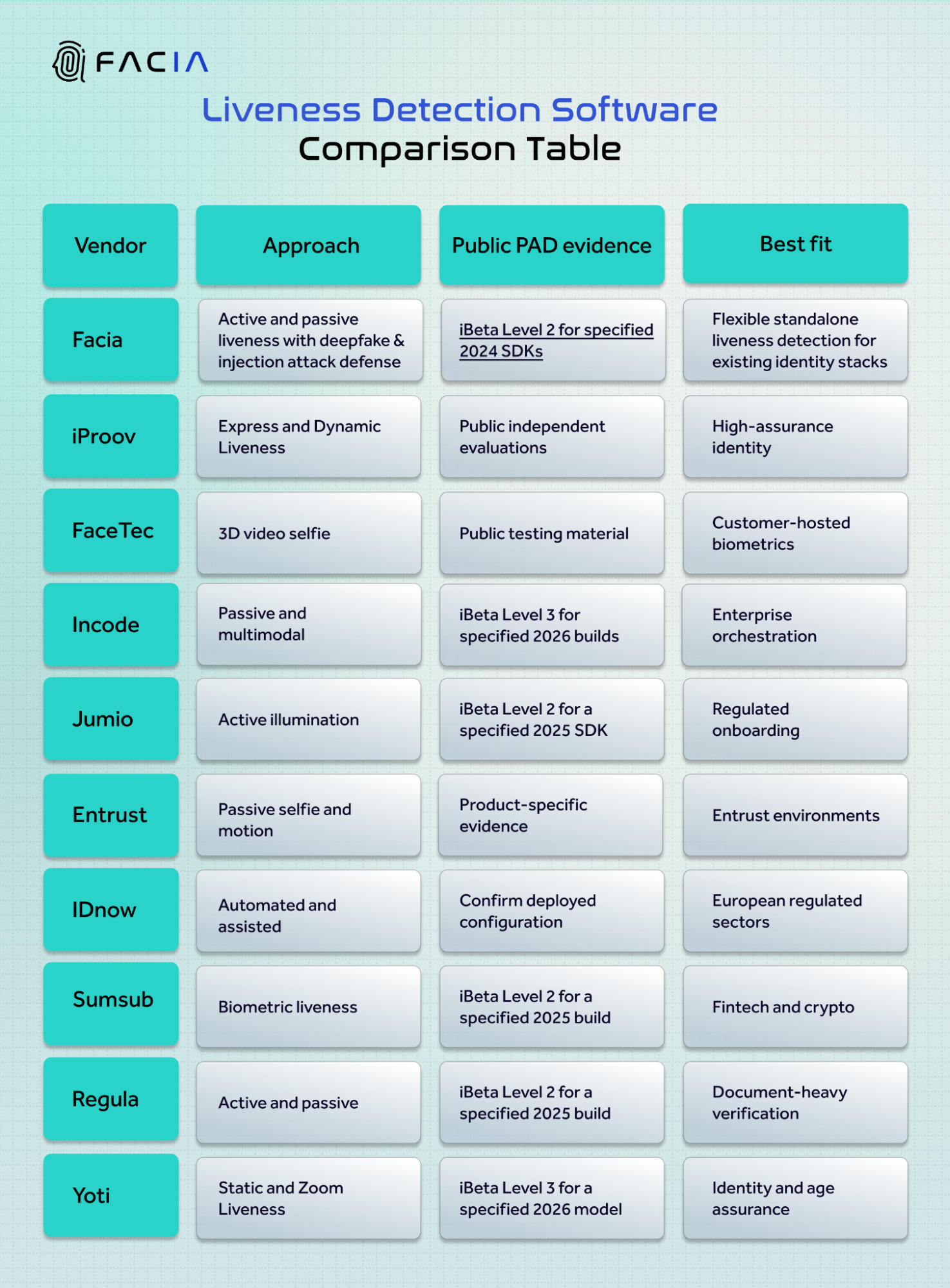
Pricing is not directly comparable. Some vendors sell standalone biometric checks, while others bundle liveness with document verification KYC, AML, and workflow orchestration. Facia and Sumsub publish prices, while most require a quotation.
Best Liveness Detection Software: Vendor Reviews
1. Facia
Facia is built for teams that need liveness detection as a focused biometric layer rather than a full KYC platform replacement. It combines active and passive liveness detection with deepfake and injection attack defense, helping organizations verify that a real user is present and that the capture channel has not been manipulated.
It is available on mobile SDKs, REST APIs, cloud services, and on-premises deployment.
It works well for companies with varying infrastructure, privacy, and compliance needs.
Suitable for: Teams looking for a standalone liveness detection solution with high deployment flexibility.
Check: Ensure the tested SDK versions, devices, operating systems, and attack scenarios match those in production.
2. iProov
iProov’s Dynamic Liveness and Express Liveness are both based on controlled illumination and are designed for different levels of assurance for different journeys.
Ideal for: High-value account creation, authentication, and recovery.
Check: It is not a full-blown KYC and AML platform, so teams may need additional workflow and compliance tools.
3. FaceTec
FaceTec generates an encrypted 3D FaceScan from a short video selfie taken by the customer for mobile and browser capture, and an optional service hosted by the customer provides the server software for capture.
Most suitable for: Companies seeking control over biometric processing and hosting.
Check: Customer-managed infrastructure involves responsibility for implementation, monitoring, and security.
4. Incode
Incode combines liveness, deepfake detection, camera-injection analysis, and device signals inside a broader identity platform.
Best for: Enterprises requiring identity workflow orchestration across onboarding, fraud, and compliance journeys.
Check: The platform may be more than teams need if they only want a lightweight liveness endpoint.
5. Jumio
Jumio uses active illumination and AI analysis for presentation attacks, deepfakes, and injected media, with hosted journeys, SDKs, and APIs.
Best for: Regulated onboarding that needs document, biometric, and identity verification together.
Check: Test older devices, difficult lighting, slower networks, and retry behavior before rollout.
6. Entrust
Entrust supports live-selfie verification, motion capture, and configurable journeys through Workflow Studio, APIs, and SDKs.
Best for: Organizations already using Entrust identity, certificate, or security products.
Check: Confirm that product evidence applies to the exact workflow and SDK being deployed.
7. IDnow
IDnow combines face matching and liveness with expert-assisted video identification and injection-attack analysis.
Best for: European-regulated journeys that need automated checks with human fallback.
Check: The broader platform can add complexity when a standalone API is the only requirement.
8. Sumsub
Sumsub includes liveness and deepfake detection within a KYC, AML, and fraud platform, with SDKs, APIs, hosted links, and bundled pricing.
Best for: Fintech, crypto, and regulated businesses seeking one compliance platform.
Check: Bundled pricing makes standalone liveness cost comparisons less direct.
9. Regula
Regula Face SDK combines active and passive liveness with face matching, identification, and document verification across mobile, web, and server environments.
Best for: Document-heavy programs that need biometrics and document forensics in one stack.
Check: Its breadth may be unnecessary for simple cloud-only liveness use cases.
10. Yoti
Yoti provides passive Static Liveness and active Zoom Liveness through APIs and SDKs.
Best for: Identity verification and age-assurance journeys.
Check: Confirm that injection controls are included and that the production model matches the public test evidence.
How to Choose the Best Liveness Detection Software
Use this checklist to evaluate whether a liveness detection vendor meets your security, deployment, and user-experience requirements.
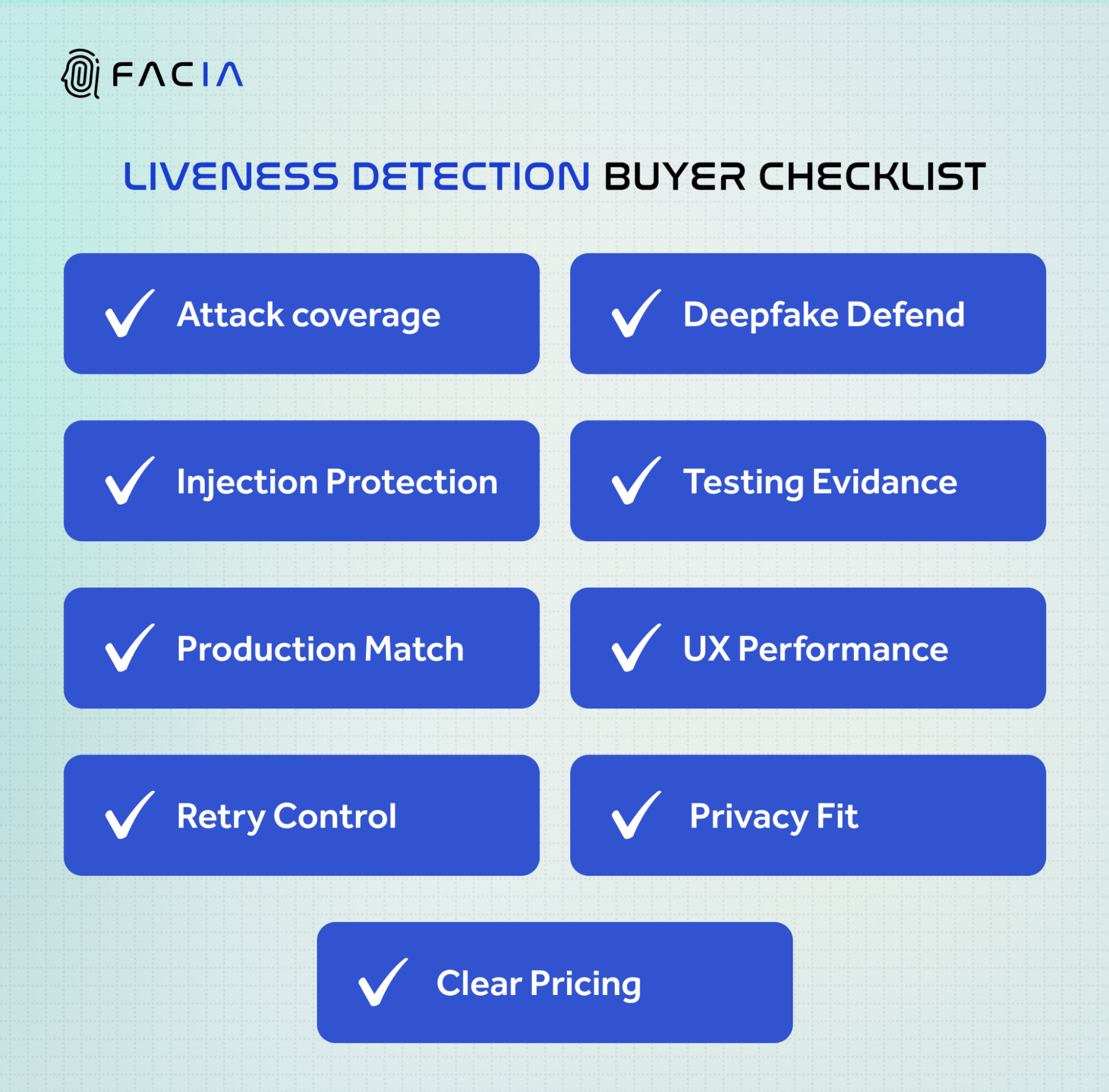
The most reliable vendor is the one that works best for your fraud, user, and device requirements. Test printed photo, masks, screen replays, deepfakes, virtual cameras, emulators, and injected video. Don’t think of PAD as a sign of injection defense.
Match the independent evidence to the specific SDK, device, backend, release, and operating system intended for production. Next, track the completion rates, retries, response time, accessibility, false rejections, and manual review volume.
Examine hosting options, APIs, SDKs, data encryption, biometric data retention, data location, fall-back journeys, and incident response planning. Lastly, determine the total cost, including integration, hosting, support, failed checks, upgrades, and manual reviews.
Choosing the Right Liveness Detection Software
The best liveness-detection software is insufficient if it only detects basic spoofing attempts. In 2026, it will be important for companies to assess each vendor’s ability to address presentation attacks, deepfakes, virtual cameras, emulators, injected video, and manipulated capture environments.
Buyers should also consider that security claims don’t count and compare vendors to actual deployment requirements. When selecting a solution for production, independent PAD evidence, SDK coverage, hosting options, user experience, pricing transparency, and integration effort are key factors.
Facia provides teams with a flexible approach to deepen biometric verification without replacing their current identity stack. Featuring active and passive liveness, deepfake detection and injection attack defense, APIs and SDKs, cloud deployment, and on-premises deployment, Facia is designed for businesses that demand enhanced security against current identity fraud and control over implementation. Stop deepfakes, virtual cameras, and injection attacks before they reach your onboarding flow.
Ready to stop deepfakes, spoofing, and injection attacks without adding friction? Explore how Facia can deliver faster, more secure liveness detection across APIs, SDKs, cloud, and on-premises deployments. Book a Demo Today.