Facial Recognition With Masks in Identity Verification
Author: admin | 02 Jun 2026In This Post
The facial recognition market is projected to grow from USD 10.02 billion in 2026 to USD 20.68 billion by 2031, driven by increasing demand for identity verification, authentication, and digital security solutions.
This expansion is part of a significant shift in how businesses verify identity. Authentication is not limited to a controlled environment that has ideal lighting and full facial exposure. Today, onboarding, account recovery, payment verification, and access are all performed on phones in airports, at work, hospitals, and at the far end of the road, where face coverings are ubiquitous.
This brings a new challenge for the biometric systems. A mask can conceal crucial facial features commonly employed in face matching, making it harder to accurately verify a face while providing opportunities to spoof a face and commit identity fraud.
Facial mask recognition addresses this problem by analyzing visible biometric features, such as the eyes, eyebrows, forehead, and upper face structure. Combined with liveness detection, it enables businesses to securely verify genuine users, even when part of the face is covered.
Why Facial Recognition With Masks Matters for Identity Verification
Secure identity verification is a hallmark of digital platforms that helps protect against unauthorized access, account takeover, and financial fraud. An additional difficulty is that masks occlude critical facial landmarks important for face matching.
This impacts both the security and the usability. Sometimes it can be harder for genuine users to get verified, and during spoofing attempts or when creating fake accounts, fraudsters may wear masks to cover their identities.
The Identity Theft Resource Center’s 2025 Consumer Impact Report found that identity-related fraud continues to cause financial and emotional harm to consumers, with account takeover remaining one of the most frequently reported identity crimes.
To deal with these risks, facial recognition systems must do more than simple face matching. They must have intelligent mask detection and powerful liveness verification.
How Facial Recognition With Masks Works
While each technology plays a distinct role in the verification process, the workflow below provides a high-level view of how AI securely verifies users when part of the face is covered.
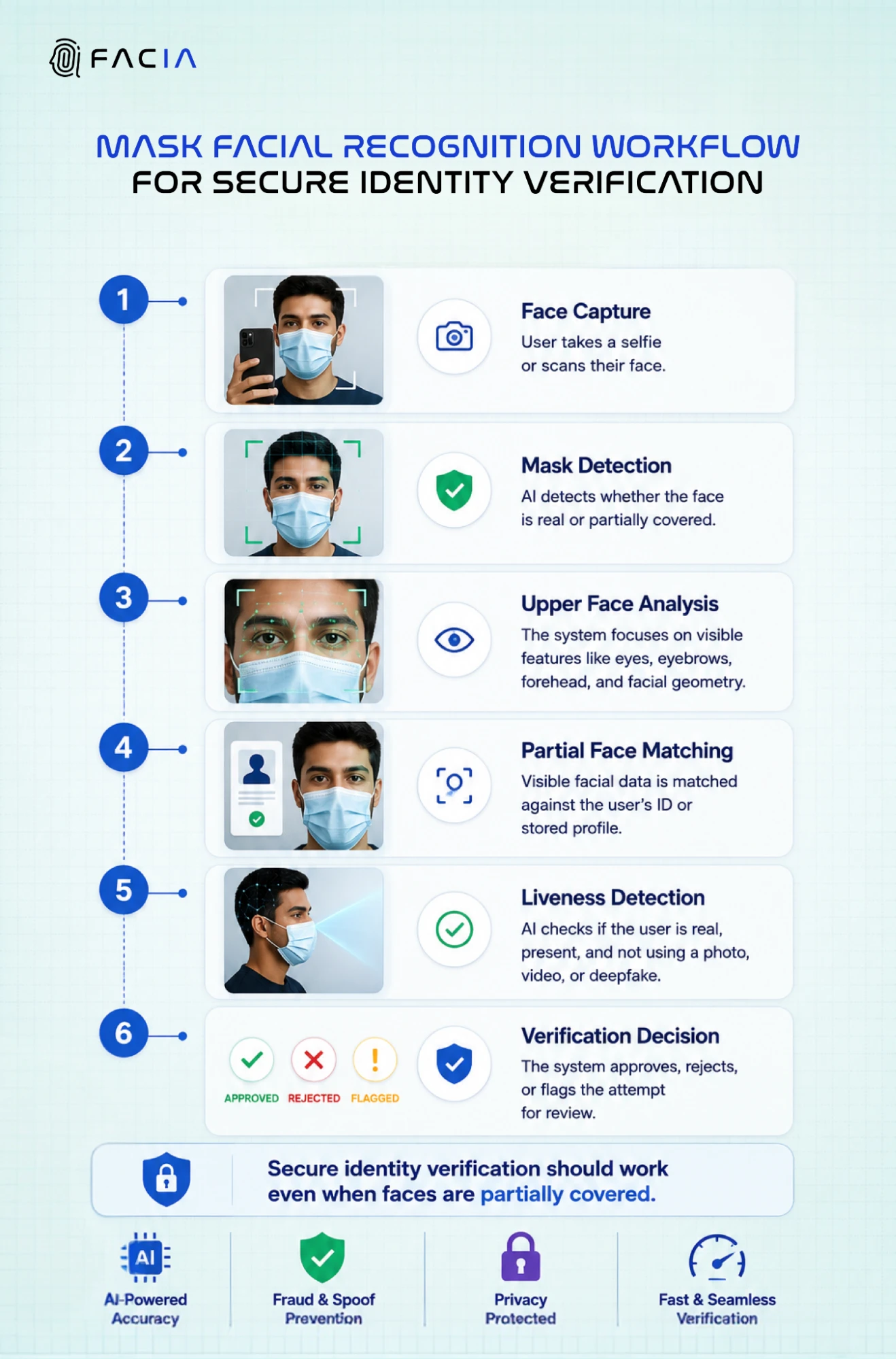
Understanding the technologies behind masked facial recognition helps explain how AI-powered identity verification remains accurate even when facial features are partially covered.
-
Upper Face Recognition for Masked Users
Biometric signals are still present at the top of the face. When the face is not visible, the spacing between the eyes, the shape of the eyebrows, the structure of the eyelids, and the shape of the forehead may be used to help systems verify identity.
-
Eye Region Analysis in Mask Facial Recognition
The eye region (also referred to as the periocular region) can be particularly important in masked verification, as it is visible in most cases.
NIST’s Face Recognition Vendor Test found that masks can significantly affect recognition accuracy, underscoring the need for facial recognition systems to be optimized for partial face visibility rather than full-face analysis alone.
-
AI Mask Detection Before Face Matching
There are two stages to the verification process in a modern system: First, it checks for the presence of a mask; Second, it actually verifies the mask. This is useful for fine-tuning the authentication process based on image quality and risk signals.
-
Partial Face Matching for Secure Verification
Partial face matching uses facial attributes visible in the image and trusted identity information to make reliable decisions regarding face verification without creating undue burden for legitimate users.
Challenges of Facial Recognition With Masks
Mask facial recognition improves flexibility, but it also creates technical and security challenges.
- Missing Facial Landmarks: Masks over the nose, mouth, jawline, and cheeks are key. These areas are heavily used in traditional recognition systems, and if they are unavailable, less biometric information is available.
- False Match and False Rejection Risks: A false match is when an individual who is not the correct person is accepted, and a false rejection is when the correct individual is not accepted. The risks are increased when it is not possible to see the face.
- Poor Lighting and Camera Quality: Whether it’s by phone or video, most remote verification sessions take place on a personal device. Masked verification may be more difficult if the camera is low-quality, suffers from glare, motion blur, or inconsistent lighting.
- Mask-Based Identity Fraud: Fraudsters can use replayed videos, masks, and stolen documents to overcome inadequate authentication systems.
What Is Liveness Detection for Masked Faces
Liveness detection for masked faces checks whether the person in front of the camera is physically present and genuine. It helps prevent attacks involving photos, replay videos, deepfakes, masks, and synthetic identities.
-
Real Person Detection Behind a Mask
Even with partial facial visibility, systems can analyze natural movement, skin texture, lighting responses, and depth cues to confirm the presence of a real human.
-
Photo and Video Replay Attack Prevention
Fraudsters often try to bypass verification using printed images or replayed videos. Liveness detection helps identify these attacks by analyzing whether the face behaves naturally in real time.
-
Deepfake and Presentation Attack Detection
Deepfake-assisted fraud is becoming a growing threat in remote identity verification. Attackers can use manipulated videos or AI-generated overlays to imitate legitimate users.
Anti-Mask Facial Recognition for Fraud Prevention
Anti-mask facial recognition refers to detecting suspicious mask usage during identity verification rather than treating every masked user as fraudulent.
A traveler or healthcare worker may have a valid reason to wear a mask, while a fraudster may use one to hide identity during account creation or authentication attempts.
ENISA’s 2025 Threat Landscape report states that phishing remains one of the most common methods of intrusion for credential theft and unauthorized access. Once attackers obtain stolen credentials or personal data, they often try to bypass authentication systems by manipulating verification flows.
Where Mask Facial Recognition Is Used
Mask facial recognition is used across industries where identity verification must remain secure without slowing down legitimate users.
-
KYC and Customer Onboarding
Financial institutions use masked facial verification to support secure remote onboarding while reducing fraud during account creation.
-
Banking and Fintech Identity Verification
Banks and fintech platforms rely on face verification for account recovery, transaction approval, and login authentication.
-
Healthcare Identity Verification
Healthcare environments often require masks, making secure masked authentication important for both patients and staff.
-
Border Control and Travel Identity Checks
Travel environments require fast identity checks, even when users wear masks during health alerts or crowded transit.
How Facia Solves Masked Face Verification Challenges
Facial recognition with masks creates two major challenges for identity verification systems: reduced biometric visibility and higher spoofing risk. Businesses need to verify legitimate users accurately while preventing fraud attempts involving masks, replay attacks, deepfakes, and manipulated facial data.
Facia addresses these challenges through facial recognition, face verification, and DeepLiveness detection technology. Its DeepLiveness system confirms that the person completing verification is physically present rather than a photo, a replayed video, a mask-based spoof, or an AI-generated face.
With Facia’s recent upgrade from standard liveness detection to DeepLiveness detection, the platform achieved a False Acceptance Rate of 0.06% and a False Rejection Rate of 0.3%. A lower FAR helps reduce fraudulent access attempts, while a lower FRR helps legitimate users complete authentication with fewer failed verifications.
For masked-face verification, this combination helps organizations securely verify users, even when facial visibility is limited, while maintaining strong fraud-prevention standards.
Frequently Asked Questions
Yes, if they are used to confuse or bypass facial recognition systems. Legitimate masks are not spoofing, but masks designed to deceive AI can be treated as a spoofing attempt.
It can be highly accurate when trained for partial face matching. Accuracy depends on lighting, camera quality, mask coverage, and liveness detection.
They use mask detection, upper-face analysis, liveness checks, and anti-spoofing technology. These checks help detect replay videos, deepfakes, fake IDs, and suspicious masked attempts.