
Top 5 Digital Forensics Challenges for Law Enforcement
Author: Carter H | 16 Jun 2026In This Post
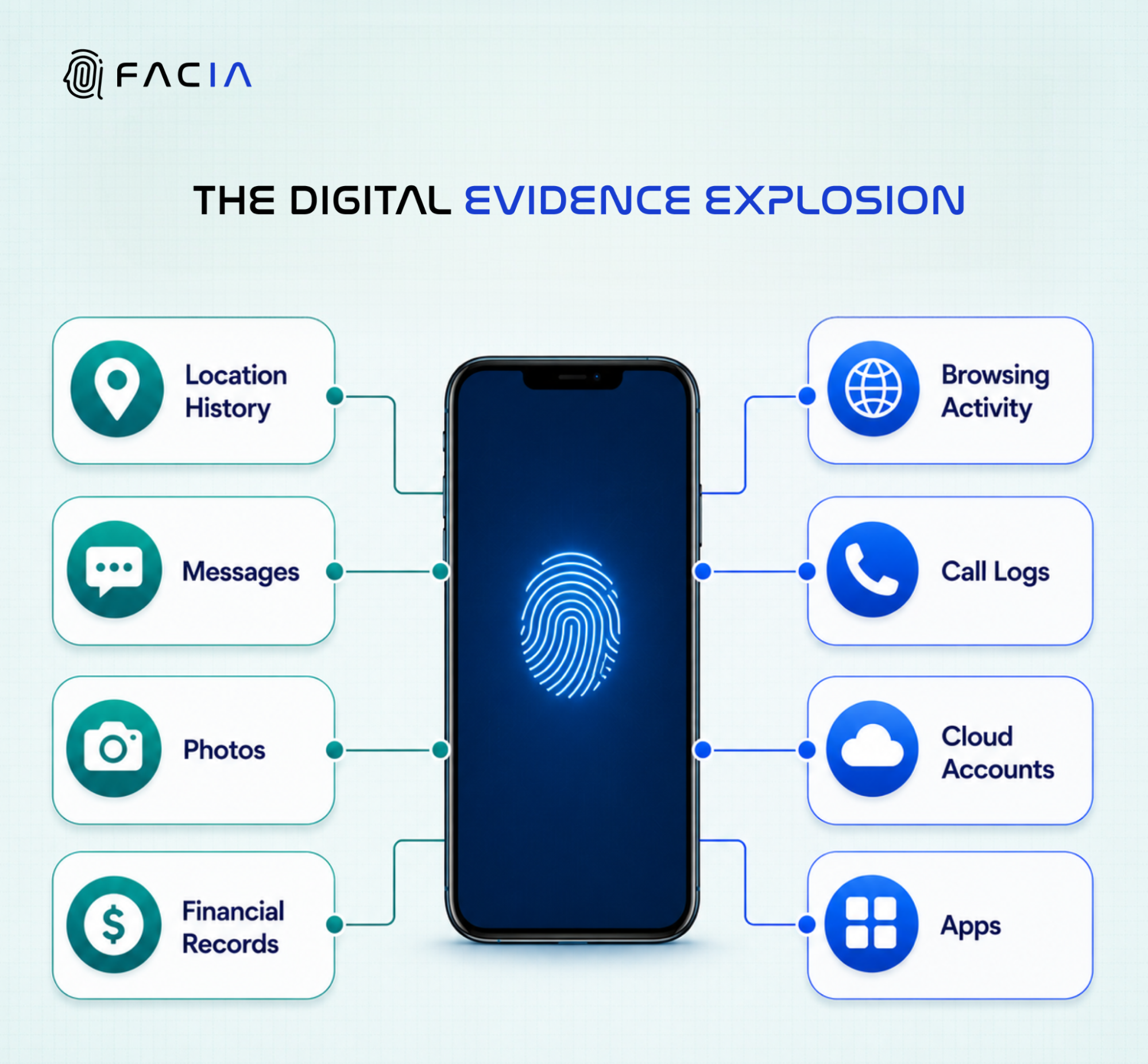
A single smartphone can contain thousands of messages, months of location history, financial records, photos, and access to cloud accounts. For investigators, that device can become one of the most important pieces of evidence in a criminal case.
This shift has made digital forensics a core part of modern law enforcement. Investigators rely on digital evidence to establish timelines, uncover connections between suspects, recover deleted information, and support prosecutions.
This trend is reflected in broader law enforcement assessments as well. In its 2025 Serious and Organized Crime Threat Assessment, Europol warned that criminal networks are increasingly using digital platforms, artificial intelligence, and online services to expand their operations, creating new challenges for investigators responsible for collecting and verifying digital evidence.
Yet collecting evidence is only part of the challenge.
Law enforcement agencies must also navigate encrypted devices, overwhelming volumes of data, cloud-based evidence, AI-generated content, and rapidly changing technologies. As digital investigations become more complex, ensuring evidence remains accessible, authentic, and admissible is becoming increasingly difficult.
Why Digital Forensics Matters in Modern Law Enforcement
The primary emphasis in criminal investigations was once on physical evidence like fingerprints, documents, weapons, and witness testimony. Those sources are always vital, but digital evidence is becoming present in nearly all cases.
Human activity is recorded using mobile phones, social media accounts, cloud platforms, GPS records, surveillance systems, and connected devices. In all investigations, whether it involves fraud, cybercrime, organized crime, or violent crimes, digital evidence is frequently a key component in determining what happened and when.
A single smartphone can generate an enormous volume of potentially relevant evidence, providing investigators with detailed insights into a person’s activities, communications, and movements.
 Why Digital Evidence Has Become Central to Investigations
Digital forensics is the process of discovering, preserving, analyzing, and presenting digital evidence in a way that is legally admissible. It aids investigators in recovering deleted files, analyzing communication history, tracking Internet use, and verifying the authenticity of electronic content.
With the rise of digital evidence in most criminal activity, forensic teams are becoming an integral part of moving data into evidence that can influence investigations and court decisions.
Key Digital Forensics Challenges Law Enforcement Faces
Finding digital evidence is only one part of the equation. Investigators also need to know how to access, control, authenticate, and maintain its integrity during the investigation.
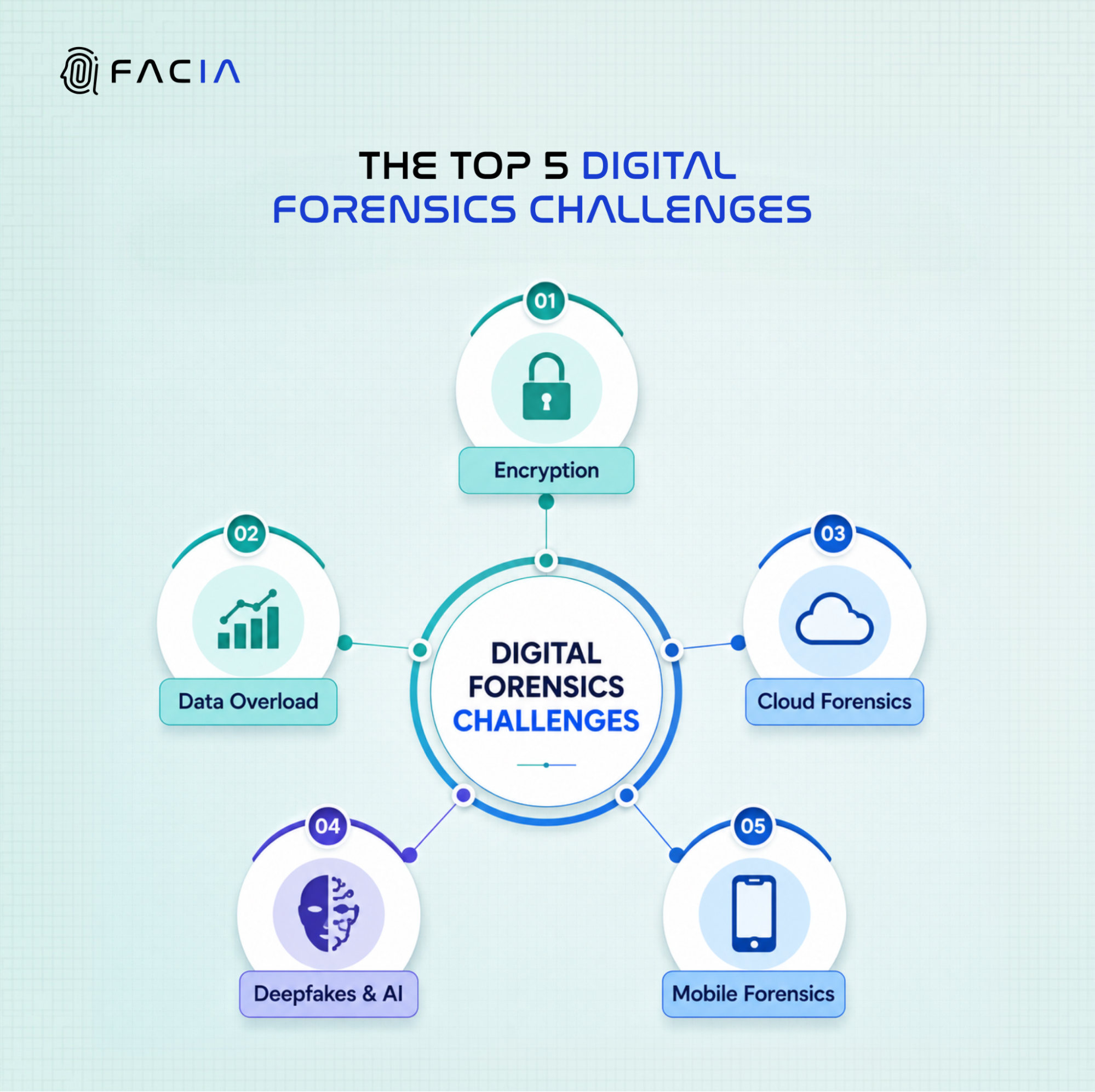
Modern investigations face multiple obstacles when collecting, analyzing, and validating digital evidence. The infographic below highlights the five most significant digital forensics challenges facing law enforcement today.
-
Encryption: The Biggest Barrier to Accessing Digital Evidence
Investigators may lawfully take possession of a device, but may not be able to access its information.
Secure encryption is now considered a common feature on smartphones, computers, communications, and cloud services. These safeguards can also pose serious challenges to criminal investigations.
For example, imagine that narcotics detectives find a suspect’s cell phone. Messages, location history, financial transactions, and contact records may be included in the device and could be useful in the case. If the device is not accessible, critical evidence may be unavailable.
The challenge isn’t just limited to physical devices. Access to communications is also often blocked, even if investigators have identified relevant accounts, by end-to-end encrypted messaging services.
-
Data Overload: Finding Critical Evidence in Mountains of Data
Modern investigations generate an extraordinary amount of information.
Multiple devices, cloud accounts, surveillance videos, emails, text messages, social media, and application data can be part of a single case. There may be thousands of files and records to review for each source
Now the challenge is to process and analyze the data. The important thing is to find the evidence.
Investigators, in many instances, waste more time filtering out information and irrelevant material than in collecting evidence. As the amount of data increases, it becomes more challenging to find the nuggets of information that can help to move the investigation forward.
The Verizon 2025 Data Breach Investigations Report is one of the most referenced annual reports in the cybersecurity industry, and it examines over 22,000 security incidents and 12,000 confirmed breaches. The volume of this data is indicative of the information that an investigator might find in a digital investigation.
Connected technologies such as smartwatches, vehicle systems, and home security devices add further complexity, increasing the amount of evidence that must be reviewed and analyzed.
-
Cloud Forensics: Chasing Evidence Across Borders and Platforms
Digital evidence is no longer confined to a single device.
Email can be stored in one application, documents in another, and messages in various messaging apps. Evidence is increasingly spread across cloud storage, productivity applications, collaboration platforms, and messaging services, making it difficult to make a comprehensive overview of a person’s digital life.
Suppose investigators are investigating a financial fraud case involving multiple online accounts. Critical Evidence can be shared among cloud storage platforms, email services, and collaboration tools.
It is often necessary to coordinate with service providers and follow intricate legal processes to gain access to that information. Further, the same Verizon report shows that about 30% of breaches involved third parties, reflecting organizations’ reliance on interdependent services and third-party platforms.
Cloud investigations are also evolving in terms of the legal aspects involved. The European Union e-Evidence Regulation has been enacted to facilitate requests for electronic evidence from the EU member states. Despite this, privacy legislation, jurisdictional issues, and international partnerships continue to be important challenges in the case of evidence that is stored in different regions.
-
Deepfakes and AI: When You Can’t Trust What You See
For years, investigators focused on finding digital evidence.
One emerging problem is whether the evidence is authentic. You can now get highly realistic images, videos, and even audio recordings from artificial intelligence that are hard to tell apart from real. With deepfake technology, a person’s appearance, voice, and behavior can be imitated with a high degree of accuracy.
Imagine a video showing a public official taking a bribe. Investigators must first determine whether the footage is genuine, manipulated, or purely AI-generated before using it. Collecting digital evidence is no longer the only challenge for investigators. It now takes longer to decide whether the evidence itself can be trusted.
Unlike traditional forms of digital manipulation, modern deepfakes can be generated quickly and distributed at scale. This creates additional pressure on investigators who must verify content before it influences investigative decisions, public perception, or legal proceedings. Governments are also responding. The European Union AI Act introduced transparency requirements for certain AI-generated content, reflecting broader concerns about identity manipulation and public trust. As synthetic media becomes more convincing, proving authenticity is becoming just as important as collecting evidence.
-
Mobile Forensics: Keeping Up With Rapid Device Innovation
Smartphones have become one of the most valuable sources of digital evidence.
They contain call records, messages, photos, videos, application data, location history, financial transactions, and browsing activity. In many investigations, mobile devices provide a detailed picture of a person’s actions and movements. At the same time, mobile technology continues to evolve.
New operating systems, security measures, encryption, and/or hardware protections can significantly impact forensic examinations. Things that work on one device may not work on another.
There’s also the added layer of complexity of mobile apps. There are many who use cloud sync and proprietary storage solutions that require their own sets of skills to decode. For forensic teams, mobile forensics is an ongoing challenge: keeping up with innovation while maintaining investigative accuracy and legal defensibility.
The Future of Digital Forensics in an AI-Driven World
AI is not just posing new investigative challenges but also new opportunities. AI-driven forensic tools can assist in handling vast amounts of data, uncovering patterns, prioritizing pertinent evidence, and minimizing manual workloads.
With digital evidence on the rise, automation can move investigators from hours spent manually reviewing data to high-value leads. Although human skills are crucial, AI is anticipated to become a more prominent part of the digital forensic process.
In addition to evidence collection, establishing the trustworthiness of evidence will be critical to the future of digital forensics for law enforcement.
How Facia Helps Strengthen Trust in Digital Evidence
As digital investigations become more complex, law enforcement agencies face growing pressure to verify the authenticity of digital evidence, identify manipulated content, and maintain confidence in investigative findings. The rise of deepfakes, synthetic identities, and AI-generated media has made evidence verification just as important as evidence collection.
Encryption, cloud-based investigations, expanding data volumes, and increasingly sophisticated synthetic media all introduce new risks to the investigative process. Even when evidence is successfully collected, investigators must be confident that it is authentic, untampered, and capable of withstanding legal scrutiny.
Facia helps address these challenges through advanced deepfake detection and identity verification technologies designed to support evidence authentication workflows. By helping organizations detect manipulated content, verify digital identities, and strengthen confidence in digital evidence, Facia can support investigators in reducing the risk of relying on misleading or compromised information.
Whether examining digital evidence, investigating potential identity fraud, or assessing the authenticity of media files, law enforcement agencies need reliable tools that support accuracy, transparency, and trust throughout the investigative process.
Explore how Facia helps organizations verify digital evidence, detect deepfakes, and strengthen trust in digital investigations.