How DeepLiveness Is Setting a New Standard in Liveness Detection
Author: teresa_myers | 08 May 2026In This Post
Digital identity verification is entering a new era. A face on a screen is no longer enough to prove that a real person is present.
The 2026 UK government update on the threat posed by deepfakes estimated that 8 million deepfakes were shared globally in 2025, compared to 500,000 in 2023. In the same update, a deepfake detection evaluation framework was announced, to be tested by Microsoft, academics, and experts against real-world threats such as fraud and impersonation.
This scale indicates that digital identity teams no longer assume that a face on the screen is evidence of a real person. Presence, movement, and visual identity can now be imitated by synthetic media in ways older verification flows are not designed to support.
That is where DeepLiveness detection alters the dialogue. It elevates liveness detection beyond a simple presence test to deepfake-aware proof of presence, helping businesses ensure a user is alive, real, and truly present during identity verification.
The Rise of AI-Driven Identity Fraud
Identity fraud is increasingly visual, scalable, and hard to detect due to AI. Synthetic selfies, manipulated videos, face swaps, fake profiles, and injected camera feeds are some of the ways fraudsters can create identities that seem trustworthy at first glance.
This is important since identity fraud seldom ceases at the point of sign-up. Onboarding can be used by a fake user to request account recovery, attempt withdrawals, manipulate customer support, or abuse platform incentives. The minute that the user is within the system, it is more difficult to detect, and the risk itself is more costly.
In 2026, the FBI published its 2025 Internet Crime Report, which reported that cyber-enabled crimes had defrauded Americans to the tune of almost 21 billion, with complaints related to artificial intelligence among the most expensive categories. The report also indicated that scammers are employing the use of fake social profiles, voice clones, identification documents, and believable videos.
Why Liveness Detection Needs an Upgrade
Conventional liveness detection was designed to provide answers to one critical question: Does a real person physically exist during the verification process?
Until recently, this sufficed to thwart most common spoofing techniques, which include printed photos, screen replays, masks, and simple video tricks. But deepfakes have changed the risk model. A real-time face-swap overlay injected via a virtual camera feed bypasses server-side liveness entirely. The system analyses a synthetic face and sees nothing unusual, because the substitution happened before the check ran.
This is the reason why liveness detection requires an upgrade. Businesses do not require any evidence of activity. They require some evidence of authenticity.
DeepLiveness detection adds that deeper layer. It helps verification systems move from “someone is present” to “the right person is genuinely present.”
What Is DeepLiveness Detection?
DeepLiveness detection is a state-of-the-art proof-of-presence layer for modern identity verification. It helps determine whether a user is an artificial being, something generated or created with synthetic media.
Simple liveness detection tests the visibility of a face as physically present. DeepLiveness extends to assist in detecting indicators of AI-generated faces, deepfake overlays, replay attempts, manipulated videos, and suspicious digital inputs.
An example of a threat that cannot be overcome by standard liveness is that of digital injection, whereby an attacker directly injects a synthetic feed to bypass the verification check before it has even started. Server-side liveness is oblivious to this type of attack since it does not measure how it was sent to it. The client-side SDK of Facia fills this gap by securing the camera feed at the device level, intercepting attempts to inject a virtual camera or modified stream and stopping the attack before it reaches the server, meaning that the input that reaches the liveness check is authentic before any analysis is performed.
Things are simple; liveness detection poses the question: Is there a live face? DeepLiveness poses: Could this live face be relied upon?
Why DeepLiveness Matters: Proof of Presence in 2026
Presence proofing refers to confirming that an actual individual is truly present at the time of verification, as opposed to being represented by a recording, a synthesized face, a replayed video, or a manipulated camera stream. It is here that DeepLiveness builds a more powerful benchmark. It is not a substitute for identity verification. One of the most sensitive parts of it is a demonstration that the individual behind the action is a genuine one.
This is more important than ever in 2026 as synthetic media is no longer a niche threat. In April 2026, the FTC reported that in 2025, almost 30 percent of the people who lost money to a scam in 2025 reported that the scam began on social media, and that reported losses amounted to $2.1 billion. Presence evidence is relevant when a user is creating an account, re-authenticating, approving a transaction, or performing a regulated identity check. In both instances, companies must not be satisfied with a face match; they have to be assured that the user is real, present, and not using AI to build a false sense of trust.
In the case of businesses, it is quite explicit. The inability of deepfake detection to remain out of the identity journey. It must work within the verification. DeepLiveness helps facilitate that transition by enhancing the risk of the presence at each high-trust digital moment.
DeepLiveness vs Basic Liveness Detection
Understanding the difference between basic liveness and DeepLiveness helps explain why modern identity systems need a stronger standard. Both approaches support fraud prevention, but they solve different levels of risk. Basic liveness focuses on whether a live face is present, while DeepLiveness focuses on whether that live input can be trusted.
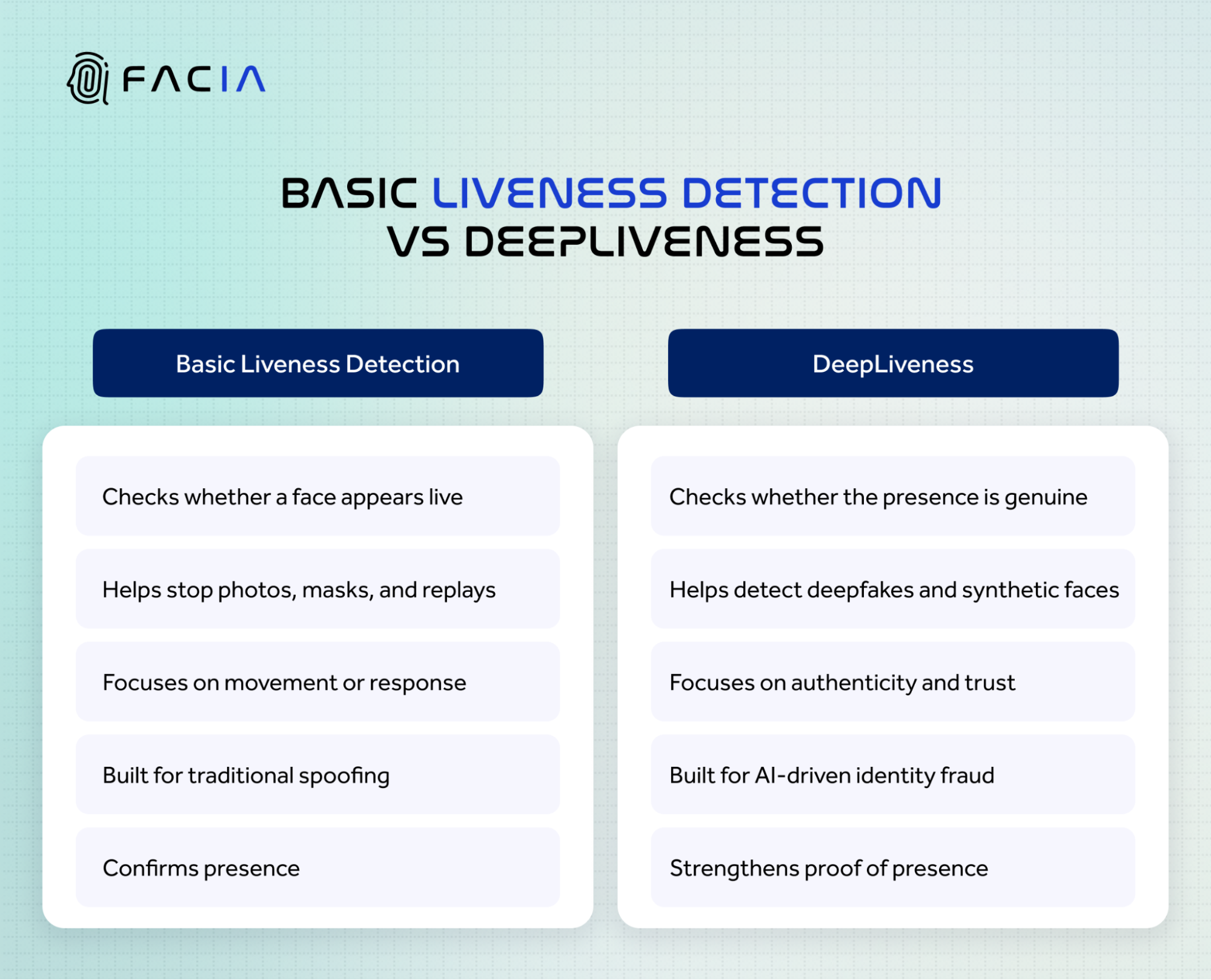
Even simple Liveness detection is not in vain. It can prevent the older spoofing techniques. However, in the deepfake era, companies must have a system that is capable of determining whether the visual input itself can be trusted. That is the task of DeepLiveness.
Where DeepLiveness Creates the Most Impact
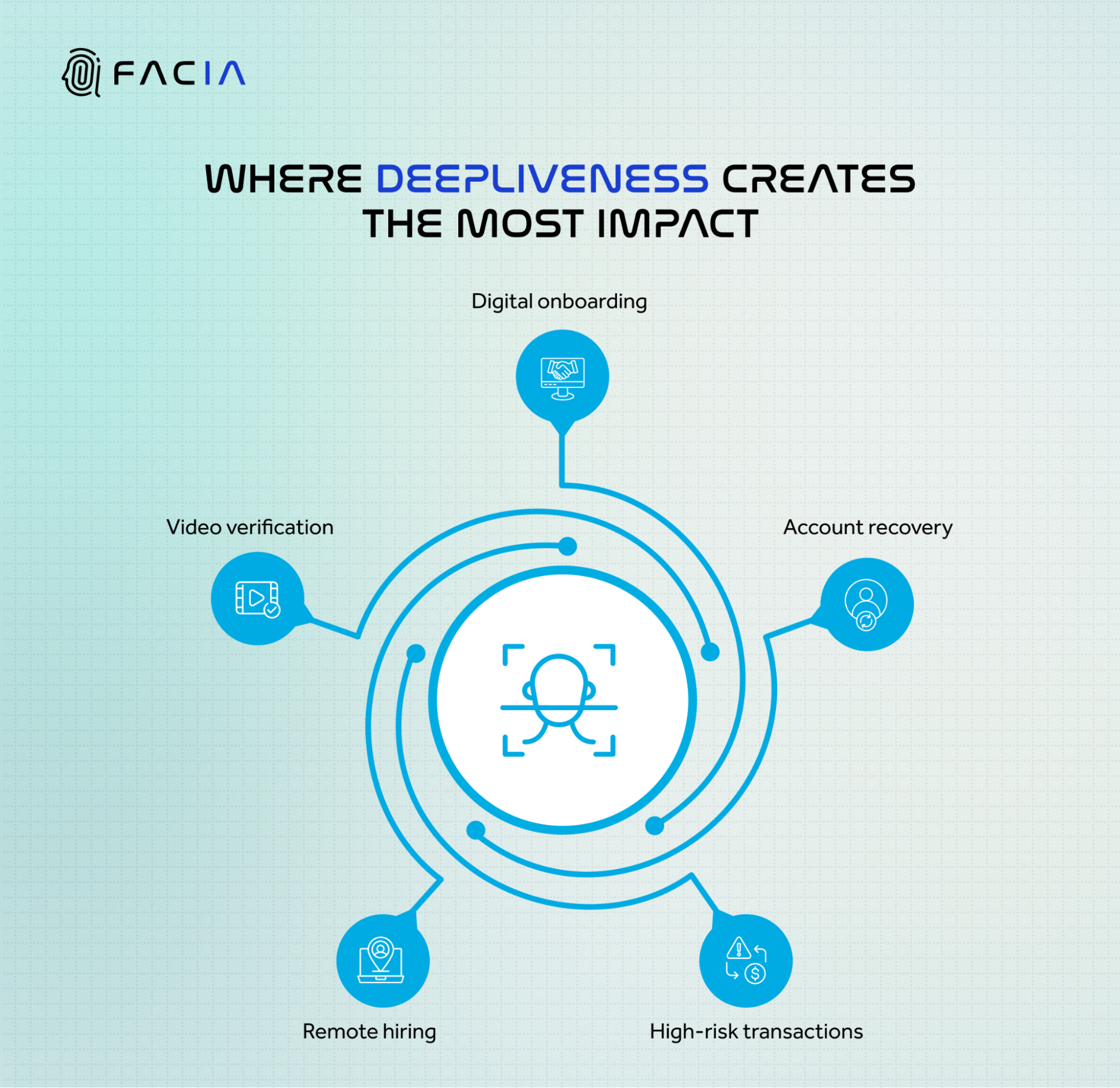
DeepLiveness is especially valuable at moments where trust matters most. These are the points where a fake identity, synthetic face, or manipulated video feed can lead to financial, operational, or reputational harm. By strengthening verification at these stages, businesses can reduce risk before it spreads across the user journey.
Digital Onboarding
The first significant risk area is digital onboarding. To open accounts, fraudsters may rely on stolen documents, fake selfies, fake accounts, or even AI-generated faces. DeepLiveness helps identify suspicious identities and block them at the entrance, preventing fake users from entering the platform.
-
Account Recovery
Account recovery is a risky time, since the user is requesting to regain control. DeepLiveness is used to verify that the individual requesting access is truly there and helps avoid returning an account to the wrong person.
-
High Risk Transactions
Withdrawals, wallet activity, high-value transfers, and updates to payment details require enhanced verification. DeepLiveness can be used as a step-up verification prior to sensitive actions.
-
Remote Hiring
Remote hiring may be susceptible to deceptive profiles, identity theft, and doctored video. DeepLiveness is used to verify that a candidate, contractor, or remote worker is physically present.
-
Video Verification
Video-based approvals, support calls, and remote checks are more and more exposed to synthetic media risks. DeepLiveness can be used to identify deepfake overlays and suspicious video behavior when using live sessions.
Business Benefits of DeepLiveness
-
Early Deepfake Detection
Prevention of fraud is best done before it turns into an account, transaction, or support case. DeepLiveness assists in identifying risks of synthetic identity at an early stage of the path.
-
Stronger Proof of Presence
DeepLiveness provides enterprises with a better confirmation about the fact that a user can be seen, but is actually present. This is needed to control and highly-trust digital services.
-
Lower Fraud Without Added Friction
Security must not subject true users to some fumbling procedures. DeepLiveness is able to enhance verification without compromising the experience. No one desires onboarding to become a mini version of an escape room.
-
Safer High Risk Verification
Smart verification should be applied when the risk is high. DeepLiveness enhances more stringent checks when it comes to account recovery, payments, withdrawals and sensitive account changes.
-
Smarter Compliance Support
Compliance teams must be assured of the authenticity and presence of verified users. DeepLiveness facilitates the need by enhancing identity assurance in the process of verification.
-
Long Term Digital Trust
The establishment of digital trust is carried out throughout the entire user experience. DeepLiveness helps to ensure safer onboarding, authentication, and reverification by assisting in verifying genuine users at critical moments.
How Facia’s DeepLiveness Sets a New Standard for Digital Trust
As AI-driven identity fraud becomes more advanced, traditional liveness detection is no longer enough. Businesses now need verification systems that go beyond checking whether a face is present and help confirm whether that face is real, live, and trustworthy through deepfake-aware proof of presence.
With Facia’s recent upgrade from standard liveness detection to DeepLiveness detection, the platform has achieved stronger biometric verification accuracy with a False Acceptance Rate (FAR) of 0.06% and a False Rejection Rate (FRR) of 0.03%. These improved liveness detection rates help businesses reduce identity fraud, detect deepfake attacks more effectively, minimize false rejections for genuine users, and deliver a faster, low-friction identity verification experience.
For digital onboarding, account recovery, high-risk transactions, remote hiring, and video verification, Facia’s DeepLiveness empowers organizations to build secure, scalable, and future-ready identity verification journeys while responding to emerging deepfake threats with greater confidence and control.
Learn how Facia’s DeepLiveness can integrate into your identity verification flow to detect deepfakes, reduce fraud, and strengthen digital trust. Book a demo today.