Beyond Accuracy: FAR, FRR, and the Business Cost of Authentication Errors
Author: admin | 22 Jun 2026In This Post
A customer completes every onboarding step correctly. Their identity document passes verification. Their selfie is genuine. Yet they are denied access.
They leave. The scam team doesn’t get a call. The support team is not notified of a ticket. The company has just lost a customer.
This is the unnoticed expense caused by biometric false matches.
In an era when organizations are increasingly turning to biometric verification to protect accounts, thwart fraud, and simplify the onboarding process, each authentication decision carries a business impact. It can be a security risk if the wrong user gets approval for this system. If the right user is denied access to a system, it can lead to friction, abandonment, and loss of revenue.
The challenge is becoming more urgent. According to the UK Government, an estimated 8 million deepfakes were shared globally in 2025, up from 500,000 in 2023, highlighting the rapid rise of AI-generated impersonation and identity fraud. As identity threats evolve, organizations need a more meaningful way to evaluate authentication performance than accuracy percentages alone.
It’s here that the biometric authentication error rates become apparent. False Acceptance Rate (FAR) and False Rejection Rate (FRR) are used to assess the accuracy of biometric systems, measure biometric verification performance, and gain insight into the real business consequences of authentication failures.
Why Biometric System Accuracy Doesn’t Tell the Whole Story
One of the initial parameters organizations consider when assessing biometric systems is accuracy. While accuracy is important, it doesn’t always tell the whole story.
A system can achieve an impressive accuracy score and still generate thousands of authentication errors when deployed across millions of verification attempts. The problem isn’t how many times a system is correct; it’s how it handles falling short.
A false acceptance can lead to fraud, and a false rejection can result in a legitimate customer being denied service. Both are authentication failures in biometrics, but they have very different implications.
That’s why organizations are increasingly focusing on biometric authentication error rates rather than eye-catching accuracy statistics. The National Institute of Standards and Technology evaluates Biometric technologies using false matches and false non-matches rather than other metrics because they better reflect actual performance in real-world environments.
Understanding Biometric Authentication Error Rates: FAR and FRR
Each biometric authentication failure is one of two types.
What Is False Acceptance Rate (FAR)?
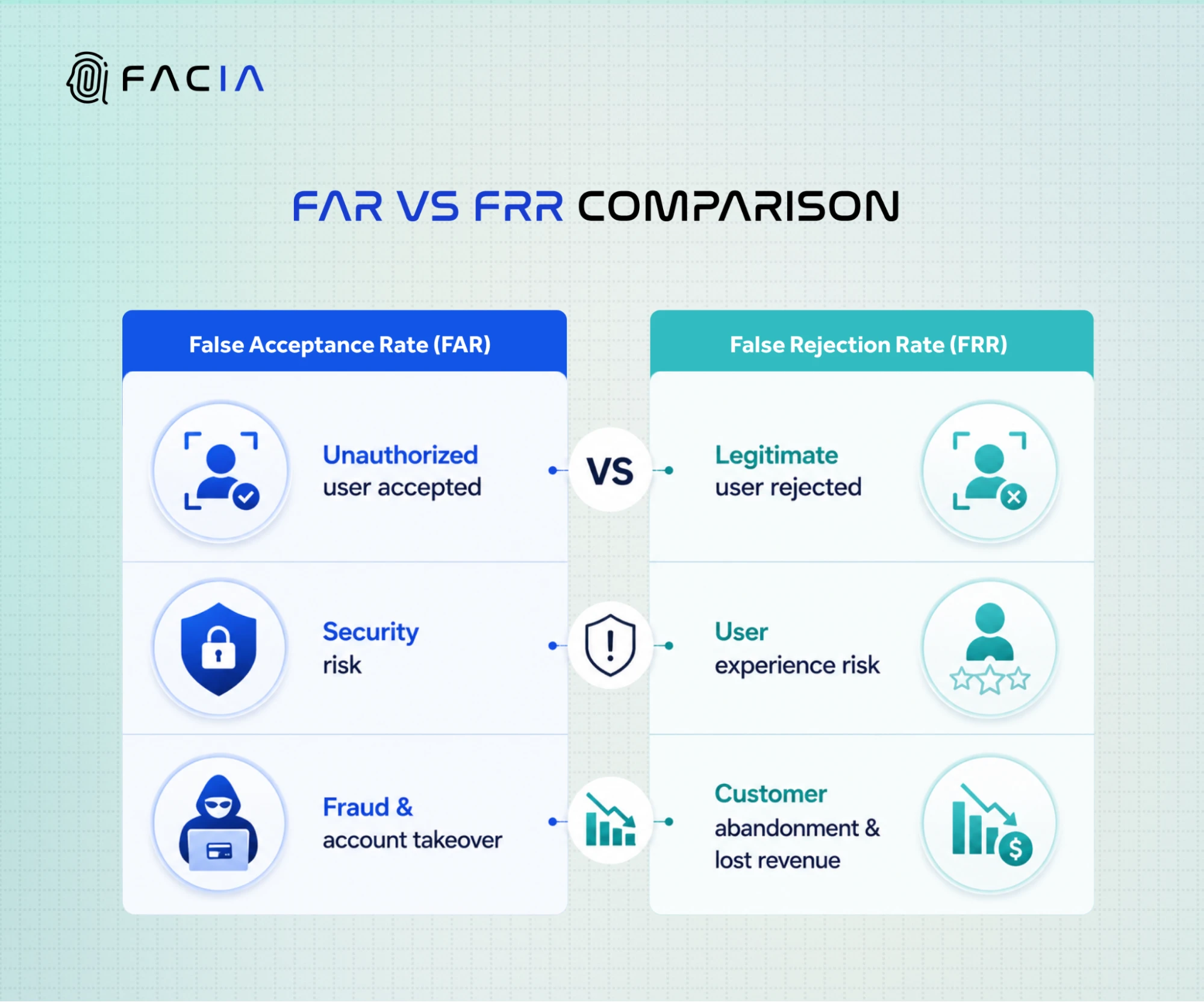
The False Acceptance Rate (FAR) of a biometric system is the rate at which it incorrectly accepts an unauthorized user.
An elevated FAR can increase the risk of Fraud, Account takeover, Unauthorized transactions, and Data exposure.
What Is False Rejection Rate (FRR)?
A False Rejection Rate (FRR) is the failure rate at which a biometric system rejects a legitimate user.
A high FRR can result in failed onboarding, Customer frustration, Increased support costs, and lost revenue opportunities.
FAR and FRR are more significant for biometric verification performance than an overall accuracy percentage.
To understand why FAR and FRR matter, it helps to compare the types of failure they represent.
Calculating FAR and FRR in Biometric Authentication
To compute the FAR and FRR of the biometric authentication system.
False Acceptance Rate (FAR) Formula
FAR = (Number of False Acceptances ÷ Total Unauthorized Authentication Attempts) × 100
The calculation of FAR and FRR is fairly simple, but the meaning of these numbers in practice is all-important.
For example:
- Unauthorized authentication attempts = 10,000
- False acceptances = 10
FAR = (10 ÷ 10,000) × 100 = 0.1%
This means 0.1% of unauthorized users were incorrectly accepted by the system.
False Rejection Rate (FRR) Formula
FRR = (Number of False Rejections ÷ Total Legitimate Authentication Attempts) × 100
This metric measures how often a biometric system incorrectly rejects legitimate users.
For example:
- Legitimate authentication attempts = 100,000
- False rejections = 1,000
FRR = (1,000 ÷ 100,000) × 100 = 1%
This means 1% of genuine users were incorrectly denied access.
Why Small Error Rates Matter at Scale
The percentages might seem small; however, they can make a huge difference as the number of verifications increases.
Let’s take an organization that is doing 10,000,000 biometric verifications per year.
- This 0.05% FAR could result in thousands of users being wrongfully accepted as authorized.
- With an FRR of 1%, it may be possible for hundreds of thousands, or more, legitimate users to be unable to access because they are not who they say they are.
That is why more businesses are considering biometric authentication error rates as a business metric instead of just a technical measure.
The Hidden Cost of Every Identity Verification Error
An incorrect identity verification will come with a price.
The false acceptance can lead to losses from fraud, recovery costs, compliance investigations, and damage to reputation.
A false rejection may result in customer abandonment, manual review costs, support workloads, and lost conversions.
The best biometric systems do not necessarily eliminate errors completely. These are the systems that reduce errors, which have the biggest impact on the business.
False Acceptance Rate (FAR): The Business Cost of Trusting the Wrong User
A false acceptance is more than a failed authentication decision. It is a security event.
A seemingly small FAR can become significant at scale. For organizations processing millions of verifications annually, even a fraction of a percentage point can translate into thousands of unauthorized access attempts.
-
Fraud Exposure
Every unauthorized user who successfully passes verification creates an opportunity for fraud.
-
Compliance and Regulatory Risk
Organizations operating in regulated industries are expected to maintain effective identity verification controls.
-
Brand Reputation
Customers trust biometric systems to protect their identities and accounts.
False Rejection Rate (FRR): The Business Cost of Rejecting the Right User
Every false rejection affects a legitimate user who should have been granted access. Unlike fraud-related errors, these failures are experienced directly by customers and often occur at critical moments in the user journey.
When FAR is, for the most part, a security issue, FRR is frequently a growth issue.
-
Customer Abandonment
Many legitimate users will give up if they are continually having to verify their identity. It’s easy to turn a simple authentication problem into a customer gone.
-
Rising Operational Costs
This causes false rejections, which can lead to support tickets, manual review, and more verification. These activities increase operational costs and negatively affect efficiency over time.
-
Lost Revenue Opportunities
Each verified user who is not is a potential revenue opportunity that could never be realized.
Which Error Is More Expensive for Your Business?
There is no universal answer.
A high FAR could be more problematic for banks, healthcare providers, and government entities, as their access can have significant implications.
For e-commerce platforms, subscription businesses, and consumer applications, a high FRR can have a more significant impact by driving customer churn and revenue loss.
The best approach is to determine in your own context which error type is causing the greatest expense and optimize for that type.
Finding the Right Balance Between FAR and FRR
Balancing security and user experience is one of the greatest challenges in biometric authentication.
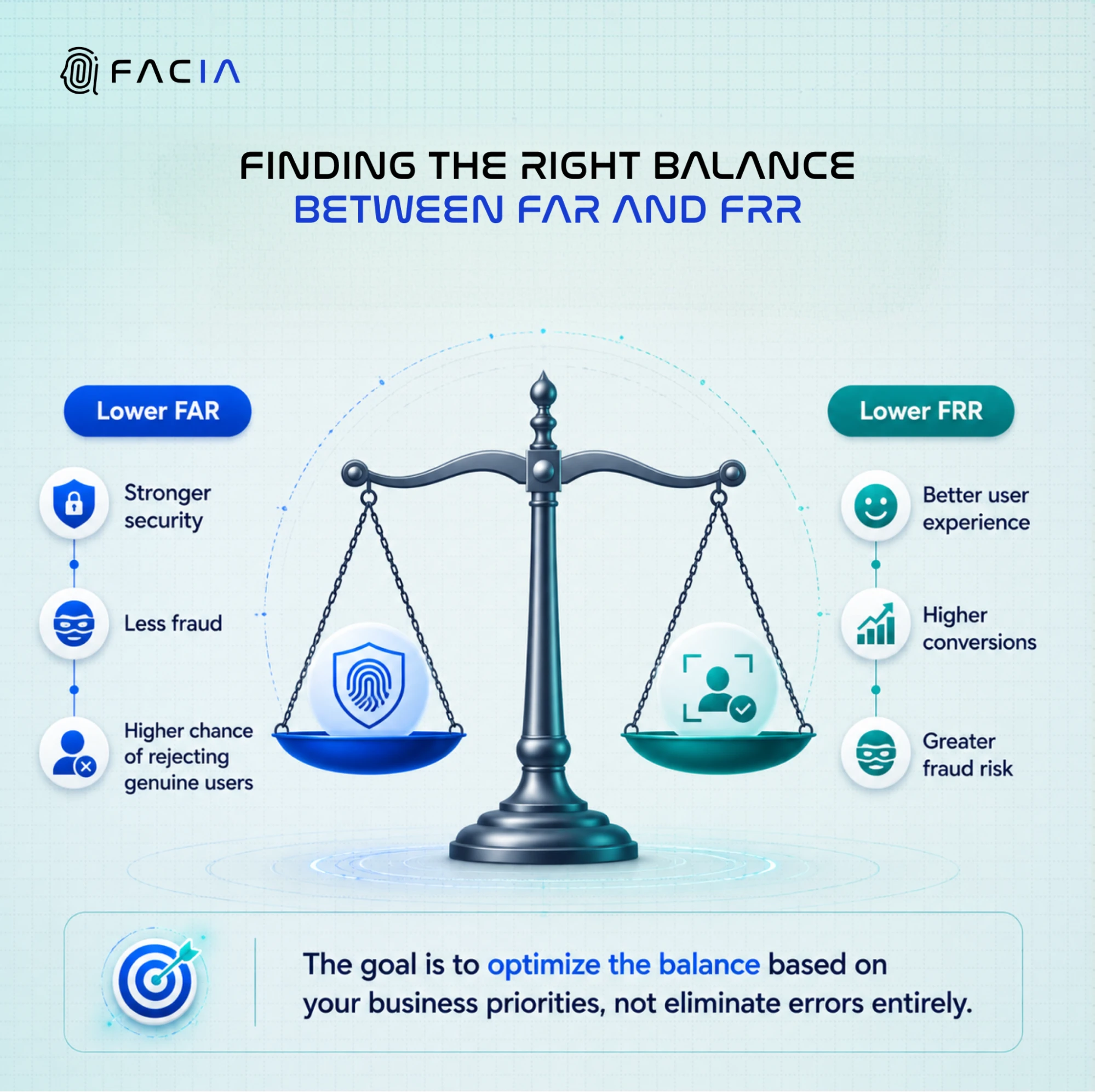
The lower the FAR, the more stringent the matching parameters must be, and the more difficult it becomes for an impostor to gain access to the system. Stricter thresholds may also result in higher FRR, though, because verifying a legitimate user may become harder.
Minimizing FRR can improve usability but also lead to more false acceptances.
This is why biometric authentication is not simply about lowering one error rate as much as possible. Every adjustment creates a tradeoff between stronger fraud prevention and a smoother customer experience.
You can’t set it just right.
The aim is not to make no mistakes at all. The idea is to reduce the number of errors that cause the most impact on the business.
Measuring Biometric Verification Performance Beyond FAR and FRR
Although the FAR and FRR are standard metrics, they should not be used alone.
What comes to mind for a wide range of organizations are more comprehensive measures of biometric verification performance, such as:
- Equal Error Rate (EER)
- Liveness detection effectiveness
- Deepfake resistance
- Verification completion rates
- Average verification time
- Manual review rates
Equal Error Rate (EER) is one of these parameters that is of special importance. The point at which FAR = FRR is called the EER. The lower the EER, the better the overall biometric performance.
How Facia Helps Reduce Authentication Errors
Biometric authentication impacts far more than security. A high False Acceptance Rate (FAR) can increase exposure to fraud and account takeovers, while a high False Rejection Rate (FRR) can create friction, drive customer abandonment, and increase operational costs. As identity threats continue to evolve, organizations need solutions that can accurately verify genuine users without compromising the user experience.
Facia helps address these challenges through AI-powered facial recognition, advanced liveness detection, deepfake resistance, and real-time identity verification. By reducing fraud risk and minimizing authentication failures, Facia enables businesses to improve biometric verification performance while maintaining a seamless user experience.
Explore how Facia can help your organization deliver secure, accurate, and frictionless identity verification at scale.