Ghost Employees and Payroll Fraud: How Facial Biometrics Strengthen Payroll Integrity
Author: admin | 22 Jun 2026In This Post
Payroll fraud rarely begins with a dramatic breach or obvious misconduct. More often, it hides within routine processes, approved payments, and employee records that appear legitimate on paper. By the time organizations identify the problem, financial losses may have been accumulating for months.
In fact, ACFE Report to the Nations 2026 estimates that businesses lose an estimated 5% of their annual revenue to fraud. There are many types of fraud, and one of the most challenging is ghost employee fraud.
While payroll errors may stem from administrative mistakes, ghost employee fraud can result from a weakness in the employee verification process. Unfiled or bogus employee records may go undetected, allowing payments to be made without permission for long periods.
As organizations strengthen payroll governance and compliance efforts, many are discovering that the issue is not simply payroll management. It is employee identity verification.
What Is Ghost Employee Payroll Fraud?
A ghost employee is an individual listed on a company’s payroll without the intent to be an active employee.
There are multiple ways of ghost employee fraud. A fake employee can be added to the payroll system, a terminated employee can be left in the payroll system, or multiple records for the same employee can be created to receive unauthorized pay. It’s sometimes just a matter of mistaken payroll records that have been altered by individuals within the organization with access to the HR or payroll functions.
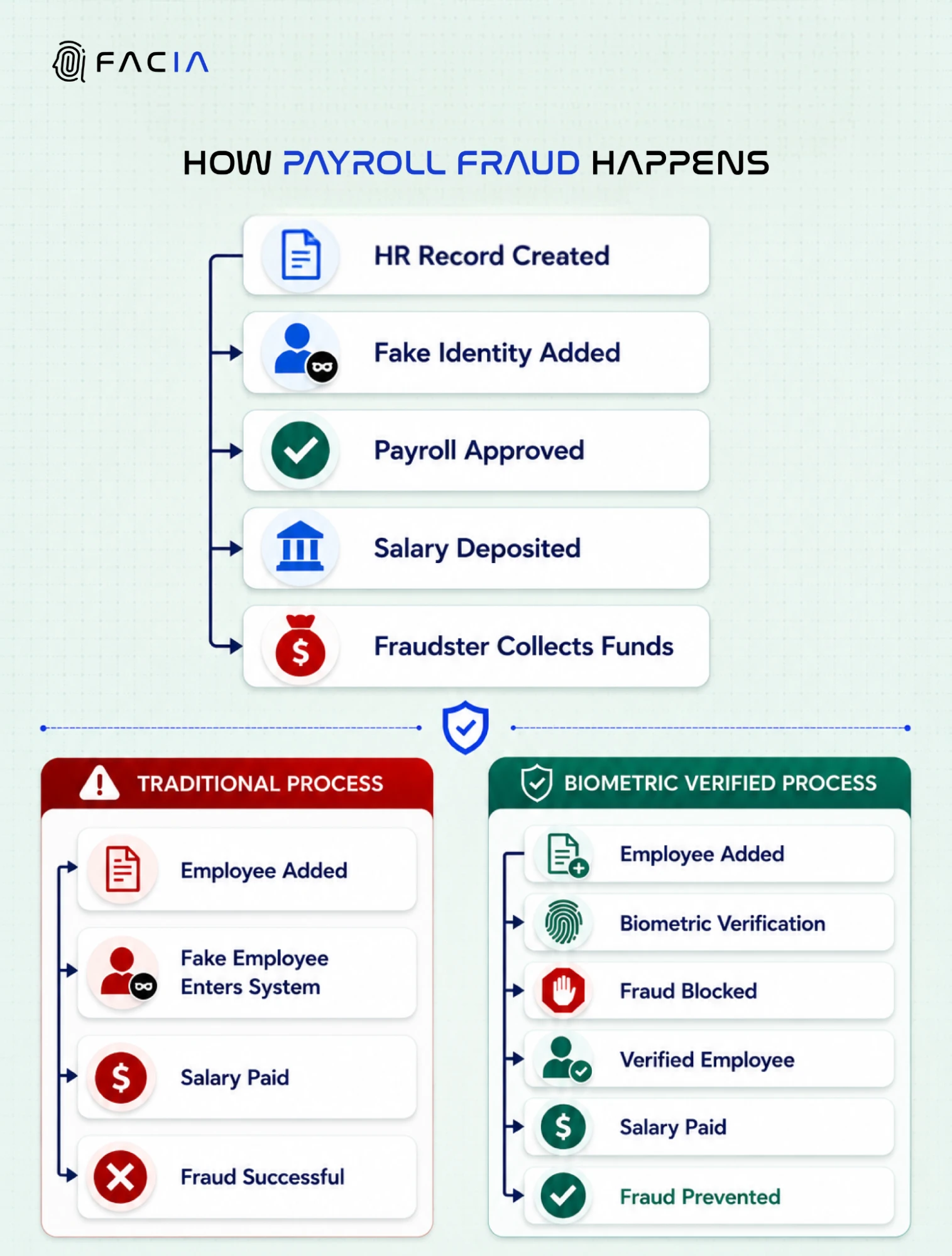
A key challenge in ghost employee fraud is that fraudulent records may appear legitimate under the current process. If the false employee enters the payroll processes, payroll and benefits can be issued without immediate concerns.
Fraudulent records can get caught in the everyday grind of business for organizations that rely heavily on manual reviews, disjointed workforce systems, and periodic audits.
To understand how difficult ghost employee fraud is to prevent, think about how false records can enter payroll systems, and how biometric verification can prevent it.
The Hidden Cost of Ghost Employees
The most obvious impact of ghost employee schemes is financial losses. Every such unearned.
Labor costs refer to the payment of salaries, which do not create any productive value for the organization.
But the cost doesn’t stem solely from payroll.
Ghost employees can inflate employee reports, hinder compliance, and impact trust in operational data. Companies might not be able to determine how many employees are working, their productivity, or labor costs if staff records are incorrect.
The severity of the situation is revealed in recent government investigations. In 2025, a government Aadhaar verification process discovered that the government had outsourced and contracted workers in Telangana, with nearly 7,000 ghost workers, a paper trail of fake identities, payroll records, and salary payments not known to the government.
Ghana also launched its inquiry in 2025 after discovering more than 81,000 ghost names in the payroll of the National Service Authority. The difference was detected during a workforce check to ensure that the person receiving the benefits is legitimate and that the records are not fabricated.
In all of these situations, it’s just a simple rule: Payroll is only as accurate as its employees. All these cases illustrate a straightforward reality: the more accurate the staff is, the more accurate the payroll will be. When the organization isn’t certain of its payroll recipients’ names, the likelihood of fraud increases significantly.
Why Identity Verification Matters in Payroll Management
Most ghost worker scams aren’t related to payroll software; they stem from issues with identity verification. The idea of the payroll system is to make the payment process more efficient, but it must be based on data from HR records, attendance trackers, and administrative procedures. If these records are incorrect, payroll systems can process payments associated with an invalid or fraudulent identity.
To manage this risk, many entities conduct routine audits, manual headcounts, and reviews. But these measures are reactive rather than preventive. This isn’t a problem confined to any one organization. The fragmented personnel systems, manual data entry, and weak workforce verification controls remain a blind spot for ghost workers in 2025, as highlighted at the Parliamentary Committee on Public Service and Administration’s meeting.
The committee highlighted the need for digital verification of payroll to improve payroll integrity and accountability.
Can every employee receiving compensation be verified as a real, active member of the workforce?
The more difficult the question to answer with confidence, the more difficult it is without reliable identity verification.
Common Warning Signs of Ghost Employee Fraud
Although ghost employee fraud can be difficult to detect, it often leaves indicators within workforce and payroll data.
-
Inconsistent Attendance Records
A lack of attendance records may indicate problems with workforce verification.
-
Duplicate Employee Profiles
If there are several employee records with the same personal information, identification, or contact details, they are likely the result of an attempt to make fraudulent payroll entries.
-
Shared Banking Information
Having multiple individuals linked to the same bank account or payment address is a major red flag that should be investigated.
-
Active Payroll Records After Termination
Older employees who continue to be involved in payroll systems can lead to payroll leakage and potentially to unauthorized salary payments.
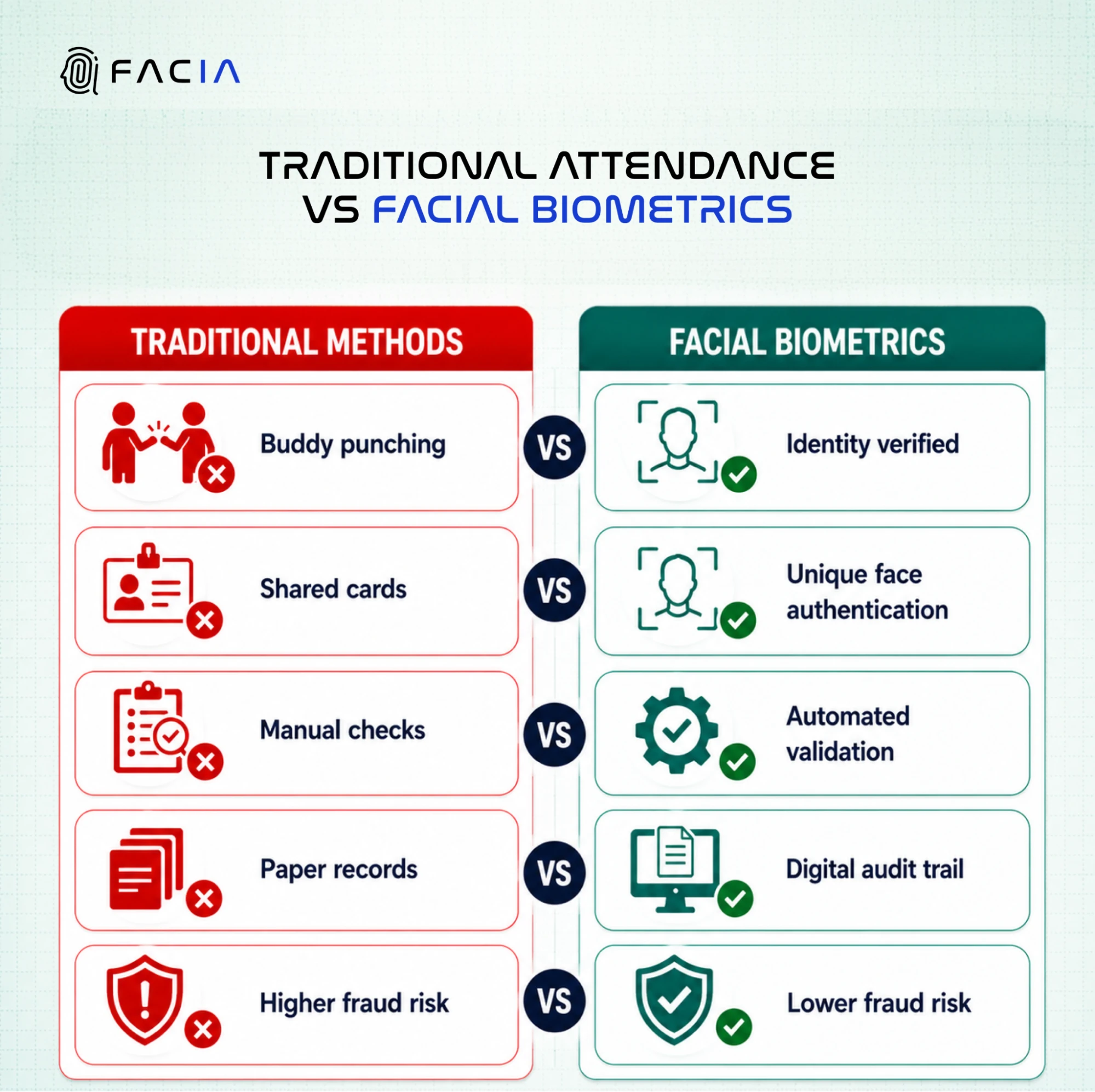
Many companies continue to use attendance and work records that weren’t created with the intent to verify an employee’s identity. The following illustration illustrates the added value of facial biometrics for payroll integrity.
How Facial Biometrics Stops Ghost Employee Fraud
By attempting to prevent payroll fraud at the source by verifying employee identity, not just workforce records, facial biometrics is a solution to the problem.
Facial verification verifies that a real person is associated with the appropriate employee profile. This provides more robust payroll integrity by linking employee records to verified identities rather than administrative guesswork.
AI-powered facial biometrics can be used to verify employees’ identities across the employee lifecycle on modern workforce verification platforms like Facia.
-
Identity Verification Begins at Onboarding
Typically occurs when a facial identity is verified during onboarding and added to a workforce management system.
-
Continuous Verification Reduces Fraud Risk
Identity verification should not end after onboarding. As employees interact with attendance systems, workforce management platforms, and payroll-related processes, facial verification can help confirm that the individual associated with a workforce record is the same person originally enrolled.
-
Identity Verification as a Preventive Control
Traditional payroll controls are primarily designed to detect irregularities after they occur. Facial biometrics introduces a preventive layer by helping organizations validate employee existence and participation before payroll records are processed.
The Role of Biometric Attendance Systems in Payroll Fraud Detection
Biometric attendance systems play an important role in supporting payroll integrity.
By linking attendance records directly to verified employee identities, organizations gain greater visibility into workforce activity while reducing opportunities for manipulation.
According to an analysis published by Thomson Reuters, payroll fraud remains one of the most common occupational fraud schemes because fraudulent records can appear legitimate within routine administrative processes, making them difficult to identify solely through manual reviews.
Biometric verification helps organizations identify discrepancies between attendance and payroll records, detect inactive employees receiving compensation, and uncover duplicate workforce profiles more effectively.
This is particularly valuable for organizations managing large, distributed, or multi-site workforces where manual verification is difficult to manage consistently.
Strengthening Payroll Fraud Prevention with Verified Identity
There is no single solution that can eliminate payroll fraud entirely. Effective prevention requires a combination of governance, oversight, technology, and workforce verification.
Regular payroll audits, integrated workforce systems, exception monitoring, and employee identity verification all play important roles in reducing risk. However, identity verification offers a unique advantage by addressing the root cause of many ghost employee schemes: the inability to confidently verify that every payroll record belongs to a legitimate employee.
Facial biometrics strengthens these efforts by helping organizations continuously validate workforce identities rather than relying solely on periodic reviews.
Why Facia Helps Organizations Prevent Ghost Employee Fraud
Ghost employee fraud is a matter of identity. The more organizations that cannot be sure that all payroll records belong to a valid, working employee, the higher the risk of payroll fraud.
Facia’s platform is a solution designed to help organizations overcome this challenge by creating AI-powered facial biometrics to establish trusted employee identities. Integrating identity verification, attendance logs, and workforce activity can improve payroll integrity and reduce the risk of fraudulent or inactive records being retained in payroll systems.
When paired with payroll audits, workforce monitoring, and integrated HR technology, facial biometric verification provides additional assurance of the accuracy of employee records, with actual people doing actual work.
Looking for an enhanced payroll fraud prevention and workforce verification solution? Discover how to use Facia’s facial biometric products to create trusted employee identities, eliminate payroll leakage, and create more secure working practices.