How Facial Recognition in iGaming Strengthens Self-Exclusion
Author: admin | 18 Aug 2026In This Post
Online gambling has made betting and gaming more accessible than ever. Players can create accounts, deposit funds, and access gambling products from almost anywhere.
For operators, this accessibility creates an important responsibility: ensuring that the person behind an account is correctly identified and that restrictions designed to protect vulnerable players cannot easily be bypassed.
This is where facial recognition in iGaming can support responsible gambling.
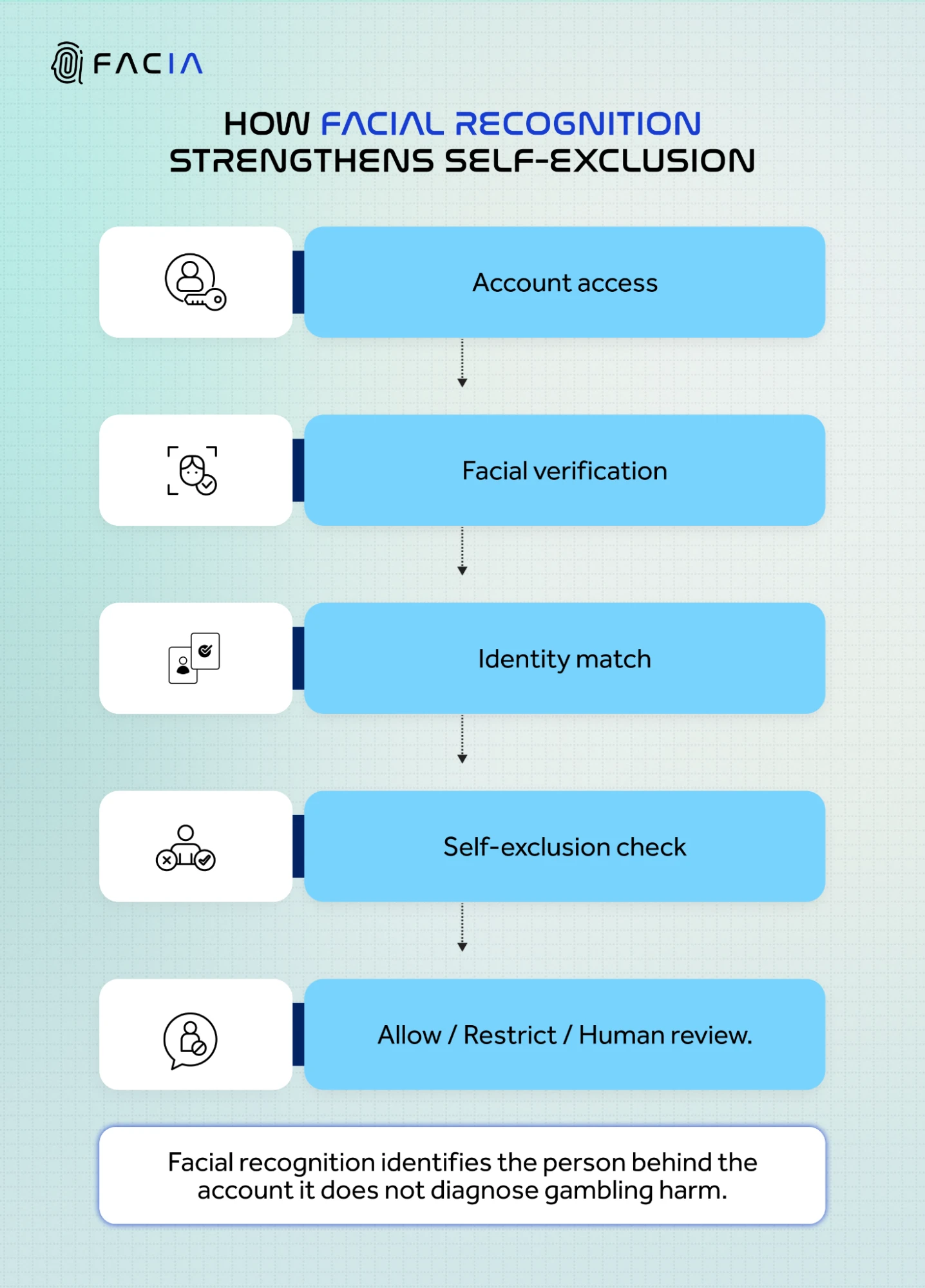
Facial biometrics can strengthen identity verification, detect duplicate identities, support account re-verification, and help operators apply self-exclusion controls to the correct individual. However, facial recognition does not determine whether someone has a gambling problem. Its role is to identify who is behind an account, enabling responsible gambling systems to apply appropriate controls.
Why Stronger Responsible Gambling Controls Matter
Given the size of online gambling, it’s more imperative than ever that players are protected well.
The UK Gambling Commission’s Gambling Survey for Great Britain 2025 (published in July 2026) found that 59% of adults in Great Britain had gambled in the last year. Approximately 38% had bet online in the past four weeks. However, the figure drops to 16% when those who participated only in lottery drawings are excluded. The survey also revealed that 2.4% of adults 20,775 people had a Problem Gambling Severity Index (PGSI) score of 8 or higher, and 3.5% scored 3 to 7.
These statistics highlight the importance of responsible gambling resources in an increasingly digital world.
What Is Self-Exclusion in Online Gambling?
Self-exclusion is a process whereby people decide to exclude themselves for a period of time from gambling with a specific gambling establishment.
Since the UK Gambling Commission has made regulations that ensure that gambling operators have systems and processes in place to prevent self-excluded users from gambling again, this is especially the case when operating remotely. Operators are also required to keep sufficient records and to take action if a person on the excluded list is identified.
The difficulty is that an online account isn’t an individual.
The user can update any account details such as email address, phone number, payment method or other account information. Gambling controls that are effective on their own must be able to link an account with the actual person behind it.
How Facial Recognition Works in iGaming
Facial recognition is a biometric method used to verify or identify individuals based on their facial characteristics.
In the iGaming industry, it can at least help with two scenarios:
- The 1:1 facial verification matches a player’s facial image against a trusted face template, typically taken from a verified identity document.
- 1:N facial matching involves comparing an enrolled face with a number of stored faces. It can assist in identifying if the same individual is linked to yet another account when legally permitted and properly set up.
- Liveness detection has the potential to add another layer of security by confirming that the biometric data is not from a fake person, such as a masked, replayed video, photo, or manipulated image.
These can be used in conjunction with other technologies to facilitate a broader identity-checking process, enabling operators to implement self-exclusion controls for the relevant person.
How Self-Exclusion Facial Recognition Can Strengthen Enforcement
Self-exclusion facial recognition is not meant to determine who is an addicted gambler based on their appearance. Gambling-related harm cannot be diagnosed using facial biometrics.
Rather, it can reinforce an operator’s identity controls that form the backbone of his/her responsible gambling program.
-
Stronger Identity Verification
If the operator cannot be certain that the player is a player, implementation is harder. Facial verification can complement other document verification and KYC checks to determine whether the person presenting an identity is its legitimate owner.
-
Detecting Duplicate Accounts
A user that has self-excluded may try to re-enter under another name and/or contact information. Besides email addresses or “username”, facial matching is an additional identity signal. These can be used to identify potentially linked accounts by combining biometrics with names, dates of birth, devices, documents, payment information, and account history. The goal is not to make decisions with a single biometric outcome, but rather to improve identity resolution.
-
Supporting Re-Verification
The threat of identity risk doesn’t stop after onboarding. Unusual account changes, account takeover, or suspicious activity might necessitate additional verification. Biometric re-verification can help confirm whether the person using the account is the verified account holder.
What Does Real-World Research Show?
In 2024, a study on gambling self-exclusion looked at the use of facial recognition in South Australian gaming centers to identify barred and self-excluded gamblers.
Over 230 sites needed to be fitted with validated facial recognition equipment. In the first six months, authorities said they’ve captured more than 50 million facial scans and over 1,700 possible identifications of banned individuals. A year later, the researchers claimed to have found some 367 million scans and over 9,000 matches.
The study didn’t use online iGaming but shows how biometric identity matching can assist with self-exclusion at scale.
The researchers also noted false positives and the importance of human oversight and staff engagement. This is a key takeaway for those operating online: facial recognition is not a replacement for human judgment but should complement responsible gambling practices.
Self-Exclusion Is Only One Responsible Gambling Tool
The research also highlights the need for self-exclusion not to be used as a standalone approach. The study, which was peer-reviewed and included 3,203 British online casino players, revealed that 75.3% of those who self-excluded in the short term returned after their self-exclusion period ended, whereas only 0.9% of long-term self-excluders returned during the study.
Players are not exempt from their restrictions. This demonstrates that the customer journey should be taken into account when thinking about responsible gambling before, during, and after the exclusion process.
Other responsible gambling tools can include:
- Deposit and spending limits
- Cooling-off periods
- Behavioral monitoring
- Customer interventions
- Marketing restrictions
- For verification, we will ask for all ages and require identification.
- Access to support services.
Facial recognition works best if it fits into this context.
Deepfakes Create a New Identity Challenge
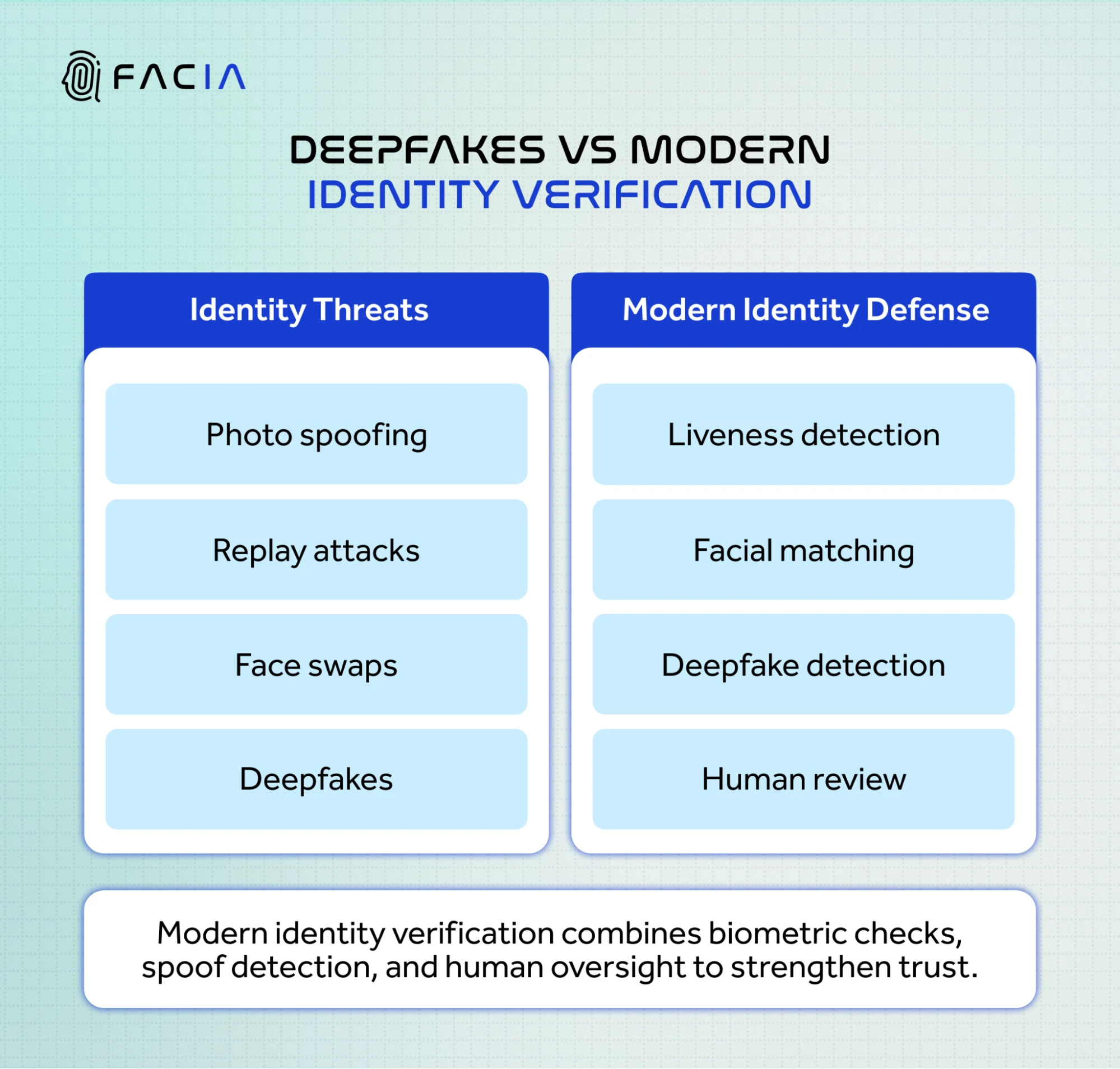
The use of Generative AI in remote identity verification has made the process more complicated. The UK Gambling Commission’s 2026 risk assessment revealed increasingly sophisticated methods to circumvent KYC checks, such as fake documents, deepfake videos, and AI-driven face swapping.
With this in mind, only comparing two faces might no longer be sufficient. These technologies are becoming increasingly important for iGaming compliance, fraud prevention, and self-exclusion, as they can help determine whether biometric data is genuine or altered. Liveness detection and deepfake-aware verification can also be used to determine if the biometric input or data has been real or altered, making them increasingly relevant to fraud prevention and self-exclusion, as well as broader iGaming compliance.
These emerging attack methods highlight why modern identity verification needs to defend against more than traditional photo or document fraud.
Privacy and Accuracy Matter
Facial recognition also creates significant data-protection responsibilities. The UK’s Information Commissioner’s Office states that biometric information used to uniquely identify someone can constitute special-category biometric data.
The operator should therefore consider the following aspects of processing: lawful processing, transparency, security, retention, accuracy, data minimization, possible thresholds for matching, and the checking of any disputed or incorrect matches.
A false positive will prevent a real player from playing, and a false negative will let an excluded player play.
For this reason, the deployment of biometrics must be accurate, secure, proportional, and supervised by humans.
Strengthening Responsible Gambling With Facia
Self-exclusion is much more than simply blocking accounts as iGaming expands. Operators need to be aware of the people behind the accounts, even if their sign-up information is altered or if their tactics involve circumventing controls, such as through identity theft. When you can’t consistently have strong identity assurance, it becomes harder to enforce responsible gambling measures.
As iGaming grows, effective self-exclusion requires more than blocking accounts. Operators must recognize individuals behind the accounts, even if registration details change or tactics like identity fraud are used to bypass controls. Without strong identity assurance, enforcing responsible gambling measures consistently becomes more difficult.
Facia strengthens this identity layer with facial recognition and biometric verification designed for iGaming environments. Its Face matching can help operators identify potentially linked or duplicate accounts, while biometric re-verification helps confirm that returning users are the legitimate account holders.
Facia liveness detection and deepfake detection add another level of protection by helping distinguish genuine users from spoofing attempts and AI-generated or manipulated facial media.
By combining facial recognition in iGaming with strong self-exclusion policies, privacy safeguards, and human oversight, operators can make responsible gambling controls more reliable while supporting KYC and compliance requirements.
Discover how Facia can help strengthen self-exclusion, identity verification, and player protection across your iGaming platform. Book a demo today.