Age Verification vs. Age Estimation: What’s the Difference and Which Do You Need?
Author: admin | 19 Aug 2026In This Post
Asking someone to confirm they are over 18 takes seconds. Knowing whether that answer is accurate is much harder.
For businesses offering age-restricted products, content, or online services, the challenge is reaching the right level of confidence without creating unnecessary friction or collecting more information than necessary.
That is where age verification and Age Estimation come in. Both are approaches used within age assurance, but they answer different questions and can create very different user experiences.
The choice can affect compliance, privacy, fraud prevention, onboarding, and conversion. According to Ofcom’s 2026 age-assurance report, more than 69 million age checks were completed across a sample of 32 UK online services between July and December 2025.
So in this guide, we will explore how age verification and age estimation differ, how each works, and which is right for your business.
Age Verification vs. Age Estimation: What’s the Difference?
The clearest distinction is the question each method answers.
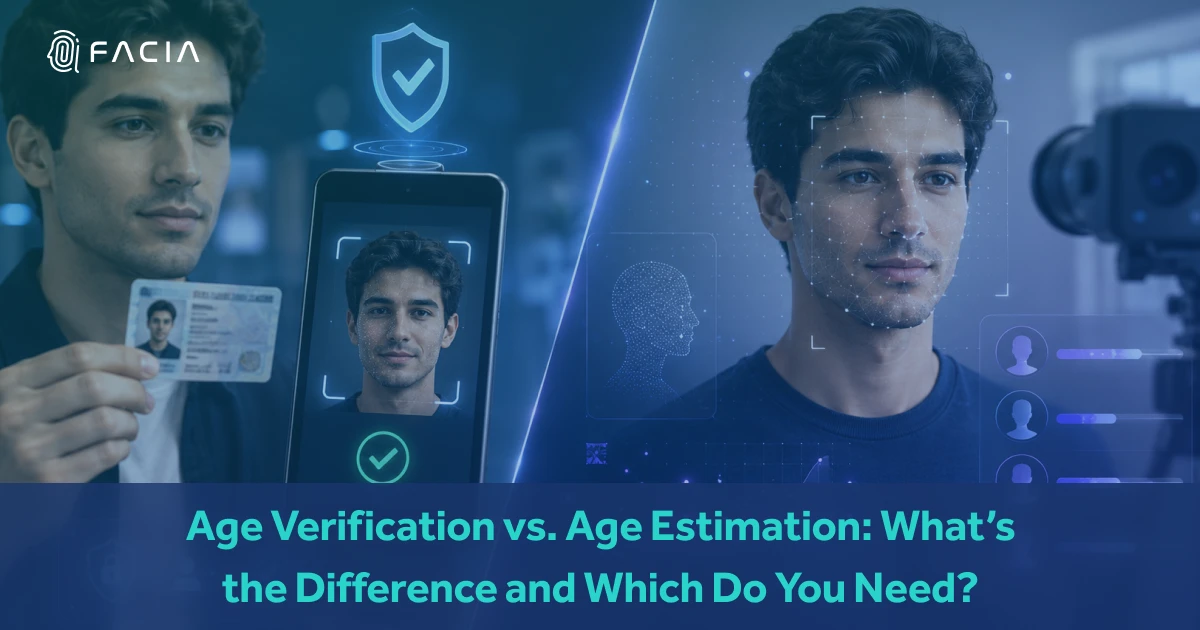
Age verification asks: Can we establish or confirm that this user meets a required age?
Age Estimation asks: How old is this person likely to be?
Age verification usually relies on evidence or an established age attribute. Depending on the use case, age verification methods can include identity documents, digital identity credentials, credit card checks, mobile-network checks, open banking, or verified account information.
Importantly, age verification does not always require collecting an exact date of birth. In many cases, a business only needs to determine whether a person is above or below a specific threshold, such as 18.
Age estimation technology works differently. Facial age estimation typically uses an AI model to analyze a live facial image and predict an age or age range. The result can then be compared with the business’s required threshold or challenge age.
Because the technology produces an estimate rather than a confirmed date of birth, the result is probabilistic. That does not automatically make age estimation less effective.
In practice, AI age verification can also combine estimation with controls such as liveness detection, anti-spoofing, and an additional verification route when more assurance is needed.
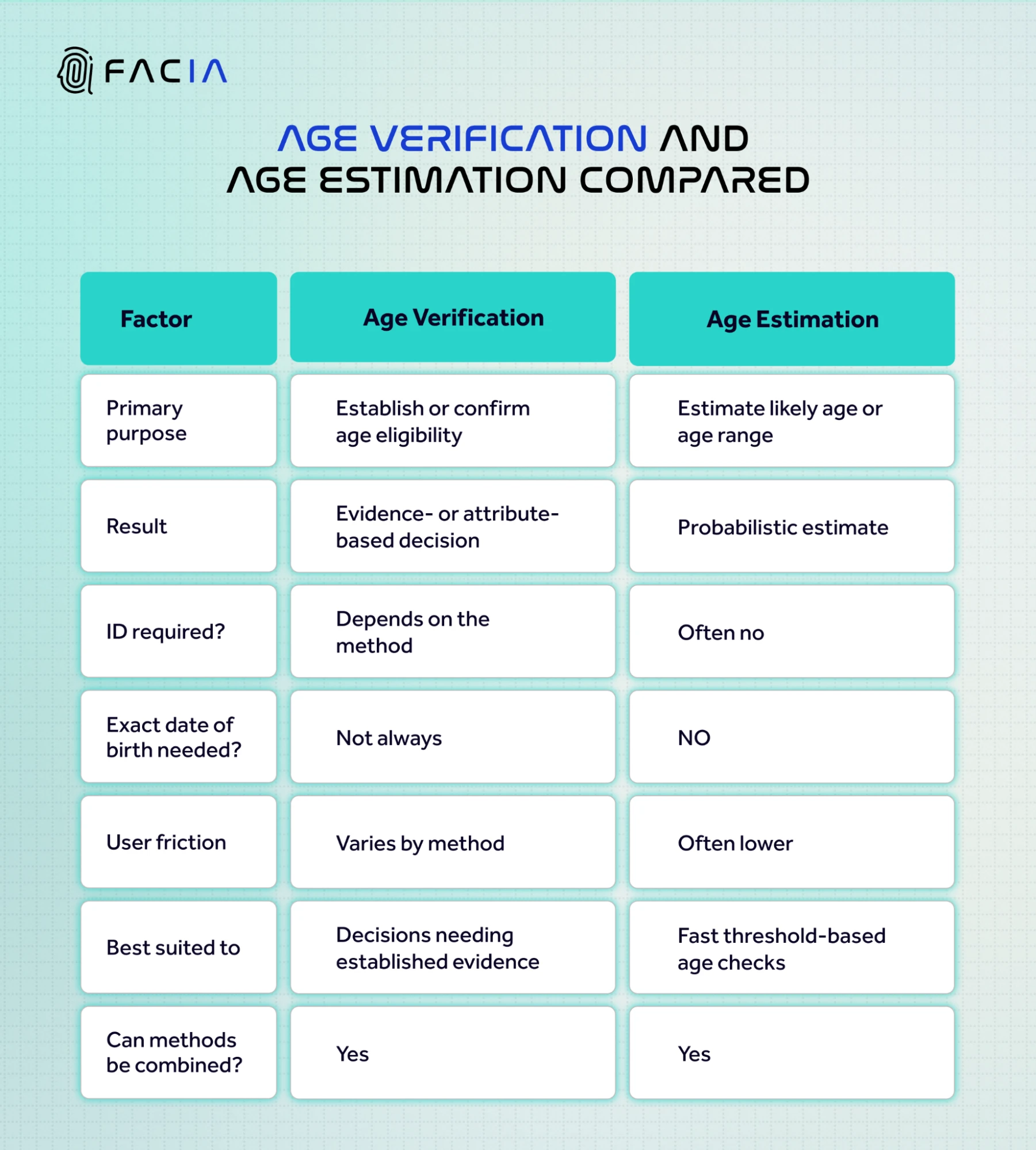
Age Verification and Age Estimation Compared
Neither method should be selected by label alone. Businesses should choose the approach that provides enough confidence for the specific decision while remaining proportionate to the level of risk.
When Is Age Verification Necessary?
Age verification is a helpful tool when a company wants to demonstrate compliance with an age requirement.
This may be the case if the wrong decision could have significant regulatory, business, or safety implications.
Different age verification techniques are appropriate for different situations. While a photo ID might be appropriate for one customer journey, a digital credential, credit card, network-based check, or any other trusted source may be more effective for another.
Verification may also be used as a backup if the age estimation result is unreliable. If an estimate is close to the required threshold, then an alternative method to establish eligibility might be offered to the customer without automatic rejection.
Its purpose is not to require the most rigorous verification for each user. It is to exercise a degree of assurance commensurate with the decision to be taken.
When Is Age Estimation a Better Option?
An age signal can be helpful for a business that requires it but would prefer not to identify the user and/or request a physical identity document.
This can save hassle in cases where it would not be practical to ask an individual for ID. Those above the selected threshold and estimated to be comfortably above it can be allowed to proceed, while those near the threshold can be directed to another age check.
This is why age estimation is particularly valuable when used in conjunction with other technologies that can be part of a risk-based customer journey.
Can Age Verification and Age Estimation Work Together?
The answer is a simple yes. Using multiple methods can provide a more flexible age-assurance experience.
The ICO describes this as a waterfall technique: one age-assurance method is used first, followed by another when additional assurance is required. Its guidance includes the example of combining age estimation with a secondary verification method.
A simple flow could look like this:
A business could start by estimating age from faces. If the result is clearly above the age the user has selected for the challenge and above the confidence level, then the user may proceed. If the customer is close to the edge, the customer can finish an alternate age check.
This helps companies to build trust without having to always ask for documentation from each customer.
How Accurate Is Age Estimation Technology?
The effectiveness of the accuracy should be measured in terms of the business decision rather than one marketing percentage.
Variations exist between algorithms, image quality, age groups, demographic groups and capture conditions.
The U.S. National Institute of Standards and Technology recently evaluated age estimation accuracy on a similar database of visa photographs, and determined that the best mean absolute error (MAE) improved from 4.3 years in 2014 to 3.1 years in 2024. The results are available from NIST’s Age Estimation Software Evaluation.
For businesses, however, the more useful question is:
If the business has an over-18 rule, they will need to monitor performance around 18. It should also take into account demographic performance, real-world imaging conditions, resistance to spoofing, and the consequences if the system does not reach a sufficiently high level of certainty.
An effective age-assurance program must have an alternative path for cases that are not clear.
How to Choose the Right Age-Assurance Method
When choosing age-assurance options, businesses need to consider accuracy, robustness, privacy, fairness, user-friction, and integration.
Technical solutions can be good, but they can cause issues when they collect information that is not needed, make it harder than it needs to be for legitimate uses, or do not offer an alternative when the first answer is inconclusive.
Fraud resistance is important, too. Printed photos, video replays, manipulated media, deepfakes, or impersonation attempts could all be a cause for concern for businesses, depending on the method.
The customer experience is important too. If the first process is not going to give the confidence the business needs, then the process should be proportionate and give an alternative process to the legitimate users of the business.
Ultimately, it depends on the establishment you wish to make, the degree of certainty you desire, and the impact of making a wrong decision.
How Facia Helps Businesses Build Smarter Age Verification Journeys
Age assurance gets complex when businesses must balance compliance, fraud prevention, privacy, and customer experience. A rigid process can add friction, while weak age verification methods can increase risk.
The challenge is to build an age-assurance journey that delivers the right level of confidence without asking every user to complete the same checks.
Facia helps businesses solve this with AI age verification that combines facial Age Estimation, liveness detection, and deepfake detection.
Its age estimation technology can assess a user’s likely age from facial characteristics without requiring every customer to start with a physical identity document. When additional assurance is needed, businesses can route users to an alternative age-verification method.
This layered approach helps organizations create more flexible age-assurance journeys while reducing unnecessary friction for legitimate users.
Explore the Facia age-verification solution to build a secure, low-friction AI age-verification journey for your customers. Book a Demo Today.