

Image Recognition in Ecommerce for Online Retailers
Author: admin | 19 May 2026In This Post
Google reports that Lens now handles more than 25 billion visual searches every month, with one in five Lens searches showing commercial intent. This shows how quickly customers are moving from text-based search to visual discovery. Customers now use screenshots, camera search, product photos, and social media inspiration to find what they want faster.
For online retailers, this shift is important. A customer may not know the exact product name, but they often know what they want when they see it. Image recognition in ecommerce helps turn images into searchable product data, making the path from inspiration to purchase much smoother.
As visual search becomes more common across ecommerce platforms, retailers are rethinking how customers discover products online. From personalized recommendations to mobile shopping and marketplace security, image recognition is shaping many aspects of the ecommerce experience. Understanding how this technology works and where it creates value is becoming increasingly important for online retailers.
What Is Image Recognition in Ecommerce
Visual commerce is becoming a bigger part of online retail. Ecommerce stores must have image search capabilities as customers find products via social media, mobile apps, and image-based search.
In ecommerce, image recognition is the application of computer vision that enables the recognition of objects, colors, patterns, materials, shapes, and styles within an image. It lets ecommerce companies analyze the pictures they upload and link them with products in a retailer’s catalog.
Customers can upload a screenshot, a product photo, or a photo taken with their camera to search for similar products, rather than writing a long description. In industries like fashion, beauty, footwear, furniture, accessories, and home decor, this is particularly helpful, as appearance is crucial to purchase decisions.
Why Image Recognition Matters for Online Shopping
Shopping online isn’t just about looking up product names. Many customers look at the pictures first, then select the brands they want to purchase.
According to a 2025 ecommerce report, mobile sales will reach $2.51 trillion. People already engage with images, videos, and camera tools when using their mobile devices, so visual search is already part of their purchasing process.
By enabling users to search with their existing images, image recognition shopping minimizes the friction customers experience when shopping. Input a TikTok screenshot, a Pinterest image, or a picture from a store, rather than a guess.
This helps retailers connect product discovery with how people actually browse online. It also improves convenience, especially for customers who cannot describe a product clearly.
How Ecommerce Image Recognition Technology Works
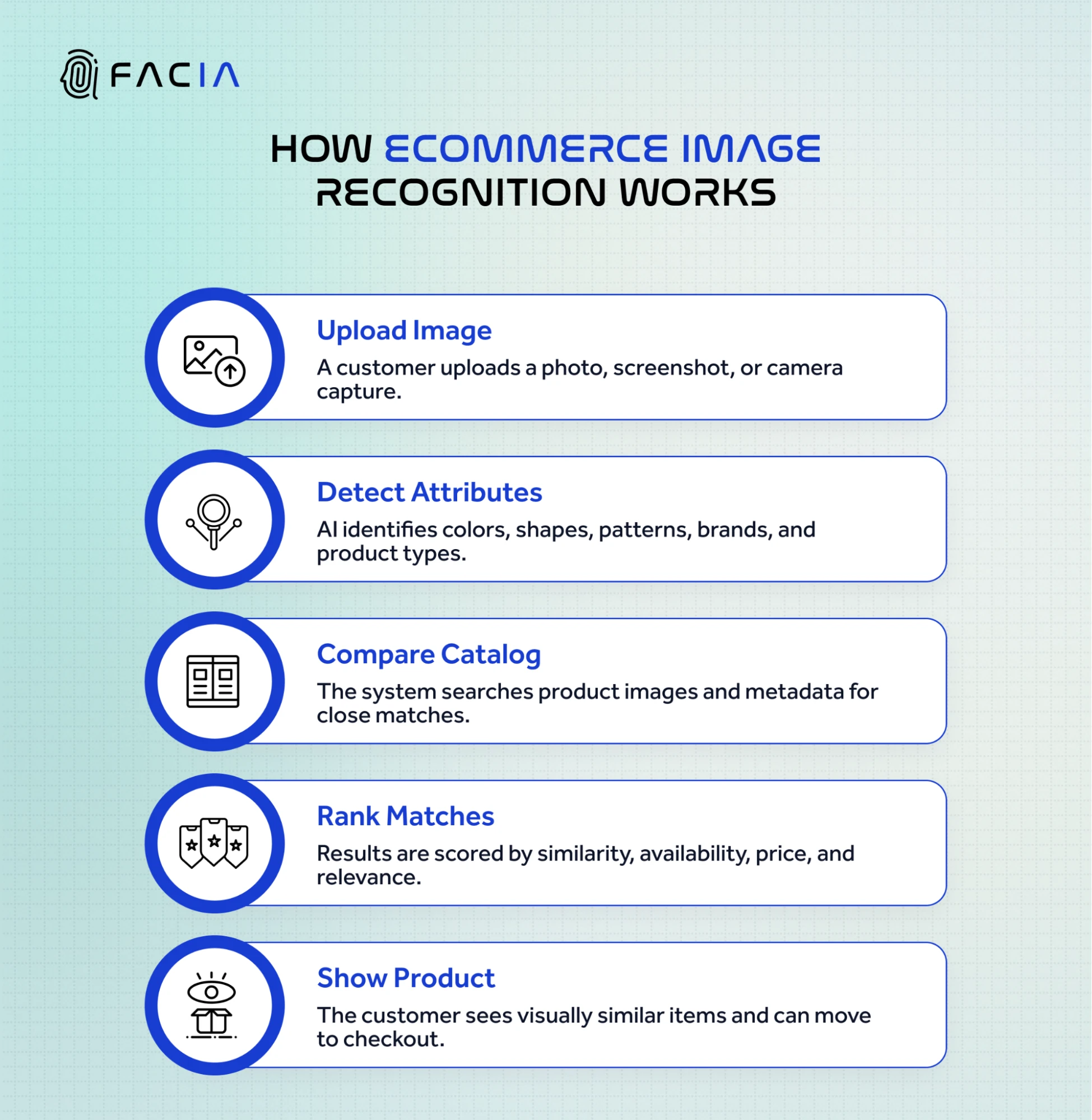
Every visual search application has a system that analyzes images and matches them to products in a retailer’s catalog. The process begins with a customer uploading a photo, a screenshot, or a camera image. The image is used as the search query.
The system then processes product attributes such as color, texture, shape, material, pattern, logo placement, etc., as well as product type. It can recognize a shoe design, a purse design, a dress pattern, a lipstick color, or even a fabric for furniture.
The platform then matches the uploaded image to images stored in the catalog and sorts photos attached to products by relevance, availability, and similarity. The better the product photography, metadata, and product tags, the more accurate the results.
Then the matching or comparable products are sent to customers in real time. Amazon launched the visual search tool Lens Live in 2025, which uses a phone camera to recognize products and displays real-time product matches in a swippable carousel.
Here’s how ecommerce image recognition works to improve visual search and product discovery.
Benefits of Image Recognition in Ecommerce
One reason retailers use image recognition is that it improves the customer experience and makes products easier to find. It also enables ecommerce teams to better leverage their product catalogs.
-
Faster Product Search
Products are easy for customers to find without having to trial multiple keyword variations or wade through numerous categories.
-
Better Product Discovery
Visual search enables customers to find products they couldn’t find with other search filters. This is beneficial for catalogs with a large number of hard-to-surface items.
-
Improved Customer Experience
People already find products through images, videos, and social content, making image recognition in shopping natural.
-
Higher Conversion Potential
Consumers who use visual search tend to start with a definite product reference. This can expedite the buying process and help customers get closer to purchasing.
-
Stronger Mobile Shopping Experience
An image is usually faster to upload than a detailed product description typed on a cell phone.
Key Use Cases of Ecommerce Image Recognition Technology
Image recognition can be used beyond simple product search. It can be employed throughout the catalog management, personalization, marketplace protection, and customer engagement workflows for online retailers.
-
Visual Search for Products
Customers can upload screenshots, saved images, or photos of the real world to locate comparable products in an online commerce catalog. This is particularly effective in fashion, beauty, furniture, footwear, and home decor.
-
Product Image Tagging
Color, pattern, material, style, and product categories can be automatically identified by image recognition. By improving the onsite search, filtering, product recommendations, and catalog accuracy, better tagging has advantages
-
Personalized Product Recommendations
Retailers can use visual behavior to understand customer preferences. If a customer often views neutral furniture, floral dresses, or athletic sneakers, the platform can recommend products that are visually similar.
-
Counterfeit Product Detection
Marketplaces can use image recognition to detect suspicious listings, copied product images, fake-branded items, and potential counterfeit products.
-
Duplicate Listing Detection
Large ecommerce platforms often deal with repeated or near-identical listings. Image recognition helps identify duplicates and maintain cleaner product catalogs.
Image Recognition Ecommerce Examples
Several major platforms already use image recognition to improve online shopping. Pinterest Lens helps users search with images and discover related ideas, styles, and products. Amazon StyleSnap allows customers to upload outfit photos and find similar fashion products.
Google Lens Shopping helps users identify products from screenshots, ads, storefronts, and real-world objects. IKEA Place combines visual commerce with augmented reality, allowing customers to see how furniture may look inside their homes before buying. These image recognition ecommerce examples show how visual search can support faster discovery, better confidence, and more engaging shopping journeys.
Challenges of Image Recognition Shopping
Image recognition can improve ecommerce search, but retailers still need to manage technical and trust-related challenges.
- Poor Image Quality: Blurry photos, poor lighting, cluttered backgrounds, and low-resolution images can reduce recognition accuracy.
- Inaccurate Product Data: Visual search performs better when catalog data is clean. Missing tags, weak descriptions, and inconsistent categories can limit results.
- Privacy Concerns: Customers may upload personal photos, screenshots, or room images. Retailers must process image data securely and clearly explain how it is handled.
- Platform Integration Issues: Image recognition systems need to connect with search tools, inventory systems, recommendation engines, and ecommerce platforms. Poor integration can weaken the shopping experience.
Future of Image Recognition in Ecommerce
Visual shopping is expected to become a standard part of online retail as customers continue using images to search, compare, and buy. A 2026 retail technology report estimates that the computer vision for retail market will grow from USD 5.24 billion in 2026 to USD 12.19 billion by 2030, showing strong demand for visual technologies in retail environments.
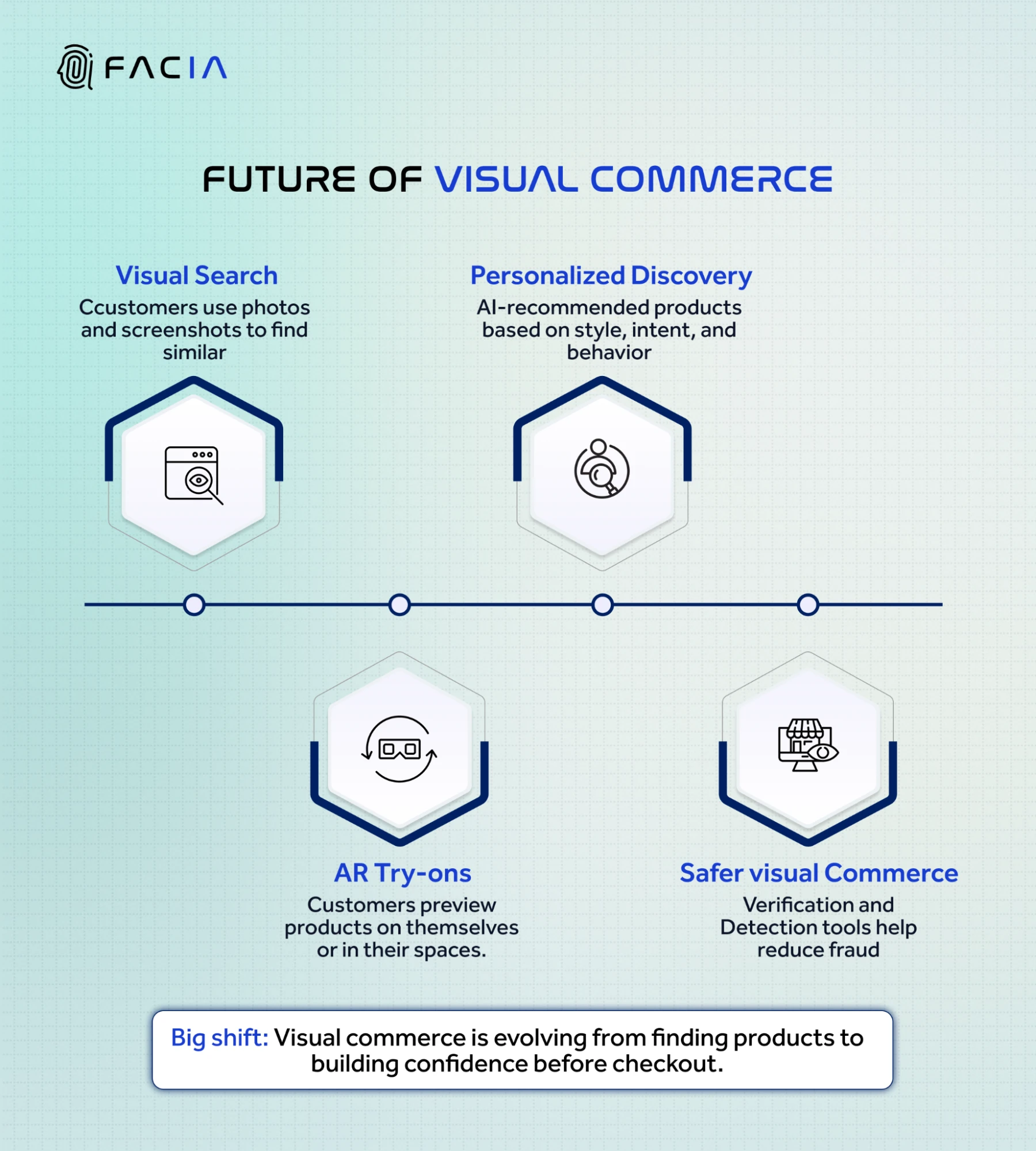
The next stage of image recognition in ecommerce will likely combine visual search with personalized recommendations, virtual try-on tools, augmented reality, and smarter product discovery. Retailers will use product images not only as marketing assets but also as searchable data to improve discovery and sales.
Here’s how visual commerce is shaping the future of ecommerce through AI, AR, personalization, and safer shopping.
How Facia Helps Build Safer Visual Commerce
Ecommerce image recognition is making product discovery quicker, more visual, and easier for customers. It enhances search precision, tailors customer suggestions, manages catalog management, and builds more robust mobile shopping experiences for retailers. However, as image-driven online retail increases, the element of trust is as crucial as convenience.
Synthetic identities, high-dollar transaction fraud, manipulated media, account takeover, and fake seller accounts are risks associated with visual shopping. Facia supports retailers to manage those risks at relevant stages of the customer journey. Through photo ID verification and face recognition, sellers can be verified to enable a safer onboarding process and account recovery. Liveness detection helps to ensure that the action being taken is by a real person, minimizing the risk of spoofing. Deepfake detection can be used to detect facial images that are synthetically created or manipulated, before they have the potential to compromise the trust of platforms.
As image recognition shopping expands, brands must not only enable seamless discovery but also ensure secure verification. Facia is a solution for ecommerce retailers that helps create ecommerce experiences that are faster, safer, and more trustworthy.
Learn how Facia helps online retailers build safer visual commerce. Book a demo today.
Frequently Asked Questions
Image recognition for product matching is highly accurate when product images are clear and catalog data is well tagged. Accuracy can vary with lighting, image quality, backgrounds, and product metadata.
AI powers ecommerce image recognition by detecting product features like color, shape, texture, style, and pattern. It helps match images with similar products, improve recommendations, and automate catalog tagging.
Image recognition improves ecommerce customer experience by letting customers search with photos, screenshots, or camera images instead of text. This makes product discovery faster, easier, and more personalized.