Biometric Identification in Ports for Smarter Seaport Security
Author: admin | 21 May 2026In This Post
A port does not need a broken fence to become vulnerable. Sometimes, the risk walks in with approved paperwork and a familiar uniform.
The ports have become the place where trade, war, cyber threats, and cargo security converge. In May 2026, Reuters reported that tankers transporting six million barrels of Middle East crude were leaving the Strait of Hormuz due to the delay associated with the ongoing war between the United States and Israel against Iran. This isn’t just an oil story for seaports. It demonstrates how quickly a regional conflict could lead to pressure on vessels, crews, cargo flow, contractors, and limited access.
The pressure makes identity verification a first-line-of-defense security issue. When there’s a lot of tension in trade, ports should know who’s coming in, why they are coming in, and whether or not they should be able to come in at that moment. That’s where biometric identification in port is useful. It improves security teams’ ability to verify people with greater confidence and ensures seamless movement across high-traffic port environments.
Ports Have Become High-Value Security Targets
Ports play a vital role in energy, customs, food supply, industry, Defense Logistics, and international trade. If a major port is breached, it can affect shipping schedules, fuel supply, cargo clearance, and other supply chains.
According to UNCTAD’s Review of Maritime Transport 2025, global maritime trade growth was expected to slow to 0.5 percent in 2025 after 2.2 percent growth in 2024. The report connects this pressure to rerouting, uncertainty, and disruption across shipping networks.
Security investment reflects the same pressure. According to the Mordor Intelligence Port Security Systems Market Report 2025, the port security systems market was estimated at USD 22.95 billion in 2025 and projected to reach USD 32.19 billion by 2030. Ports are clearly investing in stronger ways to manage access, visibility, and risk.
Why Global Trade Tensions Are Reshaping Seaport Security
The U.S.-Israel-Iran conflict is also linked to port security through maritime instability. Conflict over significant sea lanes may impact oil transportation, shipping schedules, ship traffic, crew management, cargo verification, and crisis planning.
Flows through the Strait of Hormuz accounted for more than one-quarter of global seaborne oil trade and roughly one-fifth of global consumption of oil and petroleum products in the first quarter of 2025, according t the U.S. Energy Information Administration (EIA).
Ports must be more cautious when the route is critical. A late-arriving tanker might necessitate changes to crew movements. An alternate routing vessel may need additional inspections. Control could be increased for a sensitive cargo load. In these circumstances, identity verification becomes a component of resilience.
The Problem With Traditional Access Control in Ports
Passes, gate lists, manual checks, cards, and temporary paperwork are traditional methods of accessing the port. Although these techniques are still valuable, they can be overstretched in high-speed environments.
A port is not a place where you go to have a quiet day with one desk. In an operational zone, truck drivers, crane operators, customs and shipping staff, freight handlers, vessel agents, visitors, maintenance personnel, and contractors pass through various checkpoints in the live zone.
The true challenge is to ensure that the right person is in the right place at the right time. Permission may be displayed on a card, but it does not necessarily identify the person using it as the approved person. With the addition of biometric security at seaports, identity becomes linked directly to verified access.
The Shift Toward Biometric Identification in Ports
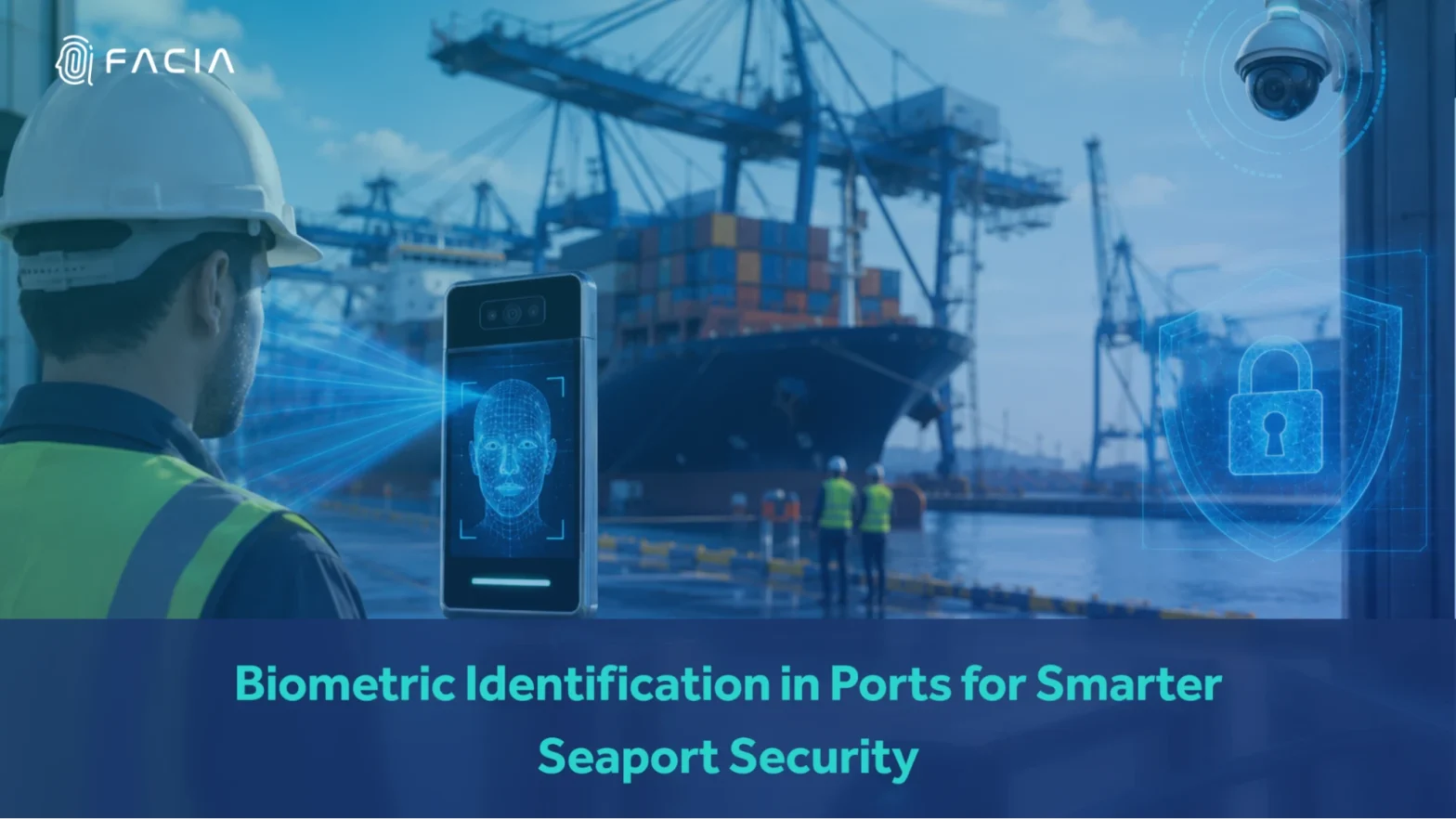
Ports using biometric identification have a more direct means for verifying people. Facial recognition, fingerprint verification, iris recognition, and other technologies help verify that the person seeking access is an authorized user.
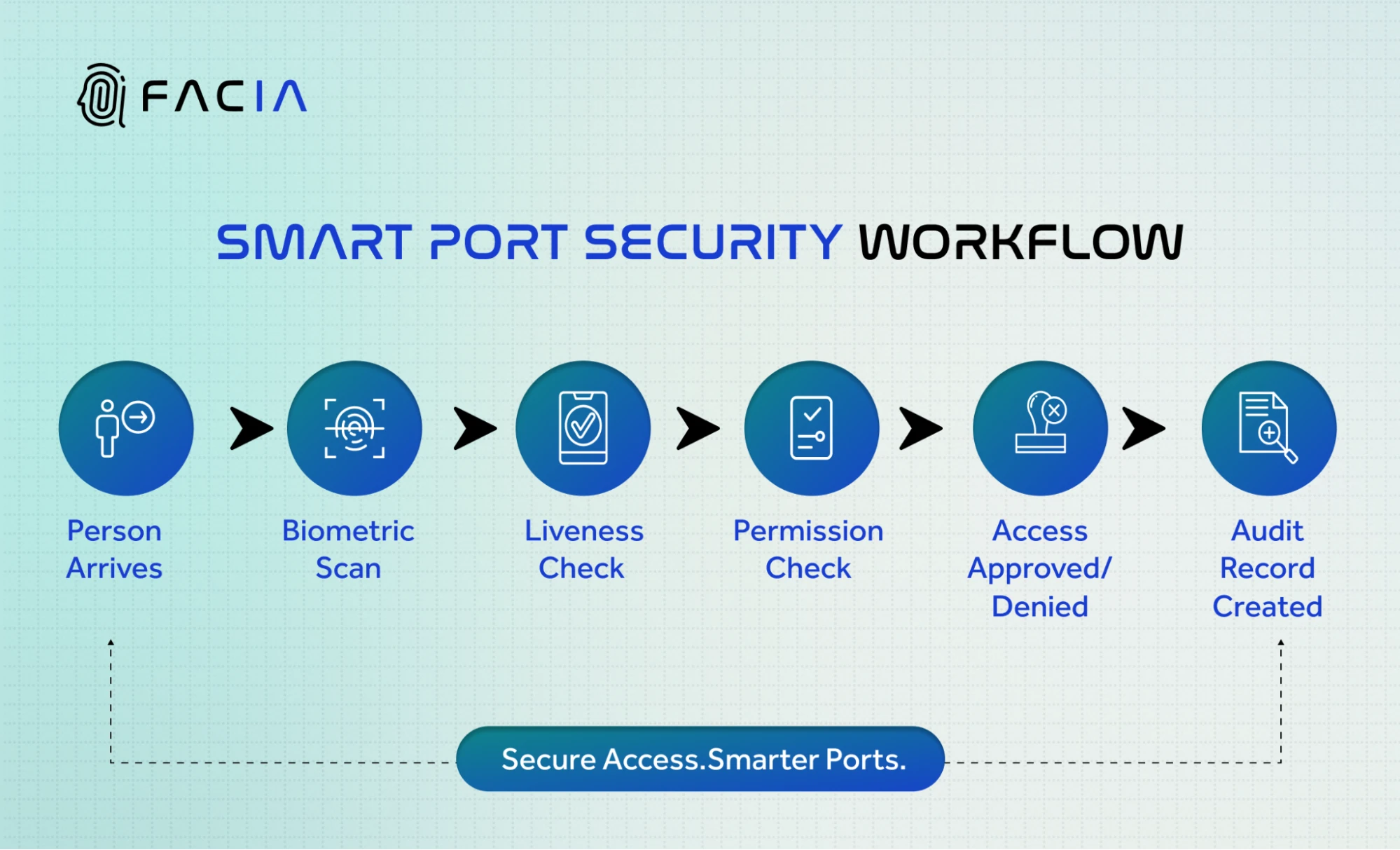
The capability of a biometric port security solution to verify identity, check permission levels, implement access rules, and create an event record is part of its capabilities. That is the key to ports transitioning from access control to smart access control.
A smart biometric port security system follows a clear workflow that verifies identity, checks liveness, confirms access permissions, and records every access attempt for stronger seaport security.
Where Biometric Security Creates the Biggest Impact
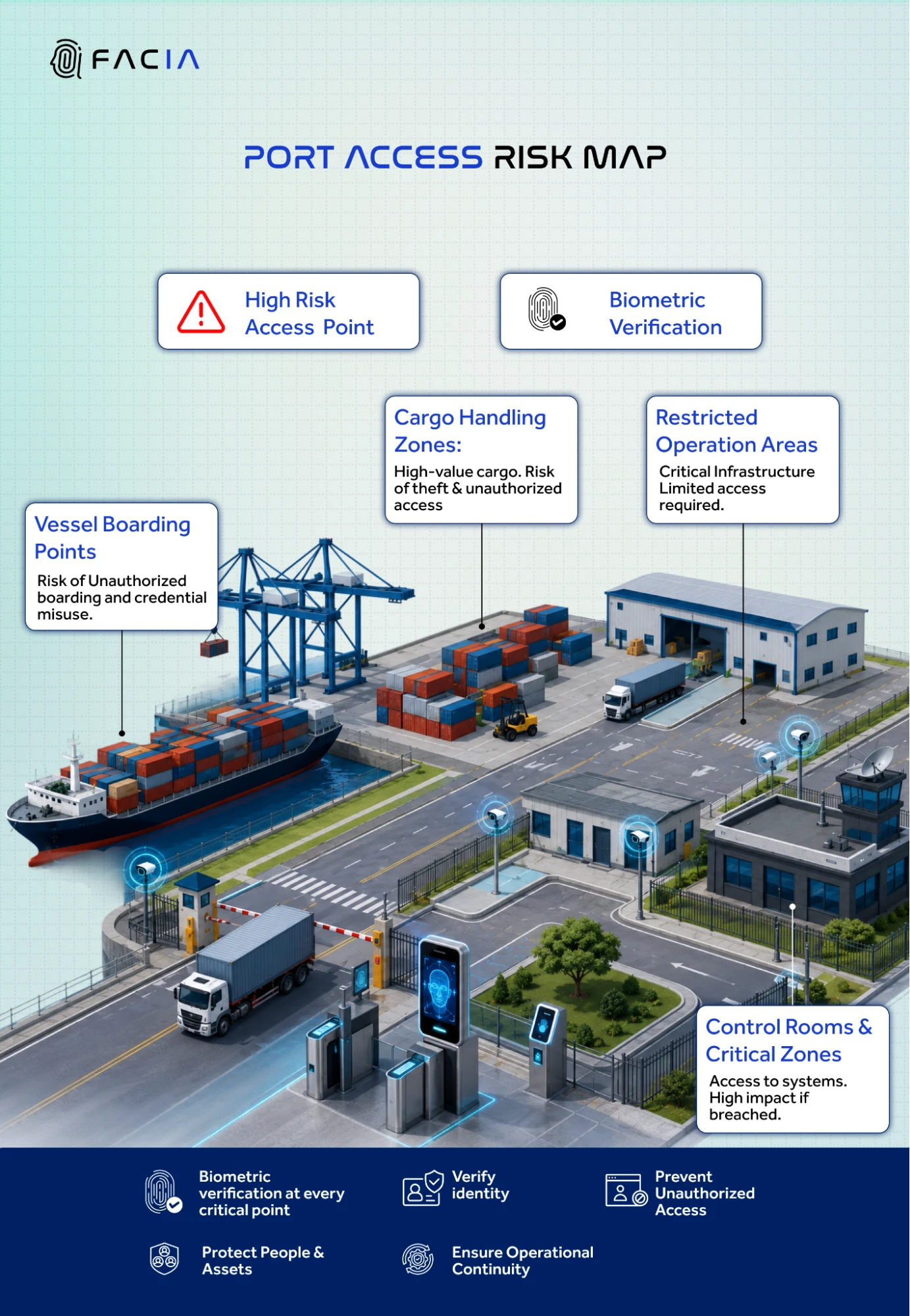
Before choosing a biometric port security solution, it helps to identify the highest risk access points where identity verification can reduce unauthorized access, protect cargo, and support smoother seaport operations.
-
-
Entry Gates
Port Security and Port Efficiency converge at the entry gates. They are constantly under time pressure with regard to workers, drivers, contractors, and visitors. At this initial gate, biometric verification can eliminate uncertainty by confirming people’s identities before they go any further onto the premises.
-
Cargo Handling Zones
Higher value items, regulated materials, and time-sensitive goods are frequently found in cargo areas. Biometric checks help ports ensure that only authorized personnel access these areas during loading, unloading, inspection, or storage.
-
Restricted Operational Areas
Access to certain areas of the port, including control rooms, customs inspection points, IT rooms, fuel storage areas, and boarding points on board vessels, is more limited than in other areas of the port. Biometric access may be more rigorous at each location.
-
Contractor and Visitor Access
The most challenging to deal with is temporary access. Contractors and visitors may only need access for a few hours, and that’s enough. Biometrics can help ensure that access is granted until the job is complete by linking temporary permissions to a valid individual.
How Biometric Port Security Software Reduces Risk
-
Prevents Unauthorized Access
Biometric port security software enables ports to move beyond surface-level access to verified access. Rather than just verifying if a pass is present on a person, the system verifies if the approved person is present.
-
Stops Identity Fraud and Badge Sharing
With simple access control systems, it is hard to manage borrowed credentials. With biometrics access control, that kind of misuse is more difficult because the person at the checkpoint must be the approved identity.
-
Improves Real-Time Visibility
Each time you try to access something, a record can be beneficial. Security teams can view users who accessed, when they accessed, where they accessed, and whether access was granted or denied. This visibility enables audits, investigations, and everyday monitoring.
-
Supports Faster Incident Response
If something seems amiss, it can help teams react swiftly, knowing they have access to accurate data. Rather than relying on logs, teams can now check identity-based logs and make decisions with greater confidence.
The Role of AI and Liveness Detection in Modern Port Security
Biometric systems are more practical in challenging environments thanks to AI. Light and weather, protective equipment, vehicles, crowds, and constant pressure all pose challenges for ports. So modern biometric systems don’t work in a perfect lab setting, but they do work under these conditions.
Liveness detection is particularly critical. It is used to verify that a real person is at the location they are verifying. This helps minimize the chances of photo, video, mask, or screen spoofing.
Cyber risk adds another layer. According to Industrial Cyber’s coverage of CYTUR’s 2026 Maritime Cyber Threat White Paper, maritime cyber incidents in 2025 surged by 103 percent compared with 2024, with DDoS, ransomware, and malware among the major attack types.
Physical and digital security are closely related for ports. An unqualified individual in a control room, server room, or closed office is a source of both physical and cyber vulnerability.
What Ports Should Look for in a Biometric Port Security Solution
Ports should select biometric technology for the real security benefits, rather than the hype.
A reliable biometric port security system will identify individuals in a timely manner, operate in high-traffic areas, be liveness-resistant, integrate with existing access control systems, grant role-based permissions, and provide an audit trail.
It should also be privacy-respecting. Ports require policies that explain consent, data storage, retention, access rights, and compliance with biometric data, as this is a sensitive piece of information
Speed matters too. According to the World Bank and S&P Global Market Intelligence Container Port Performance Index 2020 to 2024, released in September 2025, port performance is closely tied to vessel time and operational efficiency. Systems that improve confidence while maintaining smooth movement are far more useful in busy port environments.
How Facia Helps Ports Strengthen Seaport Security
Facial recognition access control gives ports a more reliable way to verify people entering sensitive areas. Instead of depending only on cards or manual checks, it confirms that the person requesting access matches an approved identity.
Facia’s face-matching technology helps reduce the risks associated with badge sharing and unauthorized entry. This is especially important in busy port environments where contractors, drivers, crews, and visitors move through multiple checkpoints every day.
Its 3D liveness detection adds another layer of protection by helping ports detect spoofing attempts involving photos, videos, masks, or screens. This allows security teams to make safer access decisions in real time.
Together, these capabilities help ports strengthen biometric identification without turning checkpoints into bottlenecks. For teams managing entry gates, cargo zones, vessel boarding points, and restricted operational areas, Facia offers a practical way to enhance security while maintaining smooth daily operations.
Ready to strengthen port access without slowing operations? Explore how Facia can help build smarter, faster, and more secure biometric identification in ports. Book a Demo Today.
Frequently Asked Questions
A biometric port security system should include facial recognition, liveness detection, access control, audit logs, and real-time identity verification. It should also integrate smoothly with existing port access systems while maintaining speed and accuracy.
Traditional access methods like ID cards and manual checks cannot always verify the actual person using the credential. Biometric verification adds stronger security by linking access directly to a verified identity.
Yes, biometric verification helps reduce identity fraud by preventing badge sharing, fake credentials, and unauthorized access. Facial recognition and liveness detection also make spoofing attempts much harder.
Ports can implement biometric verification by identifying high-risk access points and integrating biometric systems with existing infrastructure. Staff training, privacy policies, and scalable deployment also support secure adoption.