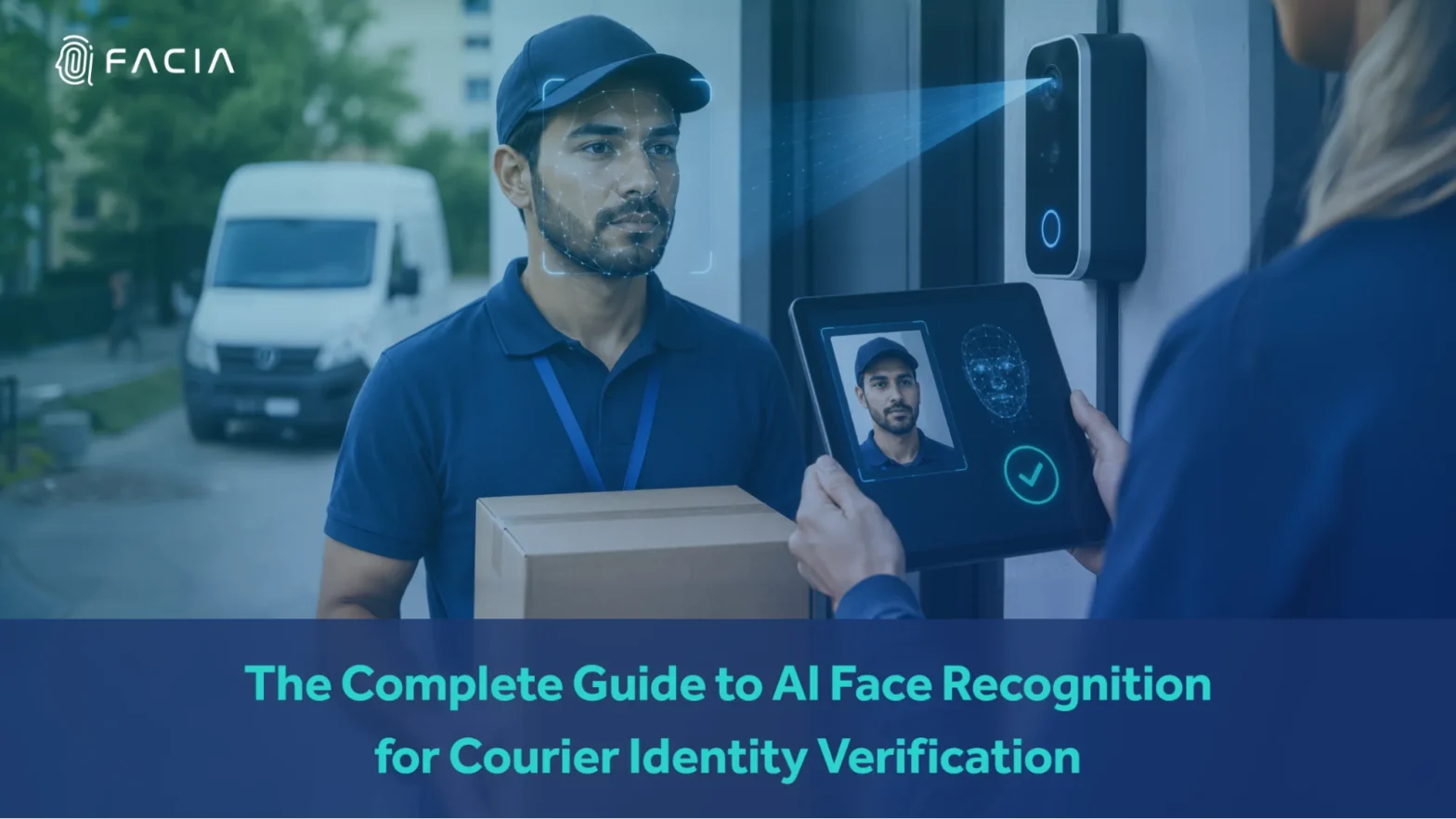
The Complete Guide to AI Face Recognition for Courier Identity Verification
Author: teresa_myers | 14 May 2026In This Post
The delivery of parcels should not end with a question mark. Customers want the right package to get to the right person, and courier companies want to know who was involved with and received each shipment. However, as delivery numbers grow, temporary drivers are hired in higher numbers, and parcel fraud is becoming a problem. Traditional methods of verification, such as OTPs, signatures, and manual verification, are increasingly difficult to trust.
According to 2025 Package Theft Report revealed that package thieves took $8.2 billion in online orders within the last year. Not all theft is due to failed identity checks, but the numbers reveal the cost of failing to secure the delivery. A more robust identity verification can minimize wrong handoffs, disputed deliveries, and unauthorized parcel collection for courier firms.
This guide covers how face recognition verifies courier identity, its role in delivery operations, the typical applications it’s used for, the advantages and compliance considerations to consider, and the features couriers should seek in a face recognition solution.
What Is Courier Identity Verification
Courier identity verification is the term for verifying the identity of the person engaged in a delivery. It can be the person who sends it, the person who receives it, the delivery person, or the person who works in the warehouse.
For daily courier operations, identity verification may occur when staff are onboarded, when they start their shift, when they enter the warehouse, when they pick up a parcel, when they are dispatched, when they are handed off at the end, or when they are returned.
At its core, courier identity verification answers three simple questions:
- Who picked up the parcel?
- Who handled the delivery?
- Who received the package?
Why Old Delivery Checks Are No Longer Enough
Traditional delivery checks still have value, but they are not always strong enough for modern courier operations.
OTPs can be shared. Signatures can be rushed or forged. You can check out ID cards. Hand checking may cause delays in the busiest of delivery periods. A delivered parcel is in no way a guaranteed receipt.
The risk is not limited to doorstep theft. Logistics fraud is also becoming more organized. The FBI warned that cargo theft losses across the US and Canada reached nearly $725 million in 2025, with criminals using tactics such as impersonating legitimate brokers and carriers to reroute shipments.
This is a huge reason why identity matters for courier companies as well. Weak verification can open a chasm from dispatch to warehouse access, from parcel collection to last-mile delivery.
Face Recognition in Delivery Verification: How it works
How Face Recognition Works in Delivery Verification
The infographic below illustrates how face recognition technology works during the delivery verification process. It shows how facial data is captured, matched, and verified in real time to ensure secure and accurate courier handoffs.
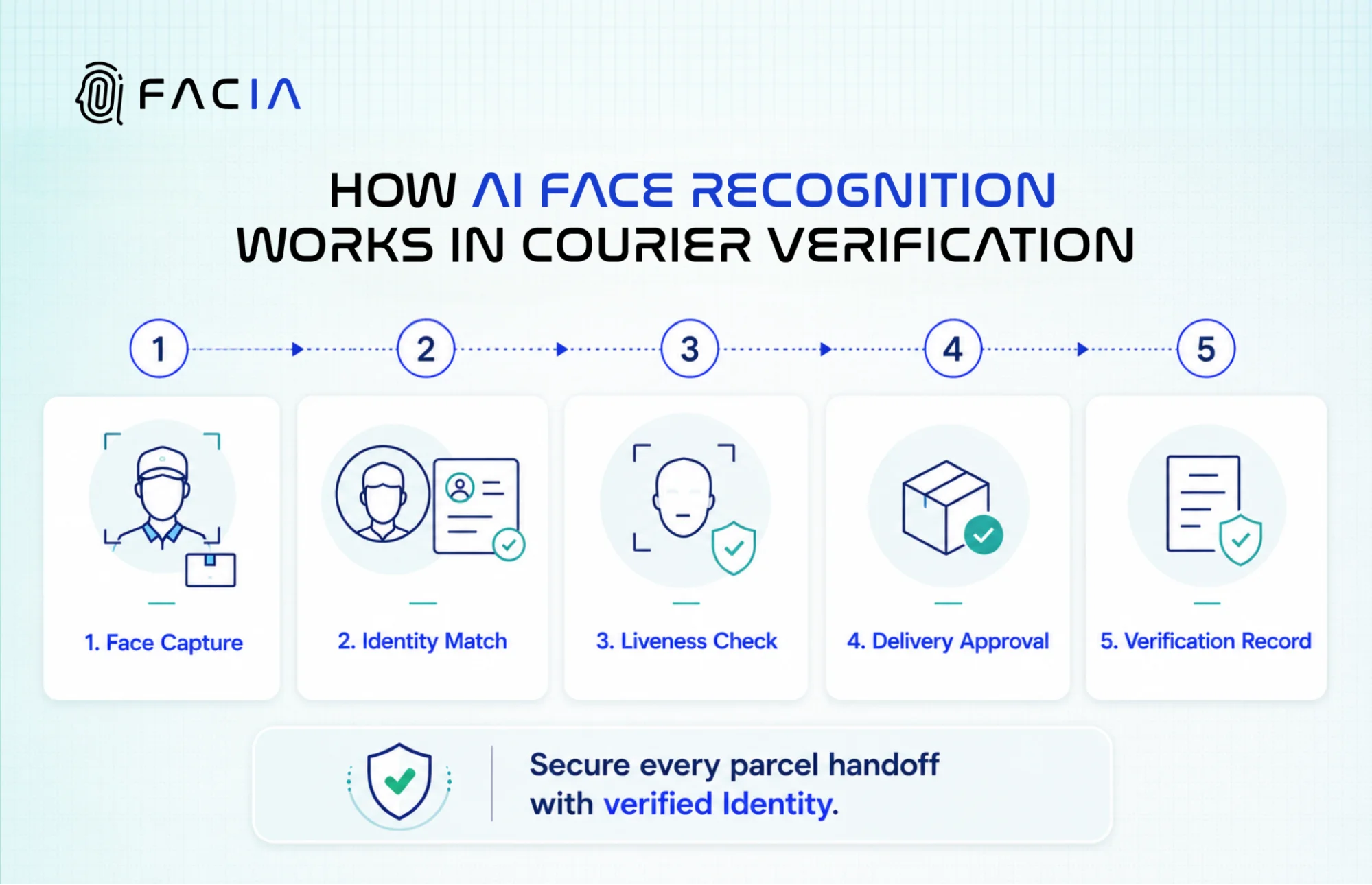
- Face Capture
The courier or recipient uses a mobile app, tablet, kiosk, or camera-based system to scan their face. This may occur at dispatch, at the warehouse entry, when picking up packages, or at the last leg of the journey to the doorstep.
- Identity Match
The captured face is matched with a verified identity record. This could be related to an employee or rider profile for courier employees. For recipients, it could be linked to an approved record of customer identities or delivery authorizations.
- Liveness Check
A liveness check is performed when verifying to confirm it is a real person, as opposed to a computer. This will prevent attempts with printed photographs, videos, screen replays, masks, or other fake input.
- Delivery Approval
If the identity is confirmed, then the delivery action can proceed. On failure of the match, the system can either block the handoff, request another check, or refer the case for manual review.
- Verification Record
Record of delivery is attached. This provides more evidence on who was checked, when the check was performed, and what delivery action was taken.
Benefits of Face Recognition for Courier Services
Face Recognition for courier services offers several advantages.
-
Stronger Delivery Accountability
Any important action taken during delivery can be tied to an authenticated person. This will offer courier companies a greater chain of custody from dispatch to the final handoff.
-
Faster Verification
Face checking can be implemented using the devices that couriers use. This will enable the practical testing of speed delivery routings.
-
Lower Fraud Risk
With face recognition, OTPs are harder to misuse, impersonate a courier staff member, or hand over parcels to the wrong recipient. It does not replace good operations; it is an identity layer over top of them.
-
Better Proof of Delivery
If there is a dispute, a verified identity record will provide more solid evidence for companies. This can alleviate strain on customer support and claims departments for high-dollar deliveries.
-
Higher Customer Trust
Consumers are better protected when they are made very aware of stronger verification measures for sensitive parcels, thereby feeling more secure. That trust can only benefit courier brands.
What to Look for in a Face Recognition Solution
Choosing the right face recognition solution goes beyond basic identity matching. The ideal system should combine speed, security, and ease of use to support real-world courier operations without disrupting delivery workflows.
-
Liveness Detection
The solution should validate the presence of the individual being checked.
-
Spoof Protection
Good spoof protection should detect fake faces, mask spoofs, replay attacks, and spoofed media. This is relevant because courier verification is frequently conducted off-site and promptly.
-
Mobile First Use
Courier teams require smartphone and tablet-friendly verification.
-
Fast Verification Speed
Routes are dependent on delivery time.
-
Easy Integration
The solution needs to integrate with delivery apps, workforce apps, warehouse systems, and proof-of-delivery systems.
-
Secure Data Handling
Biometric information should be stored securely, including through encryption, access controls, and retention protocols.
Privacy and Compliance Considerations
The privacy and compliance concerns are the same as usual. The privacy compliances are as always.
Face recognition involves sensitive personal information, and therefore, it is important that courier companies have robust privacy controls.
GDPR Article 9 defines biometric data as a special category of personal data used to uniquely identify a person. That implies companies should have robust security measures and a legal justification for their use in delivery processes.
Courier companies should also familiarize themselves with local biometric privacy regulations prior to implementing face recognition for both staff and customers on a journey. A good setup should involve informed consent (if necessary), minimal data collection, safe data storage, limited access, and explicit deletion policies.
The Future of Courier Identity Verification
Parcel delivery continues to increase. According to Research and Markets, the parcel delivery logistics market is valued at USD 620.11 billion in 2026, and will grow to USD 822.12 billion by 2030.
The more volumes that are shipped, the more evidence the courier companies will require that the delivery action was done by the appropriate person. Face recognition can help facilitate that transformation in last-mile delivery, warehouse access, smart lockers, secure pickup points, and handling of high-value shipments.
How Facia Helps Strengthen Courier Identity Verification
Businesses like courier companies are also plagued with identity issues, such as fake delivery claims, courier impersonation, and unauthorized parcel collection among couriers. In many cases, traditional verification methods are ineffective in determining the handling or receiving agent within parcels, particularly in high-volume delivery scenarios.
Couriers can rely on Facia’s enterprise-class identity verification to ensure these workflows are secure. It has liveness detection, which ensures that it is being played by a real person to prevent spoofing by photos, videos, masks, or replay. Its facial recognition technology verifies the identity of courier staff before dispatch and upon handover to the recipient. Deepfake detection provides an additional safeguard for fake and synthetic facial inputs.
Facia also enables photo ID matching for courier onboarding and step-up authentication for high-value deliveries and parcel releases. From secure deployment to compliance-ready infrastructure and flexible API and SDK integrations, Facia helps courier companies reduce fraud risk, enhance accountability, and build customer trust.
Request a demo and discover how Facia can help improve safer courier identity verification.