How AI Facial Recognition Strengthens Self-Sovereign Identity
Author: admin | 29 Apr 2026In This Post
The World Bank released a technical report in February 2026 that illustrates the growing connection between digital identity and transactions, payments, onboarding, and authentication. The future of identity is exemplified by this. Entering the architecture that supports access, authentication, and a safe method of completing transactions is now more important than simply enrolling.
That’s where self-sovereign identity comes in. It enables individuals to manage their own credentials and share information for a transaction. Instead of having to give the same information to different services, the user can share verified information in a more controlled and convenient manner.
But more control isn’t enough. While a credential may be valid, a service may require proof that the user is its legitimate holder. This is where facial recognition comes in. It adds another check to a person’s identity in a credential-based system, improving the effectiveness of self-sovereign identity.
What Is Self-Sovereign Identity (SSI)
Self-sovereign identity (SSI) enables users to manage their identity. The W3C verifiable credentials model lets trusted issuers issue statements like degrees, licenses, or age verification that users can use to share information.
This makes users choose what, where, and when to share their information. It avoids information overload since a service may only require a certain piece of information. By enabling users to disclose only what’s required, SSI improves privacy, simplicity, and efficiency, and makes online interactions safer. It allows users to safely control their identity while enabling trust and flexibility for service providers.
How Self-Sovereign Identity Works
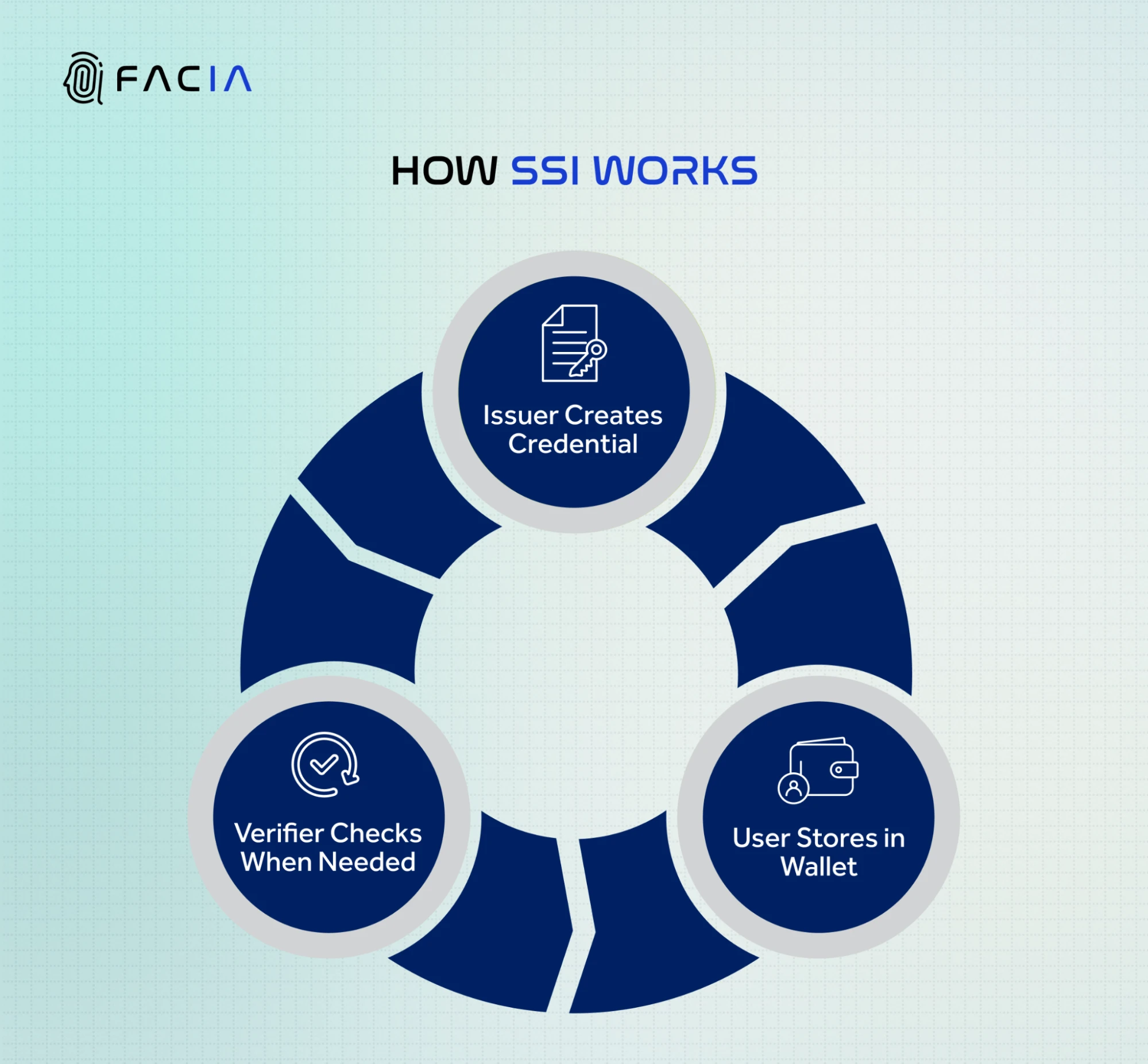
Simple steps explaining how self-sovereign identity works:
-
An Issuer Creates the Credential
It all begins with an issuer. Such as a university, an employer, a regulator, a bank, or a government department. The issuer issues a credential that makes some kind of claim about the individual, like identity, employment, or a qualification.
-
The User Stores It in a Digital Wallet
Once it’s issued, the user stores it, typically in a wallet. The European Commission defines digital identity wallets as a means for users to authenticate themselves, store and manage their digital documents, and access public and private services with their documents. This alters the typical power relationship. Rather than storing all the credentials, the user holds the credentials and chooses to share them. This is how we get a reusable identity.
-
A Verifier Checks the Credential When Needed
When a service needs to authenticate a user, the verifier checks the authenticity of the credential and the requirements being claimed. That’s what allows reusable identity. The verifier does not have to verify the user’s entire history. It just needs to verify that the credentials are genuine and fit for purpose. This eliminates duplication, eliminates friction, and makes the user journey easier.
Why Self-Sovereign Identity Still Has Gaps
While self-sovereign identity improves control and privacy, it also introduces a critical challenge: verifying that the person presenting the credential is the rightful owner.
-
A Valid Credential Does Not Confirm the Right User
Here’s the crucial bit. A credential can be valid, uncompromised, and signed by an authority, but a service cannot necessarily know who is presenting it. A secure credential authenticates the data. It does not necessarily say enough about the presenter.
-
A Wallet or Device Can Still Be Misused
That is not a small issue. ENISA’s research on digital identity and self-sovereign identity highlights concerns around unauthorized wallets, malicious wallets, and potential key compromise. That is, possession can be misused. A clean credential does not rule out theft, compromise, or misuse.
-
Some Transactions Need Stronger Proof of Identity
Some transactions need more than just valid credentials. For remote account setups, critical actions, high-risk transactions, or account recovery, stronger proof of ownership is often required. Without this extra verification, a system may be fast but not secure.
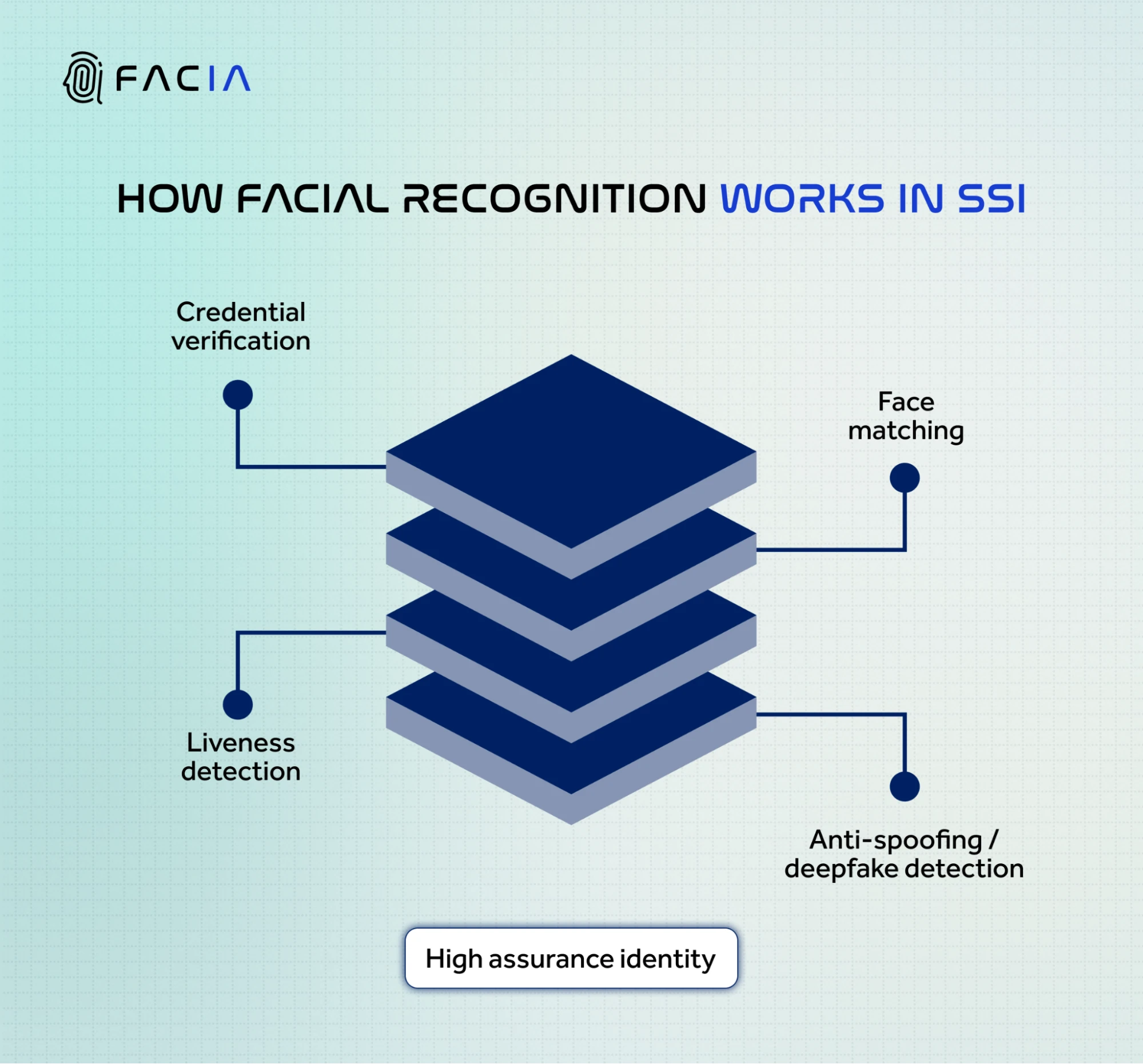
Systems must verify users’ identities even when credentials are genuine. Criminals can exploit this through spoofing, using photos or videos to impersonate others. That’s why facial recognition in self-sovereign identity systems is not limited to matching a face, but also involves other verification steps, such as liveness detection, to ensure a live person is present. Here’s how this multi-step process works.
How Facial Recognition Strengthens Self-Sovereign Identity
It Connects the Credential to the Right Person
Facial recognition addresses the identity gap that self-sovereign identity can’t. If the credential establishes that the claim was issued by a trusted party, facial recognition helps establish that the person presenting the credential is the same person for whom the claim was issued. It does not replace the credential. It adds a human connection to the credential.
It Adds Confidence During Identity Checks
This extra verification is particularly important for remote interactions, where trust is established online. NIST’s digital identity guidelines mention that digital identity systems open the door to impersonation and other attacks that can lead to false identity claims. Facial recognition can help here, particularly if it is used to help combat spoofing and presentation attacks, not just match two photos.
It Helps Reduce Impersonation in Remote Flows
This is the practical value. In remote scenarios, the system sometimes requires more than a reusable device and a mobile phone. It needs a person-level signal. Facial recognition offers signals that help with onboarding, access, and recovery processes without requiring a human document review for every transaction.
Where This Matters Most
Onboarding and KYC
An obvious place is onboarding. Digital identity and access to services are tied to onboarding in regulated settings. G20 work on digital identity onboarding, in coordination with the World Bank and OECD, draws that connection out by considering the role of digital identity to support financial services and remote onboarding. Self-sovereign identity can cut duplication. Facial recognition ensures this does not undermine security.
Account Recovery and Reauthentication
Recovery is another weak point. A stolen phone, a new device, or an account lockout can easily test the security of an identity system. If a credential is reusable, then it’s also important to be able to restore access to the right person if something goes wrong. Facial recognition helps in this case because recovery is where possession often fails.
Workforce and Access Verification
It works the same for the workforce. Contractors, employees, and institutional users may possess portable credentials for their roles, credentials, or authorizations. The credentials can be genuine, even if not the person. In role-based access and internal mobility, the difference between a proof of role and a proof of person is greater than most systems acknowledge.
What Self-Sovereign Identity Can and Cannot Do
It Improves Privacy and Reusability
Self-sovereign identity restructures digital identification. It enables selective disclosure, eliminates duplicate submissions, and puts more control of proof sharing into the hands of the user. This is a big improvement over prior systems that gather too much information and store it in too many places.
It Does Not Solve Every Trust Problem Alone
Reusable credentials will not solve governance, interoperability, and security problems alone, however. The OECD considers digital identity to be a fundamental digital public infrastructure, delivering secure and efficient access to public and private services. The more pivotal the identity is, the less acceptable the weak assurance of the human user of the credential.
It Works Better with a Strong Identity Check
That is the real balance. Self-sovereign identity works better with moving identity. Facial recognition improves trust in the mover. One supports portability. The other supports assurance. They increase the likelihood of digital identity being efficient and assured.
How Facia Strengthens Self-Sovereign Identity Security with AI Facial Recognition
Self-sovereign identity offers more control, but also presents key risks. A valid credential isn’t proof of legitimate ownership, and holding credentials can be exploited through lost devices and stolen wallets. Spoofing, deepfakes, and impersonation add to the risk in remote scenarios.
Facia strengthens self-sovereign identity by adding an advanced layer of AI-powered facial recognition and identity verification. Its facial matching and photo ID verification bind credentials to the user, rather than the mobile device or wallet. Liveness detection software makes sure a real person is behind the face, deterring attacks that use photos, videos, masks, or other spoofs.
Facia also offers deepfake detection to combat advanced cyber threats involving artificial and manipulated faces. Step-up authentication provides an additional layer of protection for critical operations like onboarding, log-in, and password recovery.
Ready to strengthen digital identity security?
Explore how Facia helps businesses secure onboarding, authentication, and account recovery with AI-powered identity verification.
Frequently Asked Questions
Self-sovereign identity (SSI) is a digital identity model where individuals control their own credentials instead of relying on centralized authorities. It allows users to selectively share verified information while maintaining privacy and ownership of their data.
SSI works through three roles: an issuer provides credentials, the user stores them in a digital wallet, and a verifier checks them when needed. Users share only the required information, and the verifier confirms its authenticity without accessing full identity records.