Best Selfie-to-ID Face Match Verification Tools in 2026
Author: admin | 24 Aug 2026In This Post
A convincing face match does not always mean a genuine verification. Stolen IDs, replayed videos, deepfakes, masks, and manipulated camera feeds can all make a fraudulent attempt look legitimate.
That is why selfie-to-ID matching now needs to answer more than one question: does the face belong to the person shown on the ID, is that person genuinely present, and can the biometric capture be trusted?
The identity market is already moving in that direction. A 2026 UK Government analysis found that 57% of digital identity providers offer biometrics, liveness detection, or verification-security capabilities.
For businesses comparing tools, face similarity is only the starting point. Stronger platforms combine matching with liveness, document checks, spoof resistance, and defences against deepfake and injection attacks.
What Is Selfie-to-ID Matching?
Selfie-to-ID matching is a one-to-one biometric verification process in which a person’s face is captured and matched against their photo on their ID.
The user scans or uploads an ID and provides a selfie. Face comparison technology compares both images and outputs a result as to whether they are of the same person. Document verification, liveness detection, and capture-security checks for replay attacks, masks, deepfakes, virtual cameras, or injected media can also be a part of a secure flow.
Face matching is used to connect the user with their ID. The surrounding checks allow you to assess if the verification attempt itself is reliable.
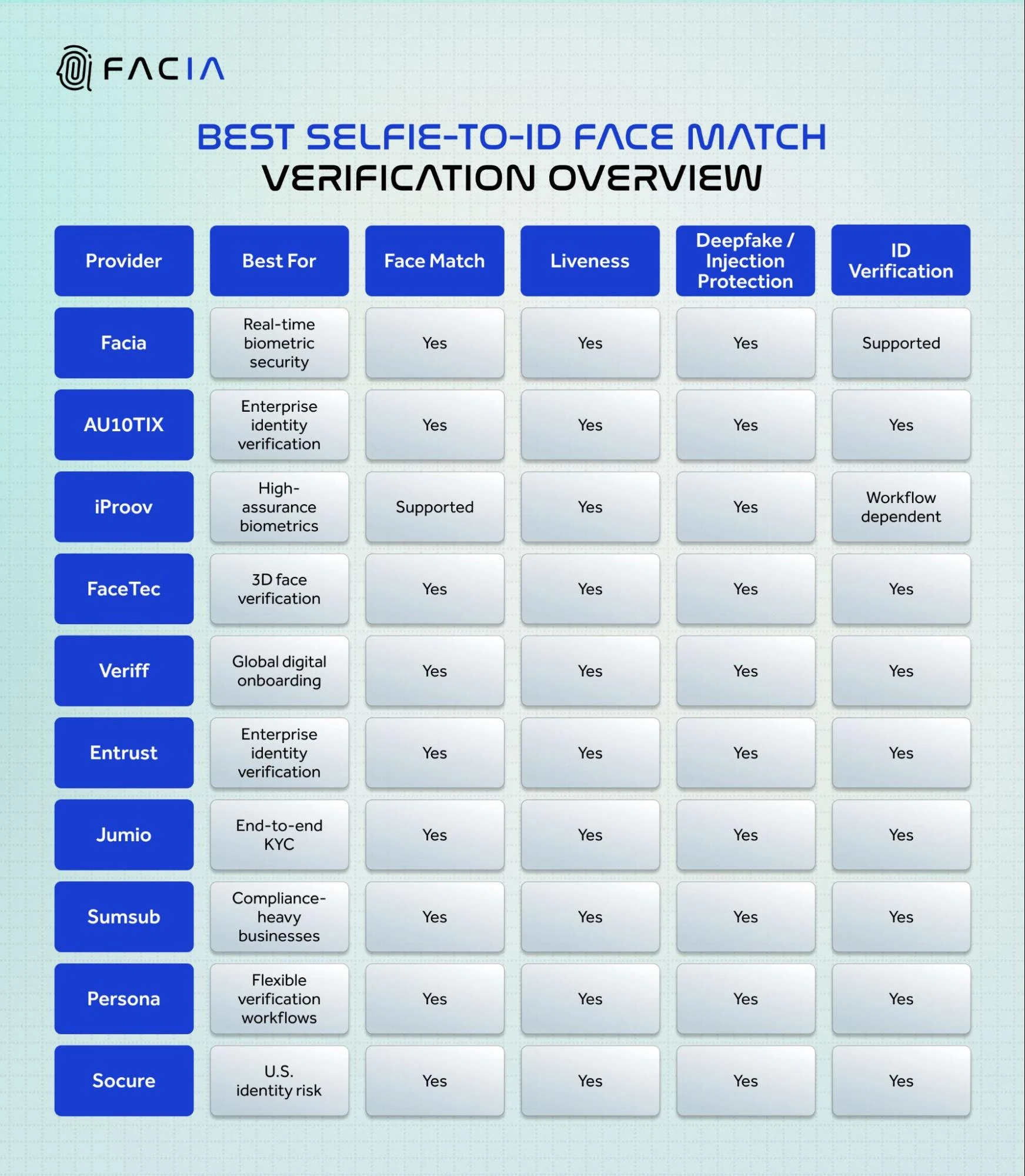
Best Selfie-to-ID Face Match Verification Tools at a Glance
This guide is based on information provided by the manufacturers and is not the result of independent testing.
 10 Best Selfie-to-ID Face Match Verification Tools in 2026
Here are some top 10 Selfie-to-ID face matching verification tools in 2026 explained below:
1. Facia: Best Face Match Verification Software for Real-Time Liveness
Facia’s 1:1 Photo ID Matching compares a live facial capture with the portrait on an identity document. Liveness, deepfake detection, anti-spoofing, and capture-security capabilities strengthen the decision around that match.
Best for: Fintech, gaming, marketplaces, account recovery, onboarding, and high-risk transactions.
Why it stands out: A focused biometric layer built around face matching and modern spoofing threats.
2. AU10TIX: Best for Enterprise Selfie Verification
AU10TIX combines ID-to-selfie matching and liveness with document authentication and broader identity checks.
Ideal for enterprises with complex identity and document verification requirements.
Buyer fit: Good where document authentication is as important as biometrics.
3. iProov: Best for High-Assurance Biometric Verification
iProov specialises in liveness and remote biometric authentication controls against presentation attacks, deepfakes and digitally manipulated media.
Ideal for: Banking, Government, sensitive authentication and regulated applications.
Builder fit: Useful when live biometric assurance is the primary concern.
4. FaceTec: Best for 3D Face Verification
FaceTec generates a 3D model of the person’s face and can match it with the image of the face captured from an identity document.
Ideal for: Companies that want to implement 3D facial authentication.
For teams that want to operate in an SDK-driven biometric model, buyer fit is worth considering.
5. Veriff: Best for Global Digital Onboarding
Veriff’s international users’ web and mobile onboarding flow includes document verification, face comparison and liveness.
Ideal for: Fintech, marketplaces, mobility and web services companies around the world.
Buyer fit: Good if international reach and user experience are important in addition to biometrics.
6. Entrust: Best for Enterprise Identity Verification
Entrust brings facial comparison and liveness detection into a broader enterprise identity and security environment.
Best suited: Banks with existing identity programs and organisations.
Buyer fit: Doesn’t make much sense if face verification is being used as part of a broader security initiative.
7. Jumio: Best for End-to-End KYC
In a KYC-based process, Jumio integrates document verification, face matching, and liveness detection.
Ideal for: Financial Services, Fintech, Telecom, Travel and regulated businesses.
Buyer fit: Robust if authenticity and due diligence are key requirements.
8. Sumsub: Best for Compliance-Heavy Businesses
Sumsub integrates biometric verification with KYC, AML, fraud prevention and overall compliance processes.
Ideal for: Cryptocurrency, fintech, gaming, marketplaces and regulated online services.
Buyer fit: Relevant for teams because they require compliance and biometrics from a single source.
9. Persona: Best for Customizable Verification Workflows
Persona enables businesses to integrate government ID checks, selfie verification, liveness, and more as part of identity flows that are defined for each business.
Best for: Companies that have many different ways to onboard or recover an account.
Buyer fit: Excellent if flexibility in workflow is an important factor.
10. Socure: Best for U.S. Identity Risk Management
Socure integrates document verification, biometric selfie verification and other identity-risk indicators.
Best suited to: U.S. fintech, banking and lending and the digital financial services industry.
Buyer fit: Best when there is a need to support more fraud decisioning with face matching.
How We Evaluated the Best Face Match Verification Software
The best face-match verification software should not be chosen based on a single accuracy claim. Performance can change with camera quality, lighting, demographics, matching thresholds, capture conditions, and attack type.
Key criteria include one-to-one selfie-to-ID matching, liveness detection, presentation attack resistance, deepfake detection, injection protection, document verification, verification speed, API and SDK support, mobile compatibility, and deployment flexibility.
Real-world testing matters too. Shortlisted tools should be tested with representative users, devices, capture conditions, and fraud scenarios before procurement.
Security Priorities for Face Comparison Tools in 2026
The challenge for face comparison tools in 2026 is that fraud can target either the camera or the digital pipeline behind it.
A presentation attack puts something fake, such as a photo, replayed video, screen, or mask, in front of a genuine camera. An injection attack introduces manipulated or synthetic content through the digital flow, potentially using a virtual camera or emulator.
A strong biometric system should answer four questions:
Identity match: Does the face correspond to the ID?
Live presence: Is a real person completing the check?
Presentation security: Is fake material being shown to the camera?
Capture integrity: Has the biometric feed been digitally manipulated?
For higher-risk workflows, leaving one of these areas unchecked can create a gap fraudsters may exploit.
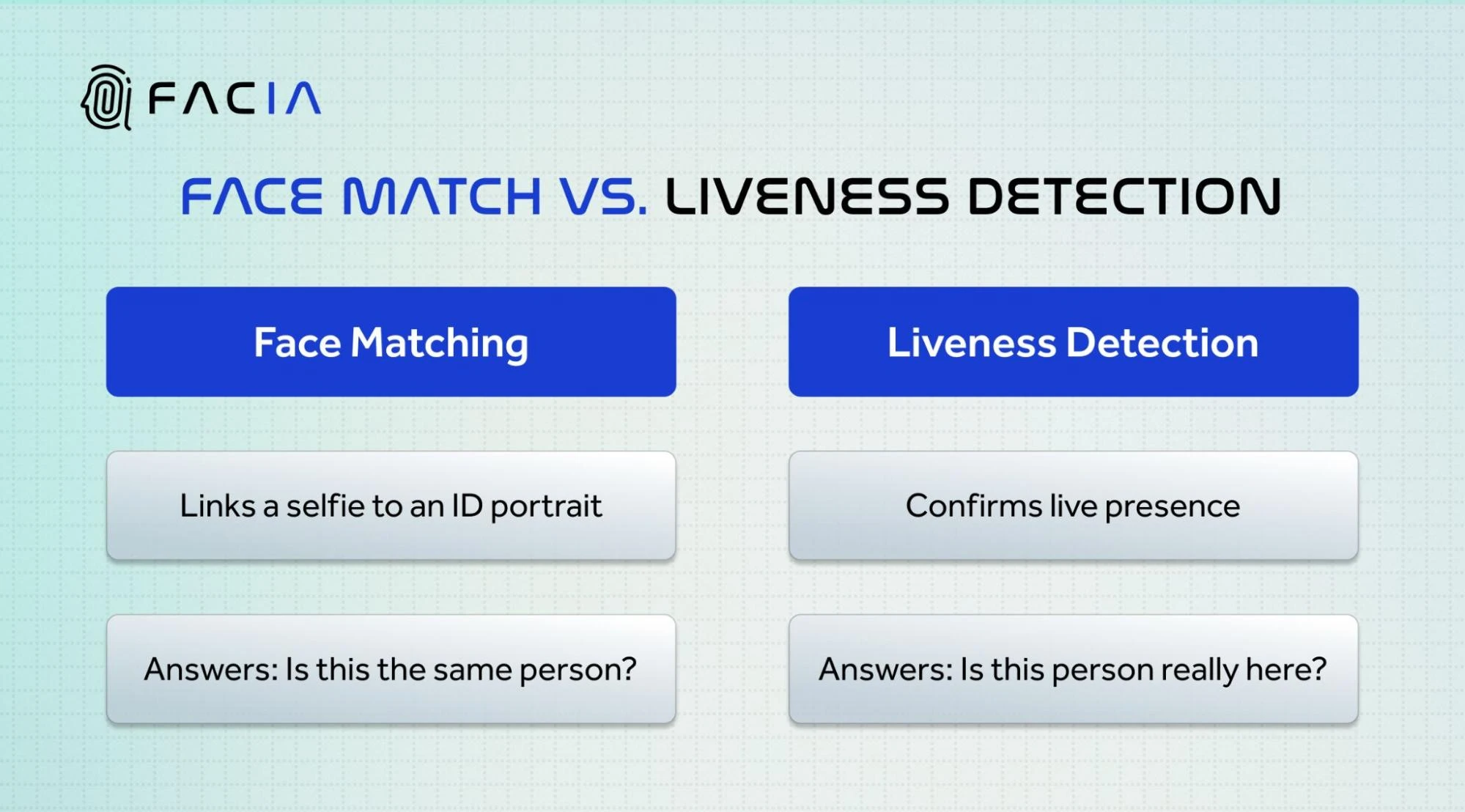
Face Matching vs. Liveness Detection
A stolen image may match an ID, while liveness alone cannot prove ownership of that identity. Reliable selfie-to-ID matching works best when both checks support the same decision.
 How to Choose Between Photo ID Matching Software Providers
When comparing photo ID matching software providers, start with the fraud scenarios your business actually faces.
Check whether each provider supports true one-to-one matching, liveness, presentation attack detection, deepfake and injection defences, document verification, mobile integration, APIs and SDKs, and suitable deployment options.
The strongest choice is the provider that covers your real risks without adding unnecessary friction for genuine users.
Why Facia Is a Strong Choice for Selfie-to-ID Face Match Verification
Identity teams need stronger fraud controls without making verification harder for legitimate customers.
A matching face can come from a replayed video, deepfake, mask, or manipulated camera feed. Basic comparison may confirm similarity while leaving questions about live presence and capture integrity unanswered.
Facia addresses those challenges through 1:1 Photo ID Matching, supported by liveness detection, deepfake detection, anti-spoofing, and capture-security capabilities. For teams comparing top ID-to-selfie verification vendors, a focused biometric approach can support onboarding, account recovery, high-risk transactions, and other workflows that require quick identity decisions.
Explore Facia’s 1:1 Photo ID Matching and liveness technology to build a faster, safer verification experience with less friction for genuine users. Book a Demo Today.