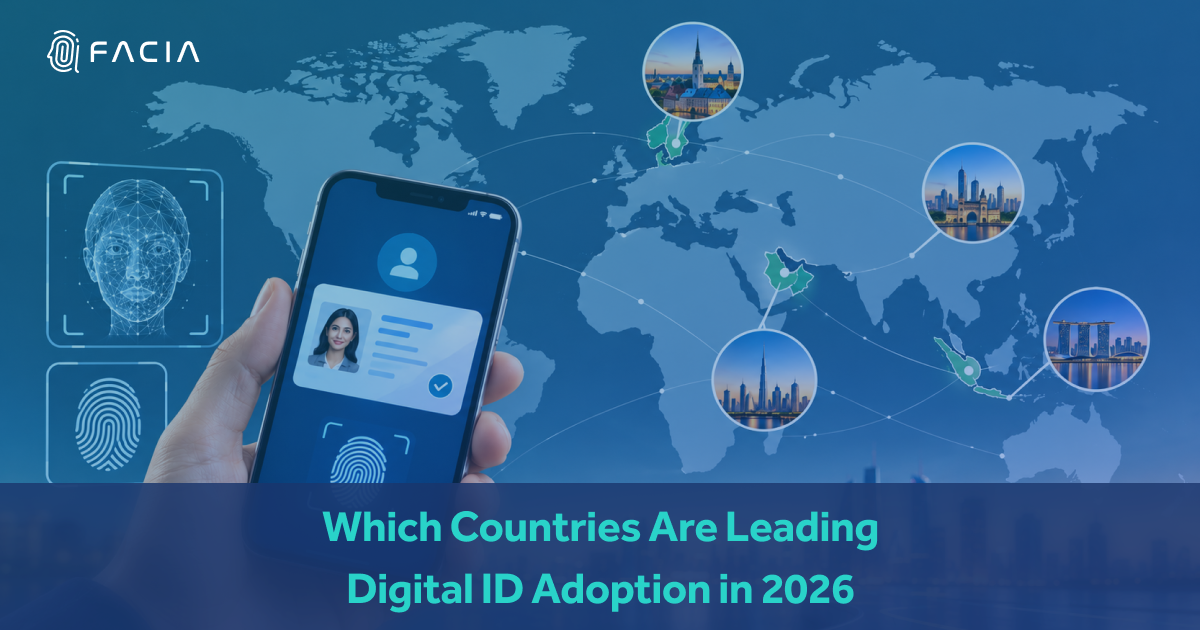
Which Countries Are Leading Digital ID Adoption in 2026
Author: admin | 08 Sep 2026In This Post
Digital identity is becoming a key part of how people access services, verify credentials, open accounts, sign documents, and interact online. In 2026, Digital ID adoption is accelerating as governments invest in national identity programs, digital wallets, biometric authentication, and reusable credentials, making verification faster, safer, and more convenient.
The scale of adoption is already clear. The UK Government’s 2026 Digital Identity Sectoral Analysis found that 77% of surveyed UK residents had used a digital identity service for at least one purpose. The sector now includes an estimated 275 providers and contributes £1.037 billion in Gross Value Added (GVA).
At the same time, deepfakes, synthetic identities, privacy concerns, and fragmented regulations are creating new challenges for governments and businesses.
This blog explores the countries leading Digital ID adoption, the technologies driving growth, and the verification challenges shaping the future of secure digital identity across public and private services worldwide.
Why Digital ID Adoption Is Accelerating in 2026
Digital Transformation of Government Services
Governments are digitising healthcare, taxation, licensing, education, and social benefits. Digital identity allows citizens to prove their identity remotely, reducing reliance on physical documents and verification processes.
For governments, this can improve efficiency. For citizens, it creates faster access to services. As public services move online, Digital ID adoption is becoming central to national digital transformation.
Rising Identity Fraud and AI-Powered Threats
New techniques such as deepfakes, synthetic identities, altered documentation, and biometric injection attacks are putting traditional verification methods to the test.
According to the UK Government’s 2026 sector analysis, 57% of the identity providers identified have biometrics, liveness detection or verification-security capabilities.
Governments and enterprises thus need more robust methods for determining the authenticity of users, documents, and biometric samples.
Demand for Seamless Digital Experiences
Users are demanding secure services without having to re-upload documents or go through lengthy checks repeatedly. Reusable credentials and digital wallets can help to remove unnecessary personal information from users’ hands while enabling them to demonstrate certain traits.
Leading National Digital Identity Programs in 2026
European Union: Moving From Framework to Wallet Rollout
Interoperable digital identity is a topic that the European Union is driving. The European Digital Identity framework envisions that by the end of 2026, Member States will provide all citizens, residents and businesses with access to at least one EU Digital Identity Wallet.
The wallet can be used to store digital documents, verify and share verified credentials, and create electronic signatures, and can be used by both public and private services. Selective disclosure allows users to only share the information needed to complete a transaction.
The EU model demonstrates the potential of digital ID policy to facilitate cross-border interoperability and give people greater control over their personal data.
India: Digital Identity at Population Scale
India’s Aadhaar ecosystem remains one of the largest digital identity infrastructures.
According to the data on UIDAI’s dashboard, over 144.66 crore Aadhaar numbers have been generated, over 17,759 crore authentication transactions, and over 2,457 crore eKYC transactions have taken place till now.
Singapore: Digital Identity Embedded in Everyday Services
Singapore exemplifies how digital identity can be woven into everyday life with Singpass. According to GovTech Singapore, it serves around five million users, provides access to over 2,700 services through around 800 government agencies and businesses and processes over 41 million transactions monthly.
With convenience and trusted authentication through government portals, Singapore’s ecosystem extends beyond this to private-sector services as well, showing a path that can help in the continued adoption of Digital ID.
Estonia: A Mature Digital Government Pioneer
Estonia remains a reference point for digital government. Its electronic identity infrastructure supports secure authentication, legally recognised digital signatures, and online interactions with public institutions.
According to Estonia’s Information System Authority, there are about 1.2 million valid ID cards and 219,000 Mobile-ID users as of July 1, 2026.
Digital identity is as much about cybersecurity, legal recognition, governance, and public trust as it is about technology – as Estonia demonstrates.
United Kingdom: Building a Trusted Digital Identity Market
The UK is becoming important in the global digital identity landscape. The government is developing a national Digital ID scheme while formalising requirements for private verification services.
Its 2026 sector analysis estimates 275 digital identity providers, while 77% of surveyed residents reported using a digital identity service for at least one purpose.
The UK Digital Verification Services Trust Framework 1.0 sets requirements covering governance, privacy, information security, technical standards, and user experience. The UK shows how digital ID regulations can develop alongside a growing commercial verification market.
United Arab Emirates: Identity Supporting Smart Government
UAE PASS is the UAE’s national digital identity and signature solution. It enables smartphone authentication across government and private-sector services and supports digital document signing.
The UAE demonstrates how national digital identity programs can support smart-government strategies by integrating identity, authentication, signatures, and service access into a single ecosystem.
Digital ID Regulations: A Growing but Fragmented Landscape
While Digital ID adoption is accelerating, there is still no global standard. Governments are building frameworks around their own privacy rules, security priorities, and service models.
The EU is focusing on interoperable wallets, while the UK is developing a regulated trust framework. Australia’s Digital ID Act 2024 establishes governance, accreditation, privacy, and consumer-protection requirements for the Australian Digital ID system.
The Digital ID Act commenced on 30 November 2024, creating a legislative foundation for Australia’s expanding digital identity ecosystem.
For international businesses, different digital ID regulations create practical challenges. A credential trusted in one jurisdiction may not satisfy another country’s requirements, making interoperable standards and reliable verification increasingly important.
Digital Identity Wallets and User-Controlled Credentials
Digital identity wallets are a defining development shaping Digital ID adoption in 2026.
Instead of submitting identity documents for every check, users can store verified credentials and disclose only what a transaction requires. For example, someone could prove they meet an age requirement without revealing their full date of birth.
This can reduce unnecessary data sharing while improving convenience. Self-sovereign identity concepts are also influencing user-controlled credentials, although many governments are applying these principles within regulated rather than fully decentralised models.
AI, Deepfakes and Why Onboarding Accuracy Matters
As digital identities become more valuable, the quality of initial verification becomes increasingly important.
Onboarding accuracy helps ensure that an account or credential is issued to the legitimate individual rather than a fraudster using stolen, synthetic, or manipulated information.
Weak onboarding can enable fraudulent account creation, synthetic identity fraud, account takeover, document fraud, and compliance failures.
Modern verification systems combine document authentication, facial verification, biometric matching, liveness detection, and fraud signals to improve onboarding accuracy without adding excessive friction.
AI creates both opportunities and risks. It can improve fraud detection, while attackers can use generative AI to create convincing deepfakes and manipulated identity evidence. Identity security must evolve alongside these threats.
How Facia Supports Secure Digital ID Adoption
Global Digital ID adoption is reshaping how governments, businesses, and citizens interact online. National digital identity programs, digital wallets, and evolving digital ID regulations are making identity more reusable, secure, and interoperable. Frameworks such as Australia’s Digital ID Act also show how governments are formalising trust, privacy, accountability, and consumer protection as digital identity ecosystems expand.
Facia helps organisations strengthen this verification layer with AI-powered facial verification, liveness detection, and fraud prevention technology. Its solutions help businesses confirm that users are genuine, detect deepfakes and synthetic identities, and reduce the risk of presentation attacks during onboarding and authentication.
By improving onboarding accuracy without creating unnecessary friction, Facia supports safer digital interactions across financial services, marketplaces, digital platforms, and other high-risk customer journeys.
Ready to strengthen your identity verification strategy? Explore Facia’s AI-powered identity verification solutions and build faster, safer, and more trusted digital experiences for your users.