
What Are the Best Practices for Customer Onboarding in Banking
Author: admin | 03 Sep 2026In This Post
Opening a bank account should feel simple to the customer. For the bank, however, several checks must happen before that relationship begins.
Banks must collect accurate information, verify identities, complete KYC/AML checks, assess risk, and approve applications. At the same time, genuine customers expect a simple and transparent process.
That balance is becoming harder. Cifas reported that identity fraud accounted for 59% of fraud-risk cases recorded to the UK National Fraud Database in the first half of 2026. Bank accounts and payment cards made up 68% of identity fraud cases.
This makes customer onboarding in banking a meeting point for compliance, fraud prevention, customer experience, and operational efficiency. Strong banking customer onboarding should help legitimate customers move forward while allowing banks to identify suspicious applications early.
What Is Customer Onboarding in Banking
In banking, customer onboarding is the process a bank follows to establish a new customer relationship. Typically starts with an application for an account or financial service and progresses through information gathering, identity verification, KYC checks, customer due diligence, risk screening, approval, and account activation.
Customer onboarding is not just the account-opening process; it also encompasses due diligence and decisions made before the customer uses banking products and services.
Why Banking Customer Onboarding Matters
-
Customer Experience and Conversion
Onboarding is often one of the customer’s first experiences with a bank. Long forms, repeated requests, unclear instructions, and delays can make a simple application difficult. A smoother journey helps genuine applicants complete the process with less effort.
-
Compliance and Fraud Prevention
Before a bank enters into a financial relationship with a client, it has to have trust in the client. Identity verification, KYC, AML, CDD, and sanctions screening are methods for detecting compliance or fraud risks before opening an account.
-
Operational Efficiency
Poor onboarding creates extra internal work. Disconnected systems and excessive manual intervention can increase delays and take staff away from cases that genuinely need investigation.
What Does the Bank Onboarding Process Include
The bank onboarding process differs between institutions, but most journeys follow a similar sequence.
1. Application and Information Collection
The customer chooses an account/service and enters the appropriate details. Banks should be explicit in their requirements and not seek information that they already have. If relevant, verified information can be pre-uploaded and verified by the customer.
2. Identity Verification
The bank must be able to verify the applicant’s identity. This could include identity documentation, customer information checks, biometric verification or a mixture of these. The purpose of the ID is not just to collect an ID. It is used to verify the identity of the individual behind the application.
3. KYC and Risk Screening
The bank conducts customer due diligence and knows your customer procedures. Other screening, such as AML, sanctions, and PEP, may also be needed. Identity verification is the process of confirming a customer’s identity. Screening helps determine which information might need more focus.
4. Decision and Account Activation
When checks are finished, the application can be approved, reviewed, or declined. Approved customers can then configure account security, enable digital access or top up the account. A seamless application of the pre-approval process to the day-to-day banking process continues the customer journey once approved.
What Is Digital Customer Onboarding in Banking
Digital customer onboarding allows customers to complete some or all of the journey through a website or mobile application.
Instead of visiting a branch, customers can provide information online, upload documents, complete identity checks, and receive decisions digitally.
For banks developing a digital customer onboarding strategy, moving forms online is only the beginning. The journey still needs to be secure, clear, and connected.
Under the European Digital Identity framework, EU Member States are required to provide EU Digital Identity Wallets by the end of 2026. Reusable digital identity is therefore becoming more relevant to online services.
What Are the Main Challenges in Banking Customer Onboarding
One of the biggest challenges is balancing security with customer experience. Not every applicant presents the same risk, so identical checks can slow straightforward cases without improving decisions.
Every extra form, upload, retry, or delay also creates another chance for the applicant to leave.
Disconnected systems add friction. One journey may involve identity verification, KYC, fraud, AML screening, CRM, case management, and core banking platforms. Poor integration can force customers and employees to repeat work.
Banks also need a sensible route for customers who cannot complete standard verification. In a 2026 review of UK Basic Bank Account journeys, the FCA found that 69% of mystery-shopping interactions involving non-standard identification or no fixed address were at risk of rejection or delay due to how identification requirements were handled.
That finding shows why proportionate checks and clear alternatives matter.
What Are the Best Practices for Customer Onboarding in Banking
-
Use a Risk-Based and Customer-Based Approach
Banks should not treat every application in exactly the same way. The journey can vary according to risk, product, customer type, geography, and relationship complexity.
-
Keep Information Requests Simple
Customers should not have to provide the same information repeatedly. Where permitted, banks can reuse securely collected information or pre-fill fields from trusted sources and ask customers to confirm them.
-
Make Identity Verification Part of the Journey
Identity verification should feel like a normal part of onboarding. Clear instructions, consistent screens, mobile-friendly capture, and fewer redirects can make verification easier to complete.
-
Give Customers Clear Updates
Customers should know what is happening with their application. If more information is required, they should know what is missing. If verification fails, the next action should be clear.
-
Build Proper Exception Paths
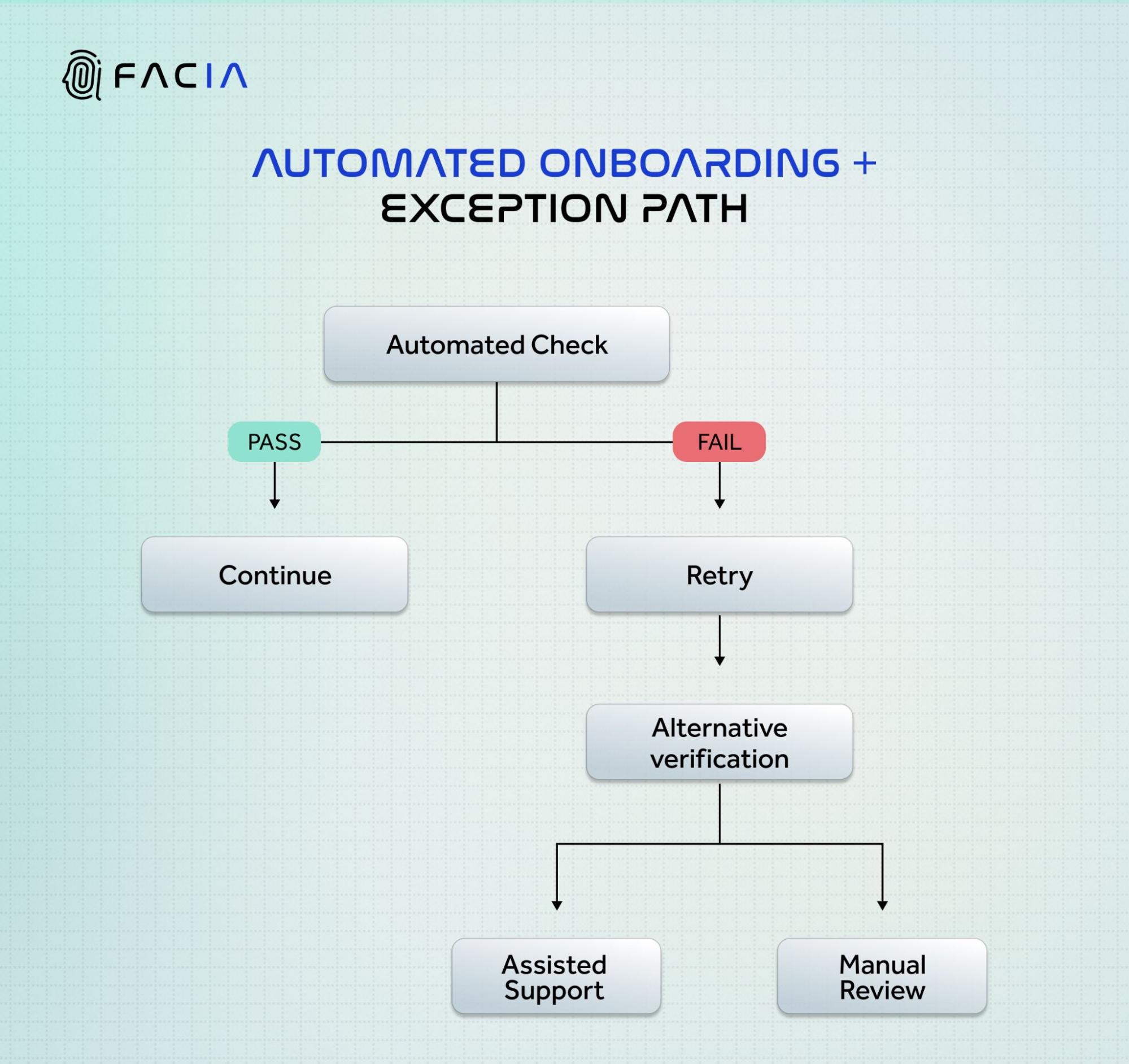
Automated processes will not resolve every case. A useful journey can move from automated verification to a retry, another verification option, assisted support, or manual review.
Customers moving from self-service to assisted onboarding should not have to restart the application.
Measure the Entire Onboarding Funnel
Approval rates alone do not show whether onboarding works well. Banks can monitor completion rates, abandonment by stage, verification retries, time to decision, manual review rates, onboarding costs, and early fraud cases. Customer feedback can also explain where applicants struggle.
How Can Banks Reduce Onboarding Friction Without Increasing Risk
The goal should not be to remove every verification step. Some friction is necessary because banks need enough confidence to establish a financial relationship safely.
The better approach is to remove friction that does not improve the decision. Repeated questions, duplicate document requests, unclear instructions, unnecessary handoffs, and avoidable reviews do not automatically make onboarding safer.
Banks can use customer and risk signals to decide when stronger checks are justified. Straightforward cases can follow a simpler path, while higher-risk applications receive more scrutiny.
What Should Customer Onboarding Solutions for Banks Include
When comparing customer onboarding solutions for banks, institutions should assess how well each solution fits the overall journey.
Important capabilities may include identity verification, document checks, KYC support, fraud controls, risk-based decisioning, exception management, reporting, and integration with existing banking systems.
Banks should also consider handling failed checks, mobile and assisted onboarding, and adaptability across products, markets, and customer types.
How Facia Strengthens Customer Onboarding in Banking
The challenge is clear: banks need to make onboarding convenient for genuine customers while meeting regulatory requirements and preventing fraudulent applicants from entering the financial system. Strong identity assurance remains essential when a new customer relationship is established.
Facia strengthens this part of the journey through document verification by combining facial verification, face matching, liveness detection, and deepfake and spoof detection. These capabilities help banks verify that an applicant is genuine and present, while reducing the risk of identity fraud during digital onboarding.
Explore Facia’s customer onboarding solutions today and strengthen trust from the very first customer interaction.