Age Verification Regulations 2026: US, UK, EU & Australia
Author: admin | 08 Sep 2026In This Post
The digital landscape is entering a new phase of accountability. As online platforms expand across social media, gaming, entertainment, marketplaces, and other digital services, governments worldwide are introducing stronger measures to protect minors and improve online safety.
A growing number of age gates are being replaced by more robust age-assurance methods, typically based on self-declaration or date-of-birth entry. In 2026, age verification regulations have become a critical consideration for businesses operating digital platforms, with regulators demanding greater confidence that users meet age requirements.
However, there is no universal global framework. The United States, the United Kingdom, Australia, and the European Union are developing distinct approaches based on their legal and privacy frameworks and digital identity models.
The article explores the key laws shaping age verification for 2026 and what businesses need to know about online safety as these regulations continue to evolve.
Why Age Verification Regulations Are Expanding Globally
Regulators face new challenges as digital services grow rapidly. From social media, gaming forums, streaming services, and new AI tools, kids and teens are spending more and more time on online platforms.
Children are a large and growing share of Internet users worldwide, according to UNICEF, underscoring the importance of creating safer online environments for children.
In response, governments are enacting more robust online age-verification regimes to better protect children while still protecting privacy.
The primary factors that have led to this change in regulations are:
- Keeping children safe from negative online experiences.
- More responsibility for digital platforms
- Minimisation of self-identified age data
- Promoting alternative, more private verification options.Encouraging private verification procedures.
While regulations differ by region, the direction is consistent: businesses must develop stronger ways to confirm user eligibility while maintaining trust, privacy, and convenience.
United States: A Fragmented Age Verification Regulatory Landscape
The United States has one of the most complicated age-verification systems in the world. In the UK and EU, there is no single, federal age-verification law that applies to all websites. The UK and EU also lack a single federal age-verification law that applies to all websites.
Rather, the US privacy system has emerged via federal privacy protocols and state laws regarding children’s online security, access to social media platforms, and age-restricted content.
For businesses operating nationwide, this poses a significant challenge: compliance requirements can vary by location.
Children’s Online Privacy Protection Act (COPPA)
The Children’s Online Privacy Protection Act (COPPA) is still one of the most significant federal laws regarding children’s online privacy.
The Federal Trade Commission (FTC) enforces COPPA, which applies to online services aimed at children under 13 or services that knowingly collect personal data from children.
The requirement is that the organisations must:
- Ensure that parental consent is obtained and is verifiable.
- Provide transparency around data collection
- Ensure confidentiality of the child’s personal information.
COPPA has not explicitly required universal age verification, but it has influenced the way businesses approach age verification and the responsible handling of children’s data. In 2026, the FTC also acknowledged the utility of age-verification technologies in helping businesses verify age while upholding privacy protections.
Texas HB 1181: Age Verification for Restricted Content
Texas HB 1181 was among the most well-known examples of state age verification laws.
The law mandates that some adult content sites check the ages of users before granting access to restricted content.
Texas HB 1181 also signals a regulatory trend: governments are increasingly looking to platforms to confirm users are eligible for access, not just the information they claim to be.
Utah Social Media Regulation Act
One of the first bills in the nation that tries to limit minors’ access to social media was passed in Utah.
- The bill made provisions in the areas of:
- Age verification
- Parental consent
- Restrictions to younger users
What’s unique about Utah’s effort is that it took the age verification debate beyond the context of pornography and into the broader arena of digital platforms where kids are spending more time..
California Age-Appropriate Design Code Act
The California Age-Appropriate Design Code Act aims to make digital experiences safer for children.
The legislation aims to tackle privacy risks, Product design decisions, and Data collection practices, rather than just verification.
The bigger picture across the United States highlights a major challenge for global companies: digital platforms can operate worldwide, but compliance requirements are shaped by regional and state-level laws.
United Kingdom: Online Safety Act Creates a New Age Assurance Standard
The Online Safety Act 2023 is one of the most advanced age-assurance regulations anywhere in the world online.
The law moves beyond just age declarations to increased platform responsibility.
Online Safety Act 2023
The Online Safety Act imposes greater obligations on some online platforms to ensure children do not encounter harmful content online.
Key areas include:
- Child safety obligations
- Platform accountability
- Risk assessment requirements
The UK framework is also important due to the increased expectations it has set for platforms to prove the efficacy of their safety features.
Ofcom Age Assurance Guidance
Ofcom’s role is to ensure the Online Safety Act is implemented and age assurance systems are:
- Effective
- Reliable
- Proportionate
- Privacy-conscious
The methods are: identity verification, age estimation, Digital identity solutions, and third-party age assurance providers.
Australia: Strengthening Online Safety Through Age Assurance
In the international debate on child online protection, Australia has emerged as a significant player.
It is based on the Online Safety Act 2021 and the activities of the eSafety Commissioner.
Online Safety Act 2021
The Online Safety Act sets out Australia’s framework to tackle online harms and increase platform accountability.
- The law encourages action on the following issues:
- Harmful online content
- User safety risks
- Platform responsibilities
Social Media Minimum Age Requirements
Australia has tightened the rules in a bid to stop children from accessing some social media.
Its strategy is to require platforms to make reasonable efforts to prevent access by minors.
For enterprises, Australia has identified an industry issue:
How can platforms verify age accurately while protecting user privacy?
Australia’s regulatory direction demonstrates a broader shift from responding to online harm toward preventing it through stronger access controls.
European Union: Privacy-First Digital Age Verification
The European Union is formulating a unique model that uses stronger measures to protect children and stricter privacy principles.
The EU approach is not about gathering more personal data but is putting the power into the hands of the user to prove eligibility while keeping control of their identity
Digital Services Act (DSA)
The Digital Services Act puts in place tougher obligations for platforms, especially Very Large Online Platforms.
The framework focuses on:
- Protecting minors
- Reducing online risks
- Improving platform accountability
GDPR and Data Protection Requirements
The age verification solution used anywhere in Europe should be compliant with the GDPR principles:
- Data minimisation
- Secure processing
- Limited retention
- Protection of personal information
European Digital Identity Wallet (EUDI Wallet)
One of the most important developments in the future of digital age verification laws is the EUDI Wallet.
The European Commission’s strategy is to encourage privacy-enhancing methods for age checking, which means people can demonstrate that they are of an appropriate age without providing any more information than necessary.
For age verification, this could allow users to prove:
“I am above the required age.”
without sharing:
- Full identity documents
- Exact date of birth
- Additional personal information
With the EUDI Wallet approach, the idea of selective disclosure is incorporated sharing information only when needed for a particular purpose.
This is a significant change in the digital identity space as the future of verification may not be in the collection of more data, but in proving what is required.
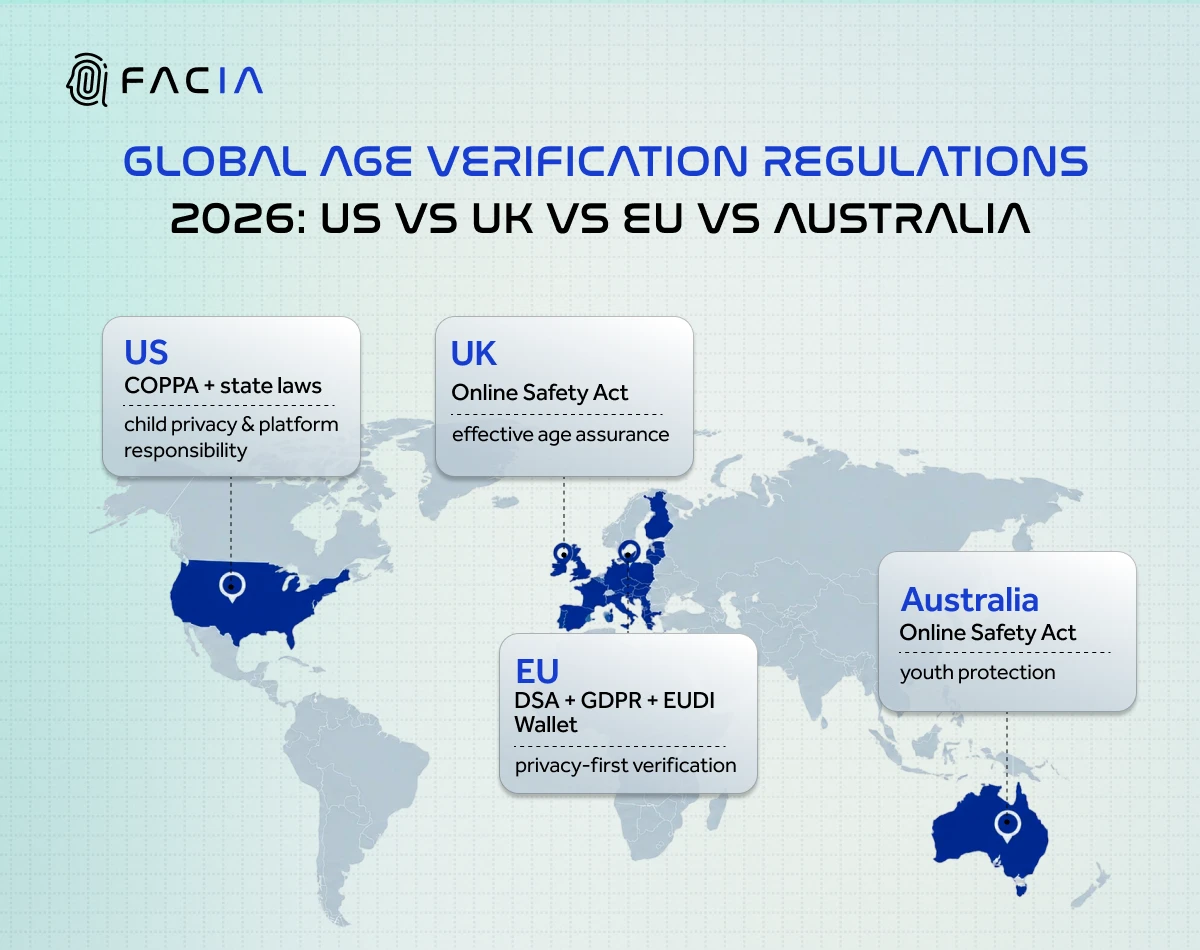
Comparing Global Age Verification Regulations
What Global Age Verification Regulations Mean for Businesses
Overall, digital platforms will be expected to do more to verify user eligibility, though regions are also pursuing different approaches.
Compliance is no longer just about one requirement for businesses operating in several markets. It involves flexible approaches that can accommodate various legal contexts, privacy preferences, and compliance requirements.
Building Flexible Compliance Strategies
The US state-by-state approach, UK age assurance requirements, Australia’s online safety measures, and the EU’s privacy-focused identity model show that age verification will continue evolving.
Businesses need solutions that can support:
- Different regulatory requirements
- Changing age thresholds
- Multiple verification approaches
- Regional privacy expectations
Prioritising Privacy Alongside Verification
Modern regulations are not only asking whether platforms can verify age. They are also asking how user information is handled.
Future-ready approaches must consider:
- Data minimisation
- Secure processing
- Reduced identity exposure
- User control
Balancing Compliance and User Experience
Age verification must protect users without creating unnecessary friction.
The future of digital access will depend on solutions that combine:
- Accuracy
- Security
- Privacy
- Convenience
How Facia Helps Businesses Navigate the Future of Age Verification
Changes in age-appropriate policies for 2026 indicate a complete rethink by digital platforms around security, identity, and trust.
The US, UK, the EU, and Australia are all setting higher age-assurance expectations and requiring more privacy and control for users.
This dynamic landscape demands business technology solutions that enable accurate verification, mitigate fraud risk, and deliver smooth digital experiences.
Facia helps organisations meet evolving age-verification requirements with AI-powered identity verification and age-assurance technology designed for secure, scalable, privacy-conscious digital interactions.
Facia’s advanced facial intelligence and frictionless verification experiences help businesses create a safer online environment and prepare for the next generation of digital identity regulations.
Ready to strengthen your age verification strategy and build trusted digital experiences? Discover how Facia can help your organisation create safer, compliant, and seamless digital journeys.