Top Face Recognition Software Providers in 2026: 10 Platforms Compared
Author: admin | 01 Sep 2026In This Post
Face recognition has become a standard part of digital identity, security, and access systems, but choosing the right provider has become more complicated.
The best facial recognition software in 2026 is expected to do more than match faces accurately. Businesses are also considering liveness detection, spoof resistance, deepfake protection, deployment flexibility, and integration options before deciding which platform best fits their needs.
The market is still moving quickly. As of August 4, 2026, NIST’s Face Recognition Technology Evaluation (FRTE) had evaluated 49 algorithms from 44 unique developers during 2026 alone, showing how competitive and fast-changing the field remains.
At the same time, not all face recognition software providers are built for the same purpose. Some focus on digital onboarding and remote identity verification, while others are designed for large-scale identification, government systems, or developer-led integrations.
This guide compares 10 of the top face recognition vendors based on recognition capabilities, liveness protection, deployment flexibility, integrations, and real-world use cases.
What’s Changed in Face Recognition in 2026?
In 2026, face recognition is undergoing significant transformation from mere matching to enhanced accuracy, security, and regulation. NIST’s latest FRTE Twins Demonstration, dated August 13, 2026, is a step in this direction with more complex recognition scenarios.
Meanwhile, CyberLink released FaceMe SDK 7.9.2 on August 18, 2026, bringing Injection Attack Detection with it, reflecting their increased concern about deepfakes and tampered biometric information.
Regulatory expectations are also increasing, with EU AI Act Article 50 transparency rules applying from August 2, 2026. Together, these shifts make accuracy, spoof resistance, and regulatory readiness equally important when evaluating face recognition software.
For buyers, the takeaway is simple: matching accuracy still matters, but it is no longer the only consideration.
For the buyer, it is easy to say now that it is important to have a match but not the only consideration.
These features give a concrete platform to evaluate face recognition software back in 2026.
What to Look for in AI Face Recognition Tools
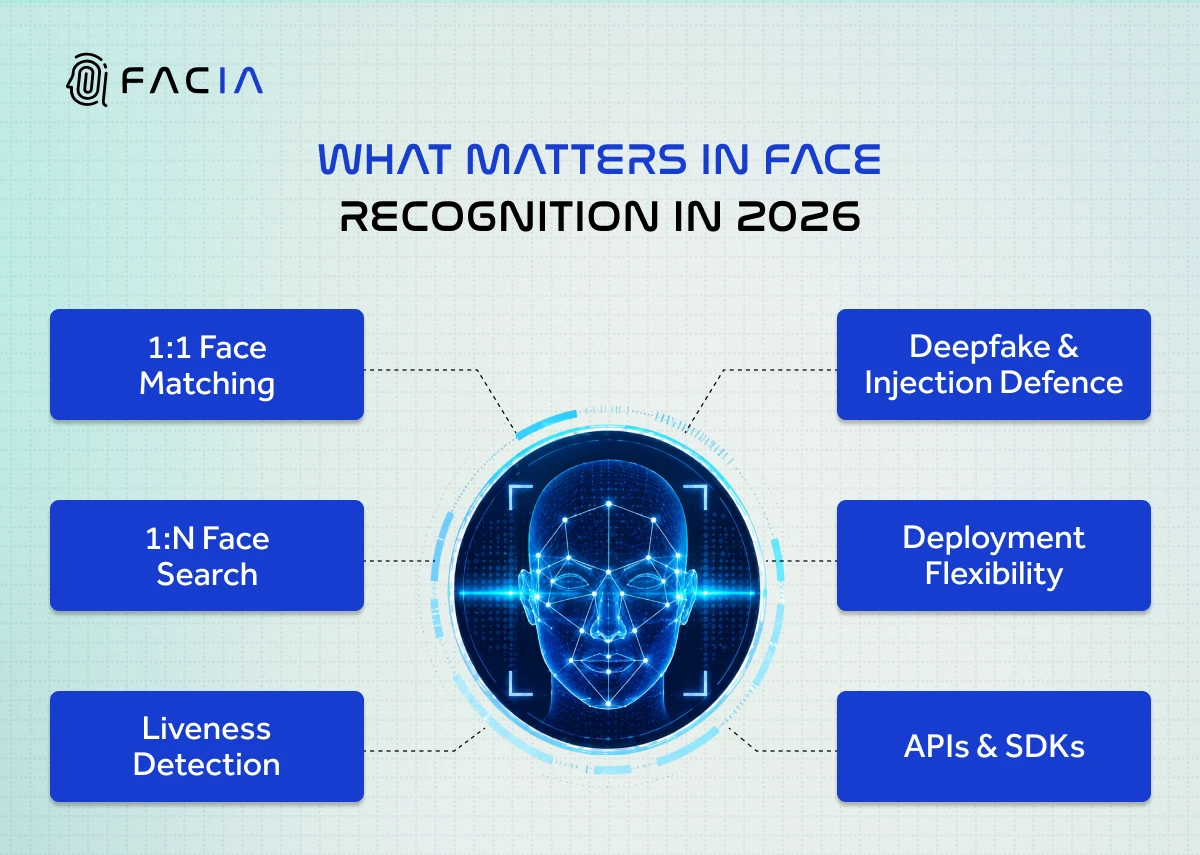
Before choosing a platform, evaluate these core capabilities:
- 1:1 face matching: Verifies a captured face against one claimed identity.
- 1:N face search: Searches one face against multiple enrolled identities.
- Liveness detection: Helps determine whether a genuine person is physically present.
- Deepfake and injection defence: Addresses synthetic and manipulated biometric inputs.
- Speed: Keeps onboarding and authentication friction low.
- Deployment flexibility: Consider requirements across cloud, on-premises, mobile, web, and edge environments.
- APIs and SDKs: Determine how easily the technology integrates with existing systems.
Top Face Recognition Software Providers in 2026
Top Facial Recognition Comparison 2026: Side-by-Side
| Provider | Best For | Key Strength |
| Facia | Secure digital identity | Recognition + DeepLiveness |
| NEC | Large-scale identification | Government-scale biometrics |
| IDEMIA | Identity infrastructure | Large biometric ecosystems |
| Paravision | Developers and OEMs | Recognition SDKs |
| Innovatrics | Flexible deployments | Commercial + government biometrics |
| Cognitec | Custom recognition systems | FaceVACS technology |
| FaceTec | Remote authentication | 3D liveness + matching |
| Amazon Rekognition | Cloud development | AWS face APIs |
| Azure Face | Microsoft environments | Azure integration |
| Aware | High-security biometrics | Multimodal identification |
Detailed Provider Reviews
1. Facia, Best Face Recognition Software Overall
Facia combines facial recognition with liveness and deepfake-oriented identity security. Its face recognition technology supports 1:1 face matching and 1:N face searching for identity verification and search workflows.
In May 2026, Facia introduced DeepLiveness, designed to extend conventional liveness checks by addressing AI-generated faces and digital injection threats. Facia reports that its combined liveness and authenticity checks can operate in under one second.
Best for: Fintech, KYC, digital onboarding, authentication, account security, and businesses that need facial recognition with integrated liveness and deepfake defences.
2. NEC, Best for Large-Scale Identification
NEC is a veteran supplier of biometric identification technology to governments and large-scale deployments.
NEC claimed to be first in four of eight major categories in a NIST FRTE 1:N test in March 2026, which involved a 12-million-person gallery with an ID error rate of 0.06%.
Ideal for: Governments, airports, border security, public safety and high-volume biometric identification.
3. IDEMIA, Best for Identity Infrastructure
The facial recognition technology is integrated with other biometric and identity infrastructure in the IDEMIA framework.
On 13 August 2026, IDEMIA announced first-place status in a number of 1:N scenarios, among them mug shot identification from a gallery of 12 million identities. The firm also said that it reduced ID errors in its Visa Border scenario by over 40% from its previous submission in 2025.
Ideal for: National identity, border management, government agencies and big biometric systems.
4. Paravision, Best Face Recognition SDK
Paravision offers software development kits (SDKs) and deployment tools for face detection, quality analysis, template generation, 1:1 verification, and 1:N identification.
It is developed with the developer in mind; thus, it can be used by organisations that already have facial recognition built into their products.
Ideal for: Developers, OEMs, system integrators and custom biometric platforms.
5. Innovatrics, Best for Flexible Biometric Deployments
Innovatrics offers facial recognition in digital onboarding, access control, fraud prevention, public security, criminal investigation and ID issuance.
Its technology spans a spectrum from commercial identity verification to larger biometric deployments.
Ideal for: Companies that need facial biometrics in various workflows & environments.
6. Cognitec, Best Specialist Face Recognition Engine
Cognitec’s FaceVACS technology is available in SDK and container-based deployments.
Cognitec announced the release of FaceVACS Engine 10.0 in February 2026, including it’s new B16 matching algorithm, which the company states will enhance facial recognition performance in difficult facial poses.
Best suited for: Organisations developing a specific face recognition system.
7. FaceTec, Best for 3D Face Authentication
FaceTec specialises in remote identity verification with 3D liveness and 3D face matching technology.
Its technology is tailored to workflows where companies want to identify and verify users while they are not present.
Ideal for: Digital onboarding, KYC, account recovery and periodic biometric authentication.
8. Amazon Rekognition, Best Cloud Face Recognition API
Amazon Rekognition is a programmable AWS service that enables face comparison and face search.
AWS APIs allow developers to compare facial images and search a face input against facial collections in the cloud.
Most appropriate for: Developers who are creating custom facial recognition workflows in the AWS environment.
Best suited for Microsoft environments.Best for Microsoft Azure environments.
9. Microsoft Azure Face, Best for Microsoft Environments
Microsoft Azure Face provides face detection, recognition, and verification and other face-related biometric features.
But according to Microsoft, face identification and verification are Limited Access features, and they have documentation about eligibility and registration.
It is suitable for: Eligible enterprises that are already using Microsoft Azure.
10. Aware, Best Multimodal Biometric Platform
AwareABIS is designed for scalability and security for biometric identification.
It is also capable of face, fingerprint, and iris identification, so it can be used for organisations that need more than just facial recognition.
Ideal for: Government, Civil identity, law enforcement and multimodal biometric deployments.
How We Evaluated These Providers
We compared publicly available product documentation, facial recognition capabilities, liveness functionality, deployment models, integrations, intended use cases, and independent benchmark information where relevant.
This is a comparison of the markets, not a ranking test. The accuracy of face recognition results may differ based on the database, image quality, thresholds, demographics, and deployment environment.
NIST’s ongoing FRTE program also evaluates recognition systems across various scenarios rather than assigning a single universal score to every provider.
Face Recognition vs Face Verification
Face verification (1:1) asks whether a captured face matches one claimed by an identity, for example, whether a selfie matches the image on an identity document.
Face identification (1:N) searches one captured face against multiple enrolled identities to locate potential matches.
The difference becomes clearer when the two workflows are viewed side by side.”
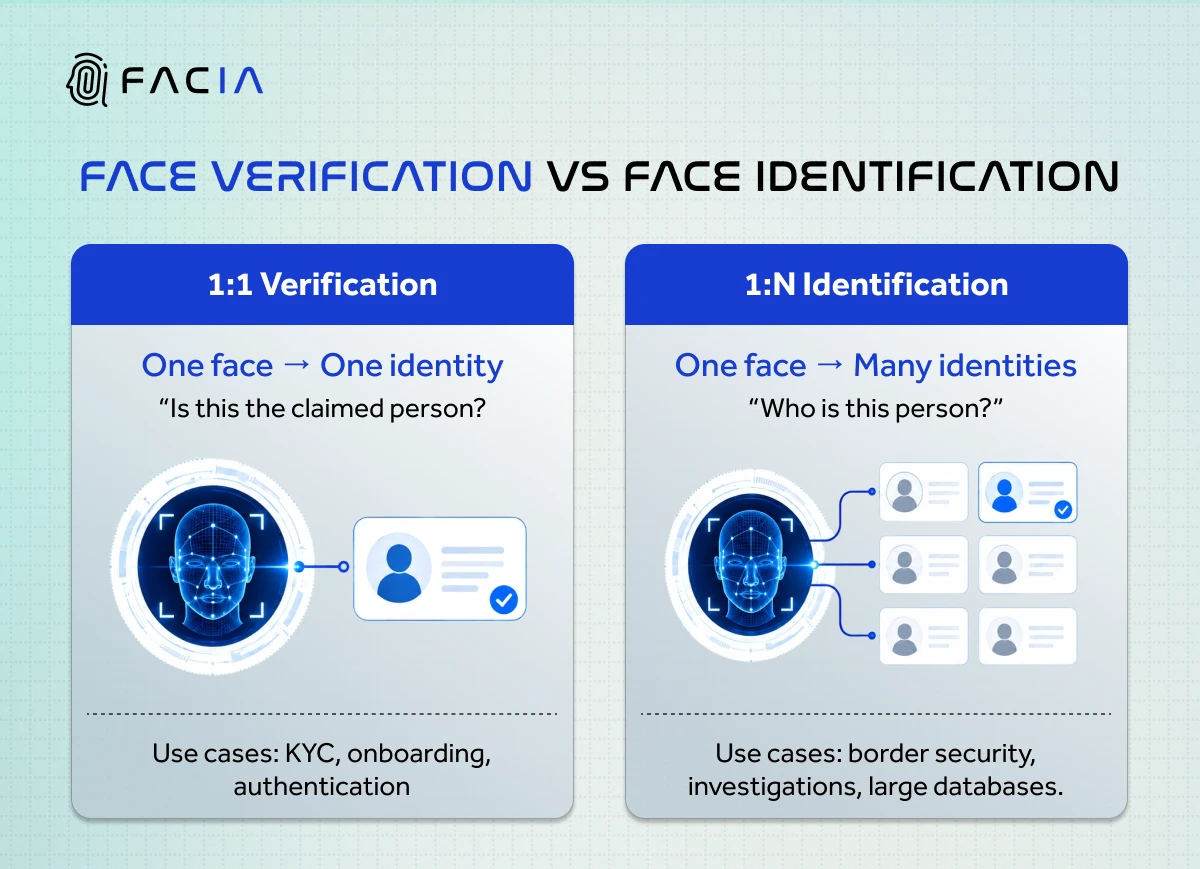
The distinction matters because software designed for digital customer verification may have very different requirements from a system intended to search millions of enrolled identities.
Why Liveness and Deepfake Protection Matter
Even state-of-the-art face matching cannot guarantee that the biometric input was from a genuine person who was present for the verification.
The biometric capture process can be targeted by printed photos, replayed videos, masks, AI-generated faces, virtual cameras, and digitally injected content.
CyberLink FaceMe’s release of dedicated Injection Attack Detection in August 2026 exemplifies how the industry is evolving to incorporate the integrity of captures as an additional security layer to face matching and presentation attack detection.
To reflect this change, Facia’s DeepLiveness technology introduces a new range of proof-of-presence checks and safeguards against AI face and digitally injected biometric content.
How Facia Helps Businesses Choose Better Face Recognition
Modern face recognition has to solve more than identity matching. Businesses also need to defend against deepfakes, spoofing, replay attacks, digital injection, and onboarding fraud while keeping verification fast and friction low.
Facia addresses these challenges by combining 1:1 face verification, 1:N face search, liveness detection, and DeepLiveness protection into a single biometric stack. This makes it especially relevant for fintech, KYC, digital onboarding, account security, and other remote identity verification workflows where both identity accuracy and biometric authenticity matter.
While NEC, IDEMIA, Paravision, and other providers are strong for specific government, infrastructure, or developer use cases, Facia stands out for businesses seeking a more complete approach to secure facial verification.
Looking for the best face recognition software for secure digital identity verification?
Explore Facia’s face recognition technology and strengthen your onboarding and authentication workflows against modern biometric fraud.