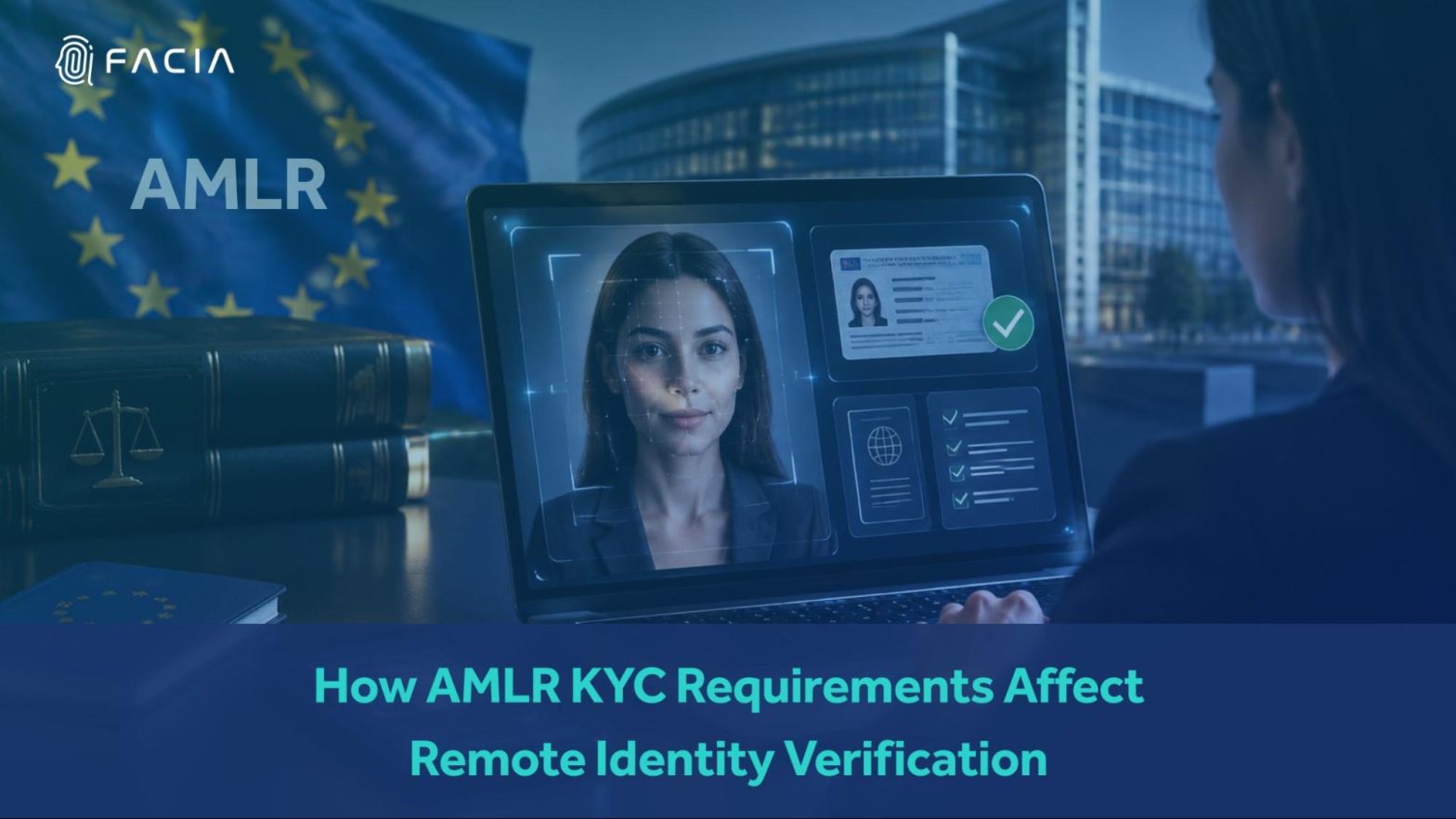
How AMLR KYC Requirements Affect Remote Identity Verification
Author: admin | 24 Sep 2026In This Post
Remote KYC has transformed customer onboarding. Identity checks that once required an in-person visit can now be completed through a smartphone or computer.
But remote onboarding creates a different challenge. Checking an identity document does not automatically prove that the person presenting it is its legitimate owner or that the verification session itself is genuine.
This matters as businesses prepare for the EU Anti-Money Laundering Regulation, Regulation EU 2024/1624, which will apply from 10 July 2027 for most obliged entities.
The regulation introduces directly applicable anti-money laundering requirements across EU Member States and places customer identification and verification at the centre of customer due diligence.
For organisations customers onboarding digitally, understanding how AMLR KYC requirements affect remote identity verification is becoming an important part of preparing for 2027.
What Is the EU AMLR and Why Does It Matter for KYC
The EU AMLR is designed to create a more consistent anti-money laundering and counter terrorist financing framework across Europe.
Unlike directives that must be implemented through national legislation, the AMLR applies directly across EU Member States.
Customer identification and verification are central to these requirements.
Under AMLR, obliged entities must identify customers, verify their identities, identify beneficial owners and understand the purpose and intended nature of business relationships. Businesses must also apply ongoing monitoring and enhanced measures where higher levels of risk are identified.
This means AMLR KYC is not simply about collecting names, dates of birth or identity documents.
Businesses need appropriate methods to establish confidence that the identity information provided genuinely belongs to the customer completing the onboarding process.
What Are the Main AMLR KYC Requirements
AMLR defines the following fundamentals for customer due diligence.
These encompass customer identification and verification, beneficial owner identification, understanding business relationships, susceptibility to relevant sanctions and higher levels of due diligence when additional risk exists. Continuous monitoring is also a key element of the framework.
For remote onboarding, customer identity verification becomes particularly important because there is no physical interaction between the customer and the organisation
The question now is whether a customer submitted valid information is no longer simple.
It’s whether the information can be linked back to the real person behind the digital interaction, reliably.
How Does AMLR Affect Customer Identity Verification
AMLR requires customer identity information to be obtained and verified using appropriate evidence.
This can be for real persons, identity documents, and reliable independent sources. The regulation also acknowledges the electronic identification methods from the European digital identity framework, which are eligible for use.
Identity is becoming more and more important in Europe through electronic means. In 2025, 52% of the EU’s 16- to 74-year-olds used eID to access online services, and around 25% to access services offered by businesses, according to Eurostat.
European Digital Identity Regulation provides the general architecture for the European Digital Identity Wallets and trusted electronic identification
Importantly, AMLR does not require all customers to be subjected to facial recognition or biometric liveness detection.
Instead, it sets forth the requirements for identity verification. Compliance with regulations and risk exposure/onboarding environment are what must be decided by businesses regarding processes and technologies.
Why Remote KYC Creates a Greater Identity Challenge
Remote onboarding removes the physical interaction traditionally available during customer verification.
Digital KYC systems therefore need to answer several questions.
Is the identity document authentic?
Does the person match the identity being presented?
Is a genuine person actually present?
Can the capture process itself be trusted?
Modern identity fraud can target each of these layers.
Fraudsters may combine stolen identity documents with photographs, prerecorded videos, face swaps or AI-generated deepfakes. More advanced attacks can attempt to inject manipulated media directly into a verification flow rather than presenting it to a physical camera.
Remote KYC therefore needs to establish confidence in both the identity and the digital interaction.
Why Deepfakes Matter for AMLR KYC
Deepfakes make the remote identity problem more complex.
An identity may be legitimate. Its supporting document may also be genuine. Yet the person appearing during verification could still be impersonating the real customer.
This threat is already receiving regulatory attention.
The European Banking Authority reported in its 2025 assessment of money laundering and terrorist financing risks that criminal networks were exploiting generative AI technologies, including deepfakes, to bypass standard remote identity verification measures.
For businesses preparing for AMLR KYC requirements, this highlights an important weakness in relying only on document checks or basic face matching.
Remote KYC increasingly needs to establish whether the customer is genuine, whether the biometric interaction is authentic and whether the capture environment has been manipulated.
Where Biometric Verification Fits Into AMLR KYC
Biometric technologies can strengthen remote identity assurance as part of a broader KYC process.
A robust digital verification journey should consider four questions:
Is the identity evidence trustworthy?
Does the face match the claimed identity?
Is a genuine person present?
Has the verification session been manipulated?
Face verification can help establish whether the person completing onboarding matches the facial identity associated with a trusted reference image.
Liveness detection can help distinguish genuine users from presentation attacks involving photographs, screens, masks or manipulated media.
Deepfake detection can help identify synthetic or altered facial content.
Injection attack protection can help detect attempts to introduce manipulated media directly into the verification workflow.
These technologies do not replace broader KYC regulations or automatically guarantee AMLR compliance. Instead, they can strengthen the identity verification layer that supports remote customer due diligence.
How Businesses Can Prepare Remote KYC for AMLR
With AMLR approaching in 2027, organisations should review how identity is established throughout their remote onboarding process.
This means looking beyond document collection.
Businesses should evaluate identity document verification, facial matching, liveness detection, deepfake resilience, injection attack protection and higher-risk customer journeys.
Businesses should also assess manual review processes, fallback verification methods, and auditability.
The objective should be to identify where confidence in customer identity could break down and whether current controls are designed for emerging forms of digital identity fraud.
Preparing early gives businesses time to strengthen those gaps before the new AMLR framework becomes applicable.
How Facia Helps You Prepare for AMLR KYC
Preparing for upcoming AMLR KYC requirements requires more than updating compliance policies. Businesses also need remote verification processes that can respond to modern identity fraud.
Facia helps organisations strengthen this layer through Face Verification, DeepLiveness, Deepfake Detection and Injection Attack Protection.
Face Verification helps determine whether the customer matches the identity being presented. DeepLiveness helps establish whether a genuine person is present. Deepfake Detection helps identify synthetic or manipulated facial content, while Injection Attack Protection helps defend verification journeys against digitally injected media.
Together, these capabilities help businesses strengthen identity assurance throughout remote KYC.
As the EU AMLR moves toward application in 2027, the goal should not simply be collecting more customer information. It should be establishing greater confidence in who is actually behind that identity.
Facia empowers businesses to strengthen remote KYC today and build more resilient identity verification processes for future AMLR requirements.