How Fake AI Selfies Bypass Identity Verification
Author: admin | 16 Apr 2026In This Post
Identity theft is no longer necessary for fraudsters. They produce one.
In 2026, attackers can generate realistic faces, fabricate identity assets, and push synthetic video through remote onboarding flows at a scale many verification systems were not built to catch. FinCEN has warned that criminals are using generative AI to create fake documents, photos, and videos to circumvent customer identification and verification controls, with suspicious activity reports increasingly describing deepfake-enabled fraud at onboarding.
That shift changes the real question for digital onboarding. It is no longer only whether a face appears live on camera. It is whether the face, the video stream, and the session itself are genuine.
As synthetic identity attacks become easier to create and harder to detect through standard checks, organizations relying on traditional onboarding controls face growing exposure at the point where trust is first established. This article explores how AI-generated faces bypass identity verification, where conventional checks fall short, and what a stronger detection architecture now requires.
The Attack Is Cheaper Than You Think
Fraud teams construct their risk assessment models based on their assumption of organized criminal groups that possess adequate resources. The current model no longer shows the actual distribution of threats between different areas.
The BIIA 2026 Synthetic Identity Fraud report shows that 8.3 percent of digital onboarding attempts were marked as suspicious during the first six months of 2025. The banks consider digital onboarding to be their most dangerous point for synthetic identity risk, according to 62 percent of institutions. The speed of attacks has outpaced the development of detection systems. KYC processes now experience synthetic attacks, which use controlled timing and spreading methods to bypass velocity detection systems, causing the attacks to display as authentic applicant behavior rather than an organized fraud attempt.
Where KYC Actually Breaks
The standard onboarding procedure for customers includes three authentication processes, which include document verification, liveness verification, and face matching. Deepfake attacks do not need to defeat all three. The attackers only need to penetrate the system. The weakest security measure, which most systems use as their primary protection, this particular system depends on the attackers to achieve their goal.
There are two distinct attack types, and fraud teams need to model them separately.
Presentation attacks work by changing the way the camera records visual information. A fraudster shows a pre-recorded deepfake video on the device or uses a face-swap tool that operates in real time. The KYC system detects a live person who shows active blinking and head movement. The system uses passive liveness detection to evaluate the frame and determine whether it shows a living human being.
Injection attacks: The problem of injection attacks presents a distinct challenge to cybersecurity. The attacker skips the camera system instead of tricking it. The virtual camera driver controls the video stream because it operates between the KYC application and the actual input from the user. The KYC application does not handle authentic video content but instead receives a specially designed synthetic stream that hides its true nature from detection methods.
The 2026 Cybercrime Atlas from the World Economic Forum tested virtual camera injection against live front-camera KYC flows and found that it works around a lot of active liveness implementations, including systems that ask for blinks, smiles, and head turns, all of which a responsive synthetic stream can copy.
Why Standard Checks Miss Injection Attacks
Passive liveness was designed to answer just one question: Is the face it shows actually alive? Or is it a glossy photograph or video replay?
The correct question to ask about spoofing required the demonstration of photographic evidence through direct camera display. The 2026 synthetic stream system delivers its high-quality stream with actual texture variation, micro-movement, and responsive motion features, which researchers use for their passive analysis work because the system was built to meet those assessment requirements.
The fraud lead needs to ask a different question because “Does this look like a live face?” does not serve as the proper inquiry. The answer to the question led to detection before the video reached its processing point. The actual inquiry needs to determine whether “the video signal authenticates itself and the detection system can process depth information together with frame artifacts and session signals.”
The Detection Stack That Closes All Five Vectors
Stopping AI-generated selfie fraud requires detection across three layers running simultaneously.
Layer 1: 3D active and passive liveness. Both modes need to run on 3D depth analysis, not 2D frame texture. Depth data distinguishes a real face from a synthetic face engineered to approximate depth cues. Active liveness raises the bar on presentation attacks by requiring unpredictable, prompted actions.
Layer 2: Deepfake and synthetic media detection. A deepfake detection engine analyzes frame-level artifacts, GAN-specific compression patterns, and temporal consistency, signals that liveness analysis does not examine. This layer needs to run during the KYC session, not as a post-submission review.
Layer 3: Injection signal analysis. Device integrity checks, virtual camera driver detection, and session metadata consistency identify attacks that produce a visually convincing synthetic stream. A system that evaluates only frame content cannot stop an attack arriving through a compromised pipeline.
Server-side liveness checks the image after it arrives, by which point a virtual camera injection has already replaced the real feed.
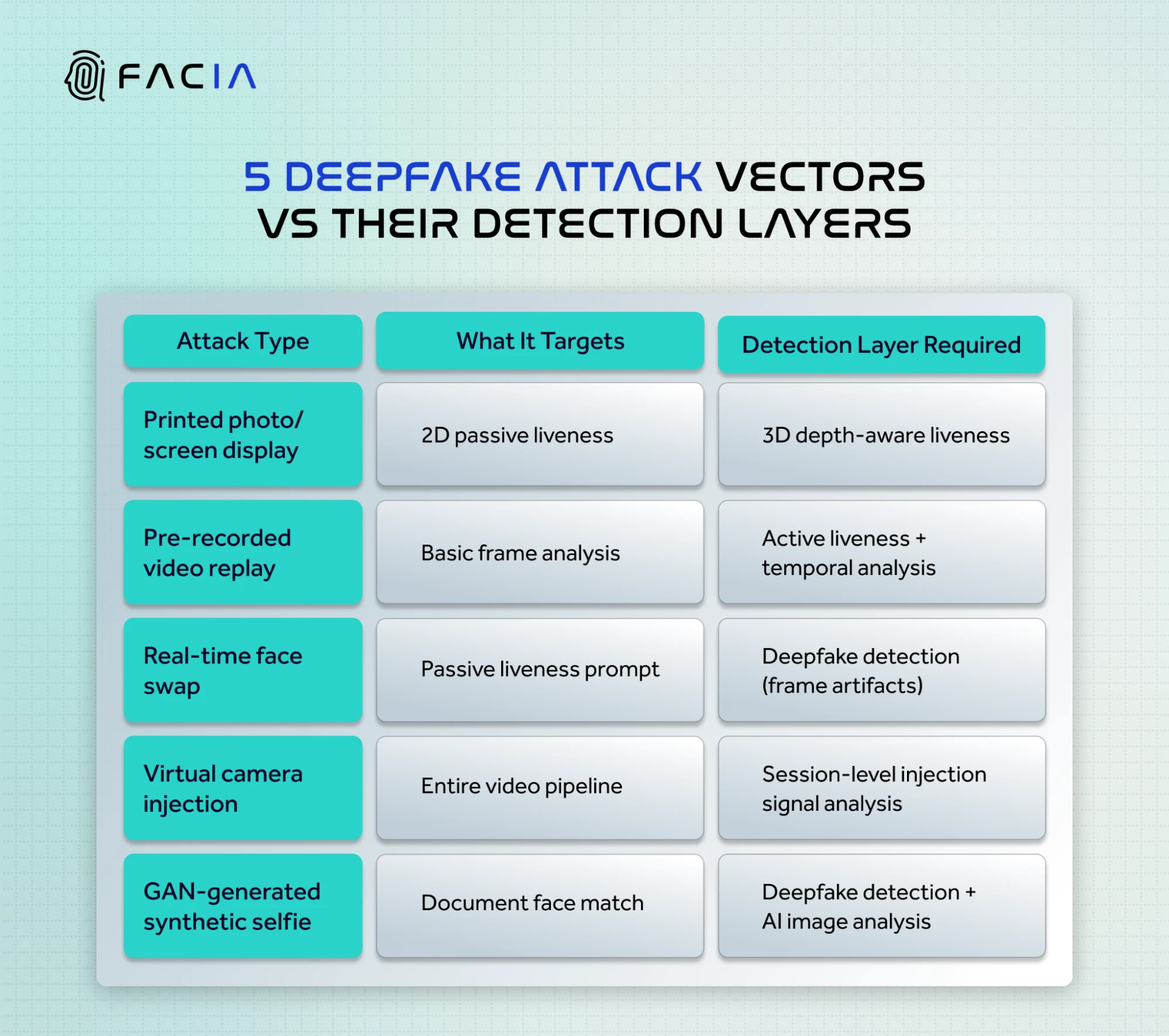
No single check closes all five vectors. The stack needs to run concurrently.
How Facia Detects AI-Generated Faces at the KYC Layer
Facia’s detection architecture covers all three layers within a single API integration , no separate deepfake vendor, no hardware change, no replacement of existing identity infrastructure.
Facia holds iBeta Level 2 / ISO 30107-3 PAD compliance, 0% APCER (Attack Presentation Classification Error Rate) on both Android and iOS, with a 1-in-100-million false acceptance rate (FAR), a sub-1% false rejection rate (FRR), and sub-1-second verification speed.
Morpheus 2.0 has achieved 100% detection accuracy. Across 100,000+ images and videos in aggregate testing, overall accuracy is 99.6%. A synthetic face triggers rejection before the application processes further, not after a post-submission review. A customer in AI-based hiring reported that Facia’s detection identified 15% of applicants submitting deepfakes during automated interview sessions, a figure that reflects how prevalent synthetic attempts already are inside digital identity workflows.
For fintech teams concerned about post-onboarding risk, step-up authentication extends the same biometric layer to high-risk moments inside an authenticated session, fund transfers, account changes, and privilege escalation. A fraudulent account that passes onboarding cannot execute high-value transactions without triggering a live biometric re-verification.
Facia deploys via Android SDK, iOS SDK, or REST API with no proprietary hardware required. For institutions with data residency requirements under GDPR or sector-specific regulation, on-premises deployment keeps biometric templates within the institution’s own infrastructure.
Fraud and compliance teams evaluating applicable deepfake laws by jurisdiction can reference Facia’s directory, which covers regulations across 40+ countries.
Learn how to update your existing technology according to changing regulations. Book a Demo Today.
Frequently Asked Questions
Traditional selfie fraud uses stolen images or simple spoofing like screen replays. Deepfake fraud uses AI-generated faces that can mimic real-time movements, making detection much harder.
Advanced liveness detection can accurately spot real users using depth, texture, and behavior analysis. It is highly reliable against spoofing attempts, including deepfakes.
Deepfakes will push companies to adopt stronger, real-time identity verification methods. This includes biometrics and continuous authentication beyond just login.