Can AI Agents Verify Their Own Identity? Agentic Identity Verification
Author: Carter H | 27 Aug 2026In This Post
An AI agent can access customer data, call APIs, approve actions and interact with business systems in seconds. But before any organisation trusts it to act, there is a more important question: how do you prove that the agent is really who it claims to be?
Agentic AI is still emerging, but adoption is beginning to grow. Research from the UK Department for Science, Innovation and Technology, based on 3,500 businesses, found that only 7% of businesses already using AI were using agentic AI.
As more organisations deploy autonomous agents, identity management becomes harder. Businesses need to know which agent is acting, who authorised it and what it is allowed to do.
And when that authority comes from a customer, employee or account holder, another question matters just as much: can the human behind the agent be trusted too?
In this blog, we explore how AI agent identity verification works, why authentication and authorisation must remain separate, and where human identity verification fits into the trust chain. We’ll also look at the security risks businesses should consider as agentic AI becomes more common and why a strong human trust layer still matters.
What Is AI Agent Identity?
The identity of AI agents is the digital identifier that allows them to be distinguished as different agents.
Agents require unique identities when accessing applications, data, or services without other agents. An agent identity can contain an identifier, credentials, the organisation running the agent, the agent’s represented entity, and its permissions.
It is important for businesses to be aware of which agent took action, what authority the agent had and who is responsible.
Separate agent and human credentials provide auditing clarity and help distinguish human from autonomous actions.
How AI Agent Identity Verification Works
AI agent identity verification helps identify the AI agent and link its identity to a trusted source.
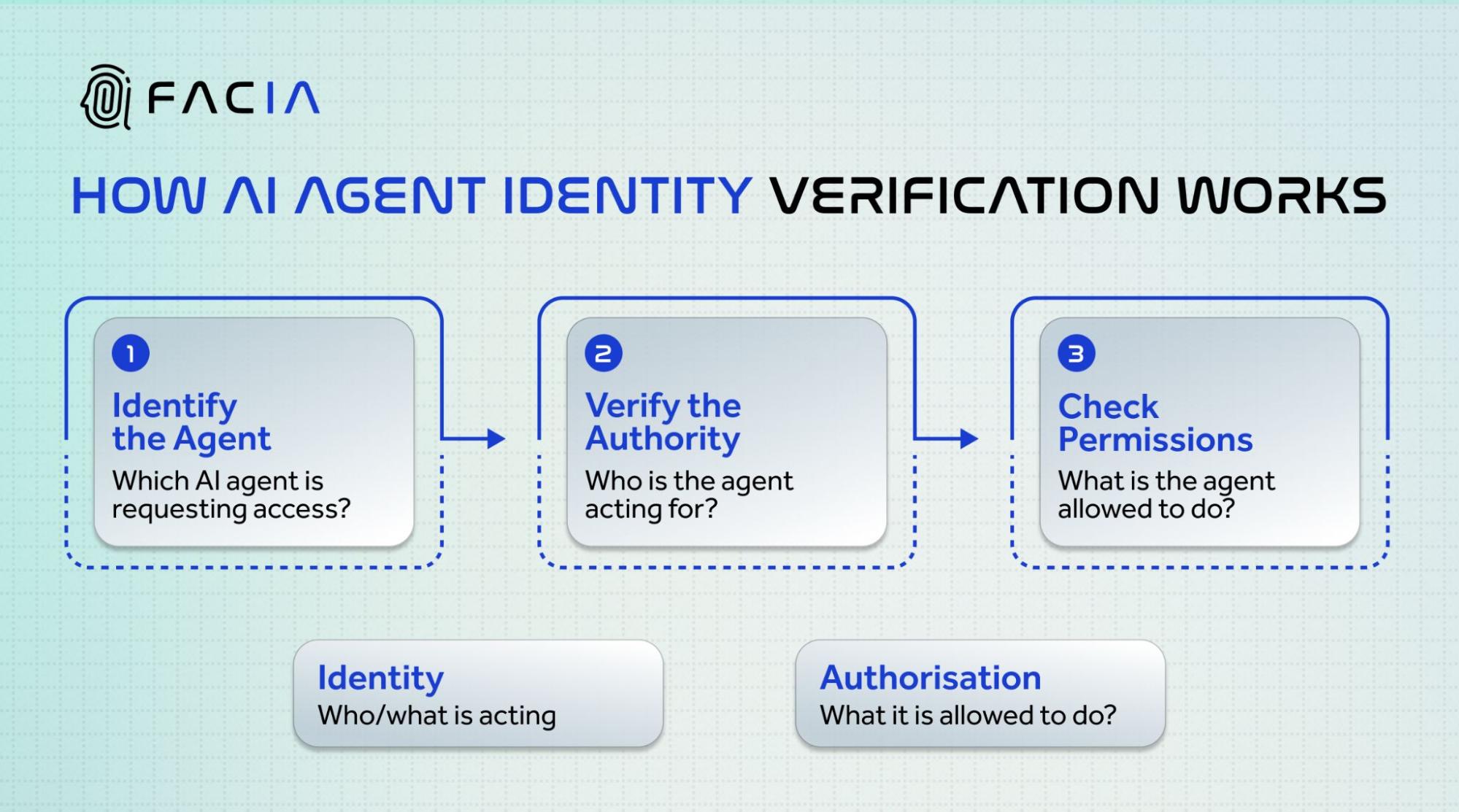
Which AI Agent Is Requesting Access?
A company may use separate agents for customer service, payments or internal operations. Each needs a distinct identity so approved software can be separated from unknown agents or impersonators.
Cryptographic credentials and certificates establish that distinction.
Who Is the AI Agent Acting For?
An agent may act for a customer, employee, company or application. Some also have permissions assigned directly to them.
Systems therefore need to preserve the connection between the agent and the person or organisation that authorised it.
What Is the AI Agent Allowed to Do?
A verified identity should never mean unlimited access.
A purchasing agent authorised to approve orders up to $1,000 may prove its identity and still have no authority to approve a $50,000 purchase.
Identity establishes who or what is acting. Authorisation defines what that identity may do.
Can AI Agents Verify Their Own Identity?
An AI agent can present identity evidence, but it should not decide whether that evidence is trustworthy.
It can return an access token, a cryptographic key, or a digital certificate during a service connection. The receiving system then checks that credential with a trusted identity source.
If it is not validated independently, the process is circular. As a person would present an identity document, an agent may present evidence without determining its authenticity.
They can validate trusted credentials but don’t need to be the ultimate source of trust.
How AI Agent Authentication and Authorisation Work Together
AI agent authentication ensures that an agent is verified before they can use an application, API, or service.
Authentication queries: Who are you?
Authorisation questions: What can I do?
A customer service agent might be able to view the order status, but not approve a large refund. A financial agent could review transactions on your account but would need your consent to make account transfers.
Only the permissions necessary for the agent’s job should be granted to him, and his permissions should be checked, scaled back, or withdrawn if circumstances change.
AI Agents Acting for Themselves vs Humans
Some agents have permissions assigned directly to them. Others act using authority delegated by a person.
If a human is involved, systems should remember two people: the agent performing the action and the person who gave them permission. When they are connected, it’s easier to know who is responsible.
Why AI Agent Identity Management Matters
Permissions, access, and credentials should be controlled throughout an agent’s Life Cycle.
Security teams should be aware of which agents are operating, who is responsible for them, what they have access to, and if their privileges are still appropriate.
Later, agents might be corrupted, and unused credentials could remain active. Effective identity management helps to minimise forgotten access and over-permission.
AI Agent Activity Needs to Be Traceable
The ability to trace an agent’s action to a specific transaction type and agent should be available when the record is changed, sensitive information is accessed, or a transaction is approved.
The audit trail should include the agent’s relationship to the person if the agent represented that person. A record that contains only an action taken by AI is inadequate in high-risk settings.
Why Human Identity Verification Still Matters
AI agent identities do not remove people from the trust equation.
Often, an agent’s authority begins with a human. A bank may authenticate an AI financial agent through machine credentials while still needing to confirm that the genuine account holder approved it.
A practical trust chain may look like:
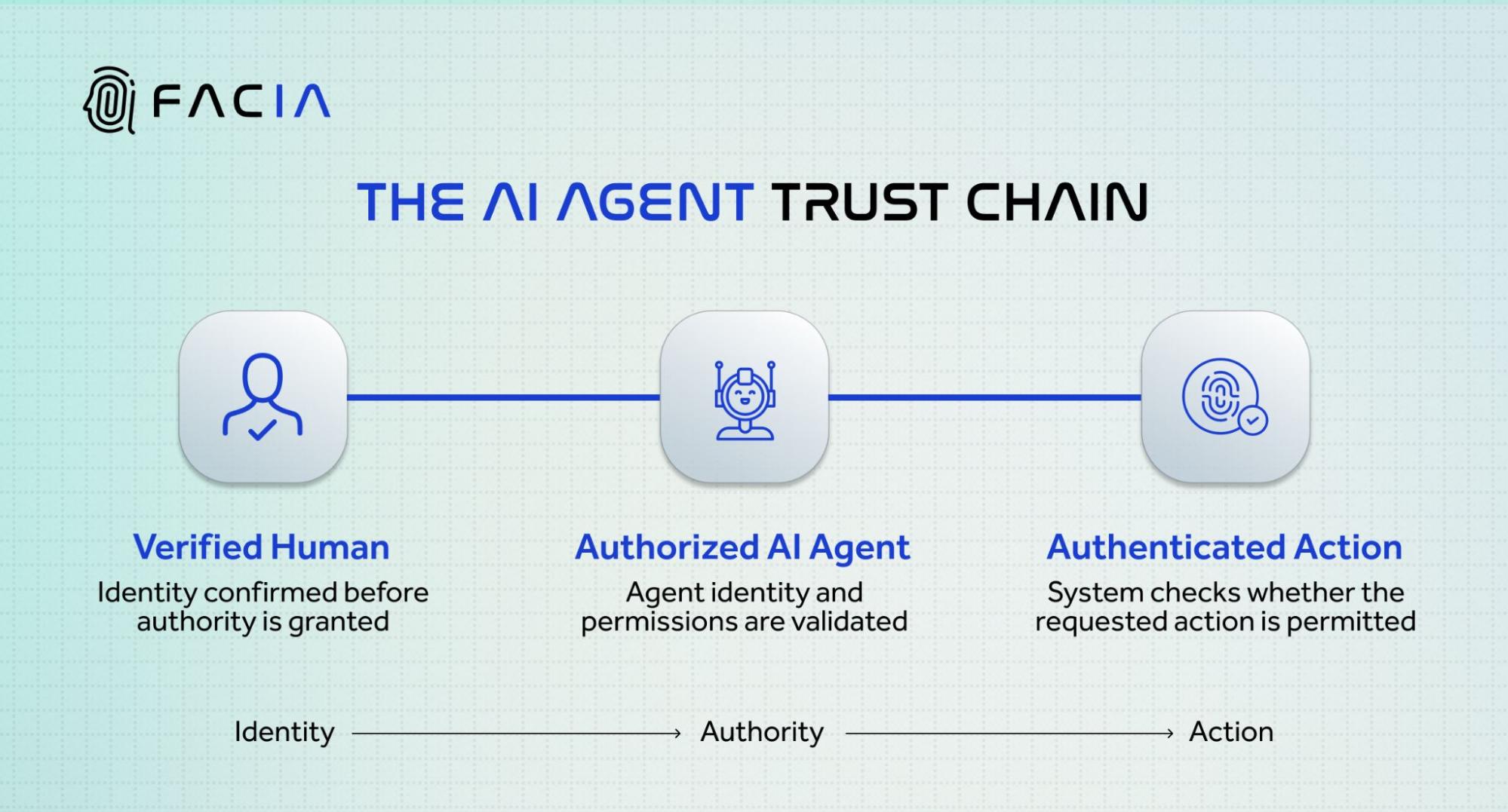
Routine tasks can stay automated, while account recovery or high-value transactions may require stronger human verification.
AI Agent Identity Security Risks Businesses Should Consider
Authentication confirms identity. It does not guarantee safe behaviour.
In a 2026 security exercise, the NIST AI Agents reported more than 250,000 attack attempts by over 400 participants across 13 frontier models, with at least one successful agent-hijacking attack against every model tested.
An authenticated agent can still be manipulated. Organisations also need to consider impersonation, stolen credentials, excessive permissions, prompt injection, unauthorised delegation, synthetic identities and deepfake-based authorisation attempts.
Identity verification, therefore, needs to work alongside access controls, monitoring, and risk-based security.
AI Agent Identity Verification Needs a Human Trust Layer
Agentic journeys can involve two separate identity checks:
Is this the legitimate AI agent?
Is the person behind its authority genuinely who they claim to be?
That second question is where biometric identity verification matters.
Selfie-to-ID matching can compare a live selfie with the portrait on an identity document. Face verification can determine whether the images belong to the same person, while liveness detection helps confirm that a real person is present rather than a photo, replay or presentation attack.
Businesses comparing photo ID matching software providers should also consider how face matching works with document verification, liveness detection and deepfake protection.
These technologies do not authenticate the agent itself. They strengthen the identity of the human who creates, authorises, or regains control of that agent.
The Future of AI Agent Identity Verification
As autonomous agents gain access to more valuable systems and data, businesses will need to treat them as a distinct class of digital identity.
Organisations will need to know which agent is operating, who owns it, what it can access and whether its authority remains valid.
Verification will become more risk-based. An order-status agent may operate without interruption, while a high-value transaction could trigger stronger authentication or human approval. The goal is traceable, accountable autonomy.
Conclusion: How Facia Strengthens Trust Behind AI Agent Identity
As AI agents gain more responsibility, businesses must verify the agent, its permissions, and the person authorising it. If human identity is compromised, access by a legitimate-looking agent can still enable fraud.
Facia helps secure this point in the trust chain by verifying the human before sensitive authority is passed to the agent. Its face verification technology can compare the user’s live selfie with the identity on record, while liveness detection helps confirm that a real person is present during the verification process.
Deepfake detection adds another layer by helping identify manipulated or synthetic facial content that could otherwise be used to approve access or high-risk actions. This allows businesses to implement stronger identity checks at moments such as authorising an AI agent, changing its permissions, recovering an account, or approving a sensitive transaction.
Build a stronger human-trust layer for AI agent authorisation with Facia’s face-verification solution. Book a Demo Today.