Why 3D Mask Spoofing Is a Serious Facial Recognition Risk
Author: admin | 29 Dec 2025In This Post
Biometric authentication has emerged as a crucial element of digital trust. The use of facial biometrics for identity verification at scale is becoming more common in financial institutions, government agencies, airports, and other businesses. However, with the increasing dependence on this technology, the possibility of attacks also increases.
Among the most sophisticated threats facing biometric systems today is face recognition spoofing using 3D face masks , a form of presentation attack that leverages realistic three-dimensional replicas to deceive automated systems.
Unlike basic photo or video replay attempts, 3D mask spoofing introduces realistic depth, contours, and facial geometry into the attack flow. This not only challenges conventional face recognition models but also forces institutions to rethink how identity verification should balance usability with security.
How 3D Mask Attacks on Facial Recognition Really Work
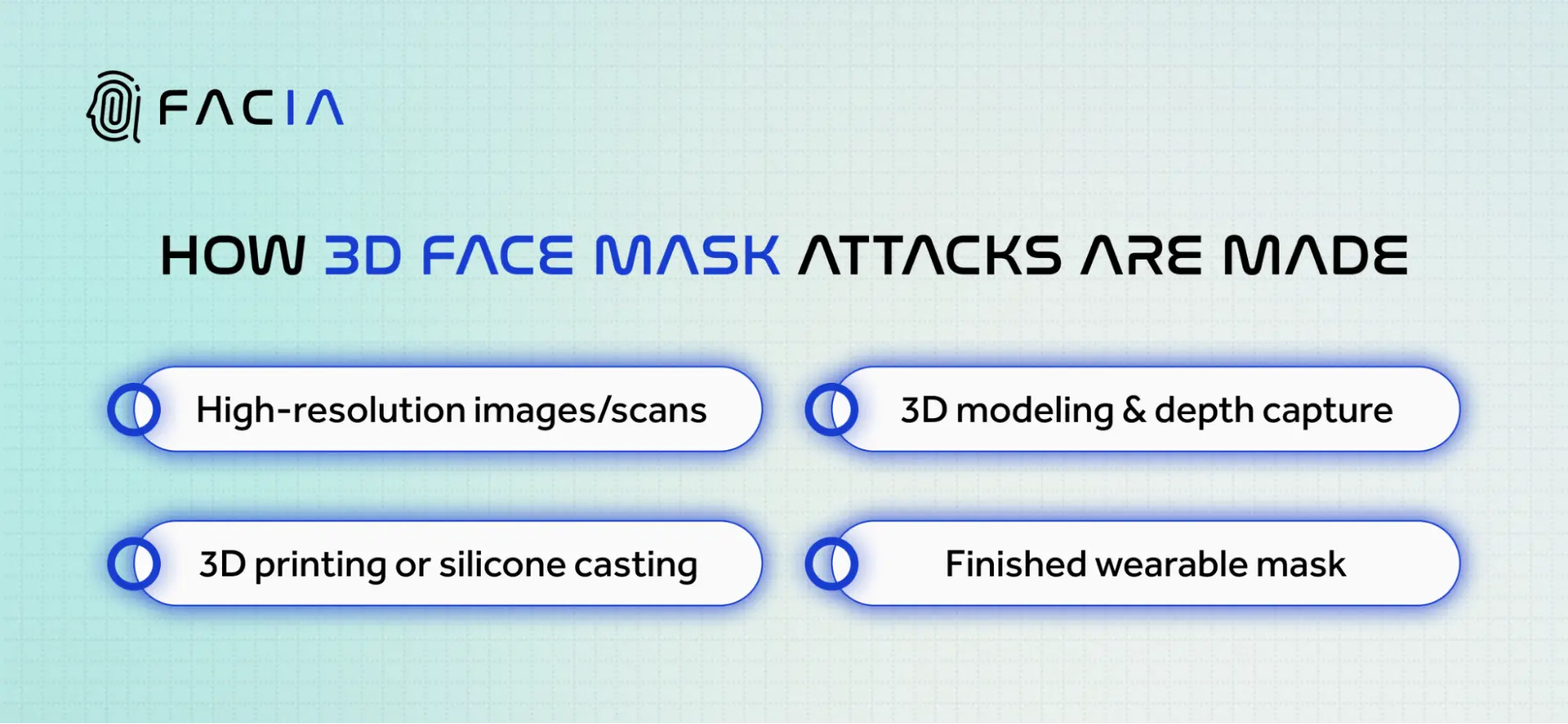
The 3D mask presentation attack is a method that involves the use of full-sized, three-dimensionally printed human face models that are able to imitate the face of a particular person. Generally, these masks are made by:
- High-resolution images or photogrammetry,
- Depth scanning, and
- 3D printing or silicone/resin casting to copy the texture and contours.
Silicone, resin, or latex are among the materials that help mimic the skin in terms of texture and shade, thus making it possible for the masks to have very realistic surface features that can trick the vision algorithms aimed at shape and color detection.
When presented to a facial recognition system, a high-quality 3D mask attempts to impersonate a legitimate user by exploiting systems that focus primarily on geometric patterns rather than biological signals. Without robust anti-spoofing checks, many systems can mistake the mask for a real face because it successfully mimics depth cues and three-dimensional contours.
Research published in the study A Survey on 3D Mask Presentation Attack Detection and Countermeasures shows that false acceptance rates (FAR) increase sharply when 3D masks are introduced to systems that lack active liveness detection capabilities , making these attacks far more effective than simple printed photos or replay videos.
Why Traditional Face Recognition Systems Struggle
Numerous initial face recognition implementations were designed primarily for visual similarity, relying on the geometric patterns of faces from one camera frame only. The method was successfully applied to simple identity matching, but it brought about some drawbacks, too, such as:
1. Focus on Geometry, Not Biology
Traditional models focus on distance and texture patterns, but they don’t check if the face is really alive biologically. Consequently, a 3D mask that mimics face shape can still get a high similarity score even though it is devoid of skin elasticity, blood flow, or micro-muscle activity.
2. Static Verification is Too Weak
Decisions made by systems that rely on just one image can’t tell apart very slight differences that exist between actual skin and artificial materials. Hence, mask attacks, which can’t be detected due to the lack of temporal or multi-sensor analysis, are not restricted anymore.
3. Usability-Driven Designs Reduce Security Signals
To minimize the friction caused to users, a lot of facial biometric systems have the following features:
- Only taking short video snippets,
- Not prompting head movement directions, and
- Using only little lighting or infrared cues.
The lower quality of the data makes it less difficult for the system to reveal spoofing attempts.
4. Lack of Layered Defenses Leads to Blind Spots
It is quite common for Presentation Attack Detection (PAD) methods, such as motion tests, depth checking, or skin reflectance modeling, to not be applied or not improved sufficiently during training on real 3D masks, thus making the systems open to attacks.
The National Institute of Standards and Technology (NIST) has repeatedly highlighted these weaknesses in its biometric evaluations, especially when systems operate without strong PAD.
Systemic Gaps That 3D Mask Attacks Exploit
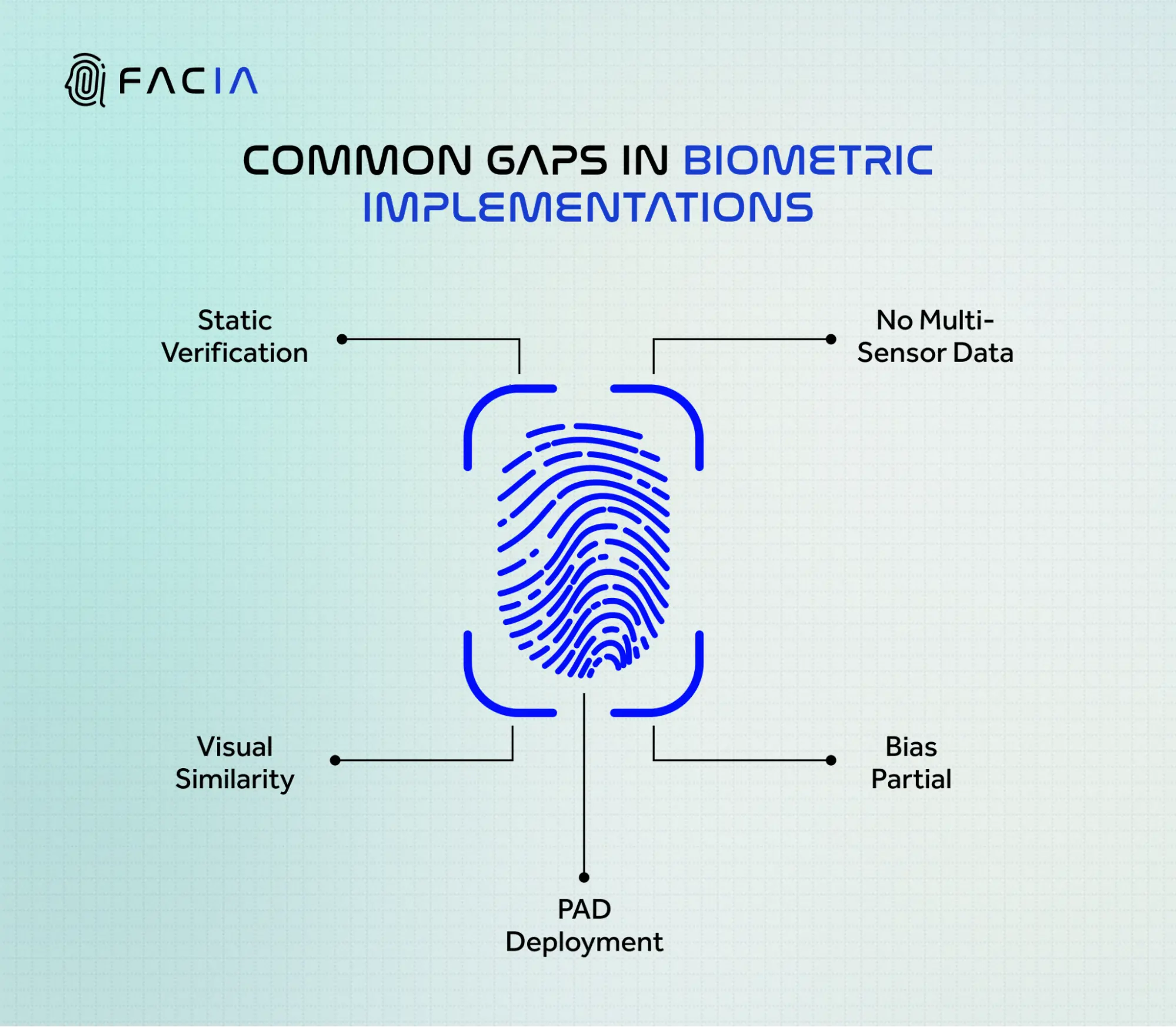
Spoofing of the 3D mask occurs due to a series of systemic gaps that are typical of many biometric implementations:
Static Image Verification
Using just one image or a single photograph that represents some biometric feature or characteristic will not be enough to confirm the presence of a person or even a living one.
Absence of Multi-Sensor Sensing
Systems without depth sensing, infrared, or multi-spectral analysis can’t distinguish between real skin and synthetic surface materials.
Overreliance on Visual Similarity
High similarity thresholds can mask the absence of biological signals.
Cost-Driven Partial Deployments
Budget constraints often lead to partial PAD integration, reducing resilience.
These gaps are not inherent flaws in face recognition itself, but rather artifacts of incomplete system design.
Why 3D Mask Attacks Still Fall Short
Despite their realism, 3D mask attacks cannot replicate the biological dynamics of a real human face. Masks lack subtle cues that advanced detection systems can exploit, including:
- Micro-muscle contractions (tiny facial movements)
- Skin reflectance patterns are unique to real human tissue
- Blood flow changes are apparent in multispectral video
- Eye moisture and natural blink timing variability
When systems are designed to analyze these signals using depth, infrared, and time-based liveness checks, mask attack success rates drop sharply.
Research from biometric security conferences confirms that layered liveness detection dramatically reduces spoof success, even on high-quality masks.
Balancing User Experience With Identity Assurance
An effective biometric verification strategy must balance friction vs security. Overly strict measures may discourage legitimate users, while weak checks invite exploitation.
Modern best practices include:
- Adaptive risk-based authentication applies stronger checks only during high-risk scenarios such as large transactions, unusual geography, and flagged devices.
- Multi-modal checks , combining face with behavioral, device, or contextual signals.
- Progressive capture workflows , where additional cues are collected only when risk thresholds are met.
This allows institutions to maintain a smooth user experience while still protecting against advanced attacks like 3D mask spoofing.
Why 3D Mask Spoofing Matters to Institutions
Understanding 3D mask attack vectors isn’t an academic exercise; it’s a real operational risk:
Financial Impact
Unauthorized access via spoofing can lead to fraud, account takeovers, or fraudulent transactions.
Regulatory and Compliance Exposure
Biometric data is classified as sensitive personal information in most jurisdictions. Failures in spoof resistance may trigger regulatory scrutiny, penalties, and reputational damage.
Customer Trust and Brand Risk
Breaches resulting from spoofing erode customer confidence and can harm long-term brand reputation.
Being proactive and understanding these attack vectors allows institutions to strengthen defenses before breaches occur, rather than reacting after an incident.
How Facia Helps Detect 3D Mask Spoofing at Scale
Facia addresses 3D mask spoofing through advanced liveness detection and biometric intelligence designed for real-world deployment. The platform analyzes depth consistency, skin texture authenticity, motion cues, and subtle biological signals that masks fail to reproduce.
Facia’s face recognition solution has presentation attack detection as a core layer rather than an add-on. This approach allows institutions to maintain smooth onboarding experiences while collecting richer identity data during verification.
For organizations facing sophisticated spoofing threats, Facia provides adaptive controls that strengthen trust without compromising usability. The result is a verification process that respects user experience while actively defending against 3D face mask attacks in high-risk environments.
Learn how Facia’s advanced liveness detection helps facial recognition systems prevent 3D mask spoofing attacks.
Frequently Asked Questions
multi-sensor or liveness checks are most at risk. Basic implementations without depth, infrared, or temporal analysis are easily spoofed.
High-quality masks mimic realistic contours, textures, and depth, making them appear genuine to algorithms. Materials like silicone or resin, combined with precise 3D printing, can trick systems that don’t detect biological signals.
Deploy multi-modal liveness detection using depth, motion, and infrared cues to verify authenticity. Layered security and adaptive verification workflows reduce spoof success while maintaining smooth user experiences.