A Smart Guide to Facial Recognition Access Control System for Enterprises
Author: admin | 08 Sep 2025In This Post
Technology that recognizes you in an instant is no longer something in the future; it is now a statement. Your face is your VIP pass, enhancing your identity and giving you more access. That is the power of facial recognition access management, which makes entry a chore-free, smooth, secure, and stylish affair.
Facial recognition access control systems (FRACS), a technology previously found only in high-security government institutions that is now changing the way enterprises secure physical and logical assets in like fashion. But how do you select the proper system? In this guide, we guide you through the assessment of FRACS from the perspective of large IT enterprises, specifically those that manage Identity and Access Management (IAM) and Privileged Access Management (PAM) systems.
Facial recognition is a smarter business than mere security. It converts access into a brand moment, generating instant trust and eliminating friction. Each look suggests faster service, and each touchpoint feeds innovation. Businesses embracing it do more than merely future-proof loyalty and gain one major edge in competitiveness.
The Real Benefits for Your Business When Using Facial Recognition Access Control
Biometric identifiers are specific to every individual, in contrast to credentials that can be shared, guessed, or stolen. Access cards and passwords do not offer the safety advantages that facial recognition offers.
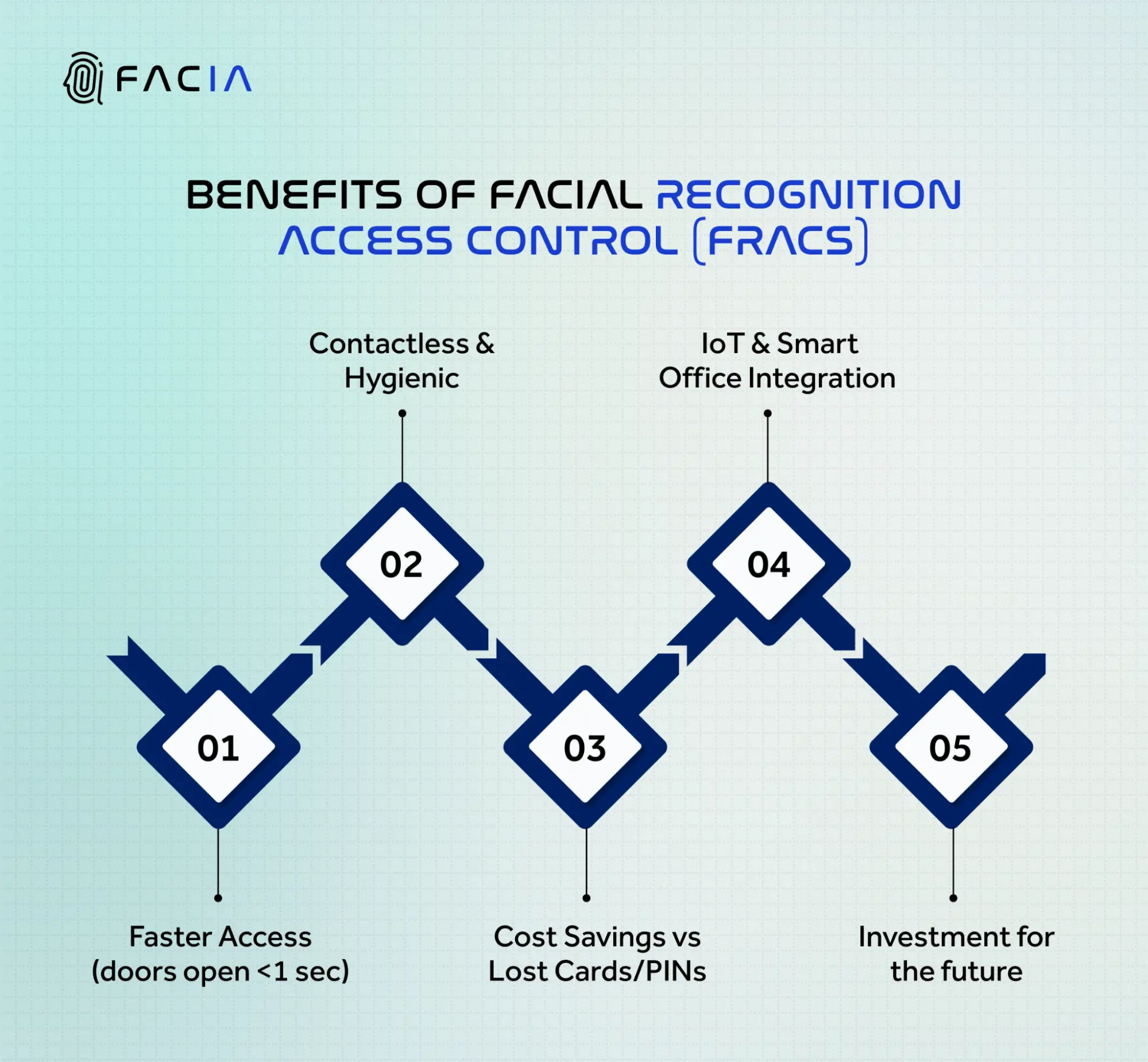
- Easier Access: Doors with facial recognition integration open in under one second. No waiting lines in crowded office lobbies or factory gateways. This saves thousands of hours per year of wasted wait time for big organizations.
- Hygienic and Contactless: After COVID-19, hygiene became a must. Cards and fingerprint scanners require touching surfaces. While Facial recognition is 100% contactless, making it the preferred choice for hospitals, labs, and high-traffic workplaces.
- Cost Savings: Yes, the initial installation may cost more than keycards. But consider the hidden costs of traditional systems: replacing lost badges, resetting forgotten PINs, issuing new credentials. With facial recognition, those costs vanish.
- Incorporation with Modern Workplaces: Modern buildings are technologically advanced. Facial recognition technology is vital to office automation because it can communicate with smart locks, guest management, time attendance, and Internet of Things devices.
- Investment for the future: As technology evolves, facial recognition becomes more powerful, faster, and precise. By making prudent decisions today, you are building security that is suitable for tomorrow’s threats.
Why Big IT Companies Are Encouraging FRACS Adoption
1. Protecting Digital Access
Since privileged accounts are most of the time the initial point of attack during cyberattacks, business organizations need identity solutions to extend to both physical and virtual spaces, connected by biometric identity. In enterprise IT environments, access protection must deal with:
- Office building, server rooms, and data center access
- Safe sign-on to mission-critical infrastructure, cloud environments, and PAM consoles
2. Privileged Access Management Requires Identity Assurance
PAM solutions protect the “keys to the kingdom”: session recordings, root credentials, and admin accounts. Facial recognition, particularly when combined with IAM/PAM systems, gives companies the confidence that only legitimized individuals, not merely those who hold necessary credentials, are able to start high-risk actions or access sensitive infrastructure.
What the Right Facial Recognition Verification Process Should Provide Businesses
Enterprise-class FRACS have more at stake than consumer or SMB environments. Here’s what really counts:
1. Extremely Low Error Rates: Reliability You Can Bank On
Accuracy cannot be compromised. Actual environments, like dim lighting, dense areas, and mixed populations, require that systems be able to accurately identify faces. Enterprises will not accept a system that inappropriately allows or prohibits entrance.
- False Acceptance Rate (FAR): Investigates how often accidental unauthorized users are accepted.
- False Rejection Rate (FRR): Monitors the rate at which genuine users are rejected.
Essential industrial requirements recommend operating at FAR ≤ 0.1%, with tighter standards (e.g., FIDO) focusing on FAR ≤ 0.01% arXiv.
2. Liveness Detection Against Spoofing & Deepfakes
Spoofing attacks are likely the biggest threat. AI-generated deepfakes, Video, Mask, and photo attacks are used by attackers to deceive vulnerable systems. A suitable access control solution employs liveness detection to ensure that there is a real, living individual. A robust FRACS would involve:
- Depth sensing with Infrared
- Detection of 3D facial geometry
Deep learning Models for Liveness Detection of Faces discovered in a 2025 Arxiv study state that the liveness detection model utilizing deep learning is 99.9% effective in blocking spoofing attacks.
3. IAM & PAM Integration without Any Interruptions
This is required to enable privileged accounts only for verified users, enable multi-factor authentication, and initiate just-in-time access processes. An API-first approach with support for SDKs guarantees extensibility throughout your stack.
Facial recognition should co-exist with:
- SSO/IAM systems
- PAM platforms
- Role-based access controls
- VPN gateways and remote desktop protocols
4. Flexible Deployment
Heterogeneous infrastructure is frequently found in large enterprises. Select a system that accommodates:
- Edge installation to ensure data sovereignty and minimal latency
- A dualistic architecture strikes a balance between ease and privacy
Edge-based FRACS are ideal for:
- Government procurements
- On-premises enterprise data centres
- High-security zones without access to the outside world
5. Data Architecture with Privacy-First
Facial information is a form of biometric information that is regulated by GDPR, CCPA, and the EU AI Act. Search for systems that:
- Face mappings are converted into encrypted biometric templates.
- Do not save raw facial photos.
- Support on-device processing for privacy.
- Create consent models and audit trails.
A privacy-focused vendor reduces your exposure to lawsuits while increasing user trust.
6. Scalability at Enterprise Level
Enterprises require a system that scales to:
- 500 to 50,000+ users
- Multiple sites, with policy management centralized
Scalability elements include:
- Faster User Enrollment tools
- Self-service registration (Selfie and ID check)
7. Monitoring in Real-Time
Security teams in enterprises require visibility. A good FRACS will deliver:
- Live dashboards of authentications, denials, and alarms
- Identifying anomalies such as location mismatch or access outside of business hours
- Audit logs that can be downloaded to facilitate compliance
IT personnel can identify and address threats in addition to locking the perimeter.
8. Support for Privileged Access Management
Facial recognition, in combination with the PAM solution, only allows the correct individual, in the correct location, at the correct time, to execute privileged operations. Facial recognition isn’t doors alone; it’s a necessary input for:
- PAM processes
- Just-in-time admin session approvals
- Biometric MFA for root access
- Smartsourcing identity authentication in DevOps pipelines
9. Why Businesses Cannot Afford to Wait
To do nothing is never a passive choice; it’s a security threat. Businesses that remain wedded to legacy platforms have:
- Higher threat of breaches through cloned cards or stolen passwords
- User frustration due to lost PINs or denied access
- Compliance failure through incorrect audit trails or absent consent mechanisms
- Higher costs through badge replacement, manual approvals, and downtime
10. How Identity is the New Periphery
What facial recognition access control system is best for a business?
It’s not a single one that opens doors. It’s one that:
- Confirms identity with great accuracy
- Protects against spoofing and fraud
- Scales with individuals and locations around the world
- Integrates well with IAM and PAM
- Respects privacy and compliance
- Enables smart decision-making
Facial recognition is not a benefit when biometric security is used as a pillar of enterprise resilience. It’s a strategic enabler. Is your company ready to grant access based on trust and identity/
Why Facia Is the Right Choice for Enterprises’ Facial Recognition Access Control?
In an environment where identity is the new boundary, and where businesses can’t make compromises between user experience, speed, and security, Facia is the most logical smart investment.
Facia Delivers:
- Enterprise-Level Accuracy: Facia’s low FAR (<0.1%) and FRR (<0.5%) surpass industry standards for real-world accuracy.
- Real-Time Liveness Detection: Stop with superior AI-powered detection of spoofing and deepfakes before they occur. Its IAM & PAM Integration integrates perfectly with your current enterprise identity and access infrastructure.
- Flexible Personalization Options: Every company is unique. Facia’s solution can be molded to your brand, security requirements, and compliance paradigms. So you get a system that integrates into your world, not vice versa.
- Plug-and-Play SDKs: Flexible Customization: Facia’s lightweight SDKs integrate seamlessly into your current IT infrastructure, whether for mobile apps, web portals, or on-premises deployments. Enterprises can go live in days, not months.
Facia doesn’t simply provide facial recognition. It provides an enterprise-grade identity assurance platform that meets today’s IAM and PAM requirements.
Frequently Asked Questions
Because of their great scalability, facial recognition systems enable centralised management across several branches. Businesses can easily add new locations without sacrificing security or speed.
With the use of updated image captures and ongoing learning, the system automatically adjusts. Despite changes in appearance, accuracy is ensured by routine re-enrollment or liveness checks.
Yes, centralised access control is made possible by cloud-based facial recognition. It enables businesses to remotely manage, update, and keep an eye on employee access in real time.